
Venezuela
Venezuela has the tallest waterfall in the world, Angel Falls, where water drops so far that much of it turns to mist before it lands.
- CapitalCaracasIn a valley behind a coastal mountain wall
- PopulationAbout 28 millionMillions more have left in recent years
- Angel Falls979 mThe tallest uninterrupted waterfall on Earth
- Oil reservesLargest in the worldBigger than Saudi Arabia's
Venezuela sits on the northern edge of South America, with a long Caribbean coastline. Behind the coast the Andes reach in from the west, the flat Llanos grasslands fill the middle, and in the south-east stand the tepuis: flat-topped mountains with sheer sides, some over 2,000 m high.
Angel Falls tumbles 979 m off one of those tepuis, Auyan-tepui. It is the tallest uninterrupted waterfall in the world, roughly 15 times the height of Niagara, and the drop is so long that in the dry season the water becomes mist before reaching the bottom.
National symbols
- National bird Venezuelan troupial
- National flower Flor de mayo orchid
- National anthem Gloria al Bravo Pueblo (Translation: Glory to the Brave People)
- National day Independence Day, 5 July
Map of Venezuela
Geography
Venezuela covers 916,445 km2 and borders Colombia, Brazil and Guyana, with a long Caribbean coast to the north.
The Andes enter from the west and rise to Pico Bolivar at 4,978 m. The Orinoco, one of the great rivers of South America, crosses the country from west to east. In the south-east lies the Guiana Highlands, where the ancient sandstone tepuis stand like islands above the forest.
Climate
Venezuela is tropical, with a dry season roughly from December to April and a wet season from May to November rather than summer and winter.
Temperature depends on height. The coast and the Llanos are hot, around 27C to 32C, while the Andean towns are cool, and the highest peaks keep patches of snow. The tepui summits are cold, wet and often wrapped in cloud.
Famous landmarks
There are several famous landmarks, monuments and buildings in Algeria including the Casbah of Algiers, Al Qal’a of Beni, M’zab Valley, Notre Dame d’Africa, Makam Echahid (Monument des Martyrs), government offices and mosques.
Algeria has developed its tourist industry over the years and offers a selection of hotel accommodation, restaurants, bars and shops located mainly on the coastal regions in cities such as Algiers. Algeria boasts fabulous beaches and many famous landmarks and attractions for tourists to visit.
Algeria is famous for its stunning white buildings, mosques and architecture which can be observed at well known landmarks such as the Casbah of Algiers, Al Qal’a of Beni, M’zab Valley, Notre Dame d’Africa, and Makam Echahid (Monument des Martyrs). This North African country is also famous for its fantastic sand dunes which form part of the Sahara Desert region of Algeria. Some of the highest sand dunes in the world can be seen at the Grand Erg in the northeast of Algeria.
Culture
Spanish is the official language, along with more than 30 Indigenous languages recognised in the constitution.
Joropo, played on harp, cuatro and maracas, is the national music of the Llanos, and baseball rather than football is the great national sport, a legacy of oil workers from the United States. Around 88 per cent of Venezuelans are Christian, mainly Catholic.
History
Evidence suggests that the history of ancient Algeria dates back 1.8 million years or more as the discovery of stone tools offer proof of early human existence. Later, the original people of North Africa (indigenous peoples) defended their land against various empires and invaders including the Phoenicians, Romans, Byzantines, Arabs, Turkish and French. The Arabic language was introduced to Algeria around 700-1000 AD, as was the religion of Islam too. The newly acquired language and religion brought significant changes to Algeria, defining its culture and identifying its people.
Algeria has been involved in numerous wars and conflicts throughout history, and has been under Spanish and French rule at various times. The French colonized Algeria and created the country’s modern day borders. Colonization of Algeria began in 1830.
A long and bloody war, known as the Algerian War of Independence, began on November 1, 1954 when a prominent attack was launched by a group opposing French rule known as the National Liberation Front. Another organization that strongly opposed French rule was the Algerian National Movement. The Algerian War of Independence, also known as the Algerian Revolution and Algerian Civil War, marked a significant turning point in history and resulted not only in independence for the country but sadly in the deaths of thousands of people also. Algeria gained complete independence in 1962 following the signing of a treaty on March 18, 1962 known as the Évian Accords. The Algerian War of Independence came to an end on November 19, 1962.
Economy
Venezuela holds the largest proven oil reserves of any country in the world, much of it heavy crude around the Orinoco Belt. Oil has provided the overwhelming majority of export earnings for a century.
Depending so completely on one product proved dangerous. When oil prices collapsed the economy did too, and severe shortages and hyperinflation from 2014 onwards led over 7 million Venezuelans to leave the country.
The flag
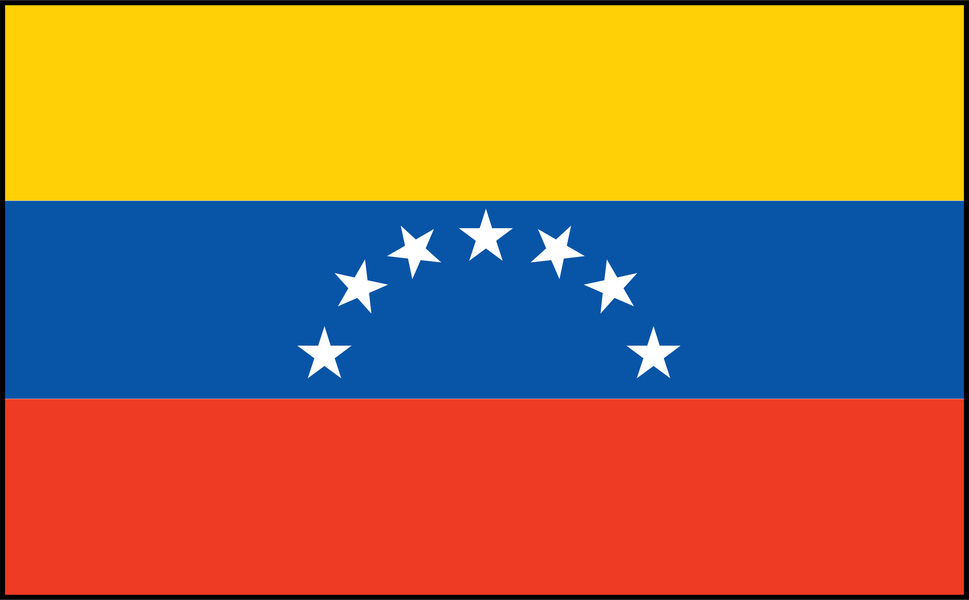
Three horizontal bands of yellow, blue and red, the colours shared with Colombia and Ecuador from the days of Gran Colombia. Yellow stands for the land's riches, blue for the Caribbean Sea and red for courage.
An arc of eight white stars sits on the blue band. Seven stand for the provinces that signed the declaration of independence in 1811; an eighth was added in 2006 for the province of Guayana.
