
Uruguay
Uruguay hosted and won the very first football World Cup in 1930, and it has more cattle than people by roughly three to one.
- CapitalMontevideoHome to nearly half the population
- PopulationAbout 3.4 millionOne of the smallest in South America
- Area181,034 km2Second smallest country on the continent
- CattleAbout 12 millionRoughly three cows per person
Uruguay is small, flat and green: gently rolling grassland almost from end to end, with no mountains to speak of and a long Atlantic coastline of wide sandy beaches.
It is often called the most stable and least unequal country in South America. It was among the first anywhere to legalise an eight-hour working day, and it now generates the large majority of its electricity from wind, water and solar power.
National symbols
- National bird Southern lapwing, called the tero
- National flower Ceibo, a bright red flower
- National anthem Himno Nacional de Uruguay, one of the longest anthems in the world
- National day Independence Day, 25 August
Map of Uruguay
Geography
Uruguay covers 181,034 km2 and borders only Brazil and Argentina, with the Atlantic Ocean and the wide Rio de la Plata estuary to the south and east.
The land is gently rolling grassland with low hills. The highest point, Cerro Catedral, is only 514 m, making Uruguay one of the flattest countries anywhere. The Rio Negro cuts across the middle and is dammed to make the largest artificial lake in South America.
Climate
Uruguay has a mild temperate climate with four proper seasons, which is unusual in South America. Summers average around 28C and winters around 12C, and it rarely snows.
Rain falls fairly evenly through the year. Because there are no mountains to block anything, winds sweep across the country freely, including the cold pampero blowing up from the south.
Famous landmarks
There are many important landmarks, monuments and buildings in Uruguay including the Salto Grande Bridge, Salto Grande Dam, World Trade Centre Montevideo, Telecommunication Tower (highest skyscraper in Uruguay), Palacio Salvo, Palacio Legislativo, Solis Theatre, La Mano de Punta del Este (sculpture), Juan Manuel Blanes Museum, Metropolitan Cathedral, Torres Garcia Museum, Palacio Taranco, Museum of Visual Arts, and Punta Brava Lighthouse.
Uruguay is famous for its high standard of living, a strong economy and for being a leading promoter of peace and democracy in South America. Despite being the second smallest country on the continent, Uruguay is considered one of the world's most progressive and socially developed nations. The country managed to reduce its carbon footprint significantly by introducing wind farms and other means that has allowed almost 95 percent of its electricity to come from renewable energy sources. The population is well educated and respectful of personal rights.
Culture
Spanish is the official language. Uruguayan culture is heavily European, shaped by large numbers of Spanish and Italian settlers, and around 88 per cent of the population has European ancestry.
Candombe, a drumming tradition brought by enslaved Africans, still fills Montevideo streets during Carnival, which is the longest carnival in the world at around 40 days. Roughly 40 per cent of Uruguayans say they have no religion, the highest share in Latin America.
Economy
Beef is the flagship export, and Uruguayan cattle are grass-fed on open pasture, which is a selling point abroad. Soybeans, rice, wool, dairy and timber follow.
Uruguay has also built a strong software and services industry for its size, and its beaches at Punta del Este draw large numbers of Argentine and Brazilian holidaymakers each summer.
The flag
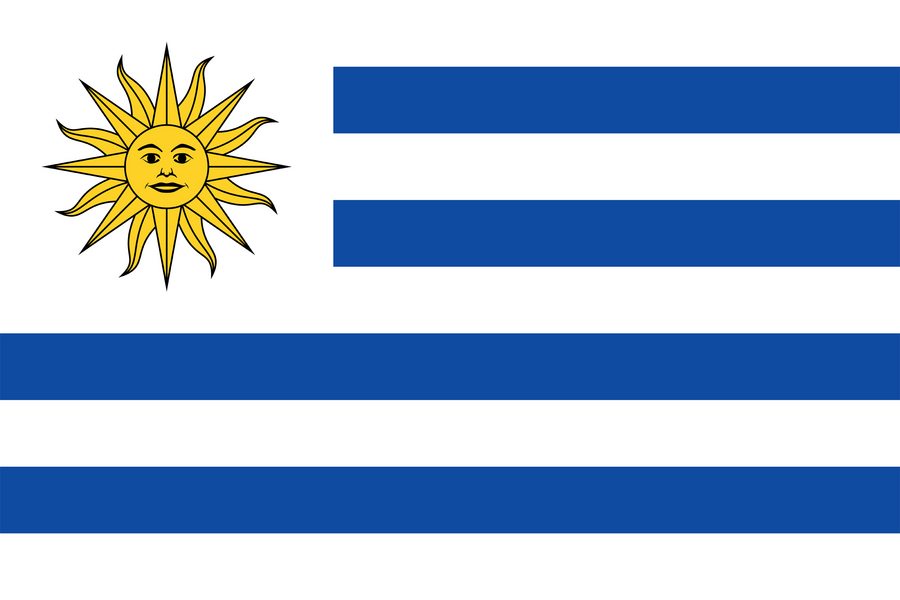
The flag has nine horizontal stripes alternating white and blue, one for each of the nine original departments of the country.
In a white square in the top left corner sits the Sun of May, the same golden sun with a face used on the Argentine flag, marking the shared struggle for independence from Spain. The stripe design was inspired by the flag of the United States.
