
Suriname
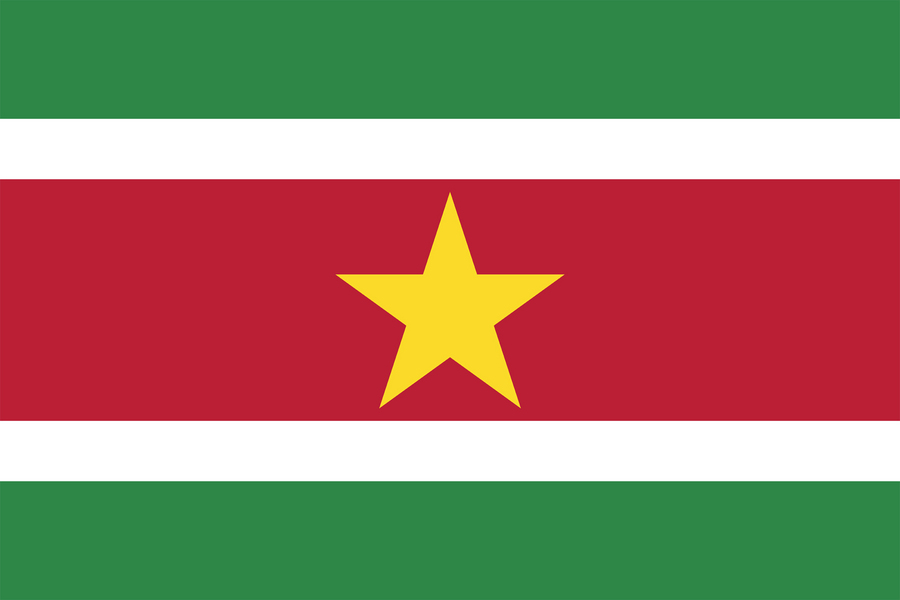
Suriname is the smallest country in South America, the only one where Dutch is the official language, and around 93 per cent of it is rainforest.
- CapitalParamariboIts wooden colonial centre is a World Heritage Site
- PopulationAbout 620,000The smallest in South America
- Area163,820 km2Smallest country on the continent
- Forest coverAbout 93 per centThe most forested country on Earth
Suriname was Dutch Guiana until 1975, which is why Dutch is still the language of school and government. Nearly everyone lives in a narrow band along the north coast; the rest of the country is rainforest with almost no roads.
Suriname is the most forested country in the world by percentage. That has made it one of the very few carbon-negative nations, meaning its trees absorb more carbon dioxide than the whole country produces.
National symbols
- National bird Lesser kiskadee
- National flower Faya lobi, a bright red flower whose name means fiery love
- National anthem God zij met ons Suriname (Translation: God Be With Our Suriname)
- National day Independence Day, 25 November
Map of Suriname
Geography
Suriname covers 163,820 km2 and borders Guyana, Brazil and French Guiana, with an Atlantic coast to the north.
A flat coastal plain of swamp and farmland gives way to sandy savannah and then to dense rainforest across the southern four fifths of the country. The Central Suriname Nature Reserve alone covers 16,000 km2 of untouched forest. The highest point, Julianatop, is 1,286 m.
Climate
Suriname is tropical, hot and humid all year, typically 23C to 31C, with little variation because it lies close to the equator.
There are two rainy seasons, roughly April to August and November to February, separated by shorter drier spells. Annual rainfall is heavy, around 2,000 mm on the coast and more inland.
Famous landmarks
There are many notable landmarks, monuments, religious sites and buildings in Suriname, particularly in the capital city of Paramaribo, including the Fort Zeelandia Museum, Saint Peter and Paul Cathedral, Waterkant, Jules Wijdenbosch Bridge, Presidential Palace, Neveh Shalom Jewish Synagogue, Independence Square, Suriname City Mosque, Arya Dewaker Hindu Temple, and the Lutheran Church.
Suriname is famous for being the smallest country in South America and the only territory outside the continent of Europe where Dutch is the main official language spoken by most of the population. It is known for being one of the most ethically diverse countries in South America, and the rest of the world, where a multitude of religions and traditions are practiced by its people.
Culture
Dutch is the official language, but Sranan Tongo, an English-based creole, is the one people use to talk to each other across communities. Hindi, Javanese, Chinese and several Maroon and Indigenous languages are all spoken too.
That mix comes from history: Indigenous peoples, enslaved Africans, and indentured workers brought from India, Java and China. Hindu, Muslim and Christian holidays are all celebrated nationally.
Economy
Gold is the largest export, followed by oil. Bauxite mining, once the mainstay, has largely wound down.
Rice, bananas, shrimp and timber are exported too, and significant offshore oil discoveries similar to Guyana's have raised expectations of a boom in the coming years.
The flag
Five horizontal bands: green, white, red, white, green, with the red band twice the width of the others. Green stands for the forests and hope, white for peace and justice, and red for progress and love for the country.
A large yellow star sits in the centre of the red band. It represents the unity of all Suriname's ethnic groups, and its golden colour stands for the sacrifices they made and the bright future they are working towards.
