Peru

Where is Peru located? Peru forms part of the continent of South America. It is situated in western South America, on the coast of the Pacific Ocean and its border countries are Ecuador, Colombia, Brazil, Bolivia and Chile.

Peru population and size Peru is the third biggest country in South America. Its estimated area size is 1,285,216 km sq. It is predicted that the country has a population in excess of 31,488,600 people with Peru’s most populous city being the capital of Lima.

The capital of Peru The capital city of Peru is Lima which is positioned in the west of the country. Lima is the most populated city in Peru and has an approximate population of 9,897,000 inhabitants. The area is known for being economically important. There are many notable landmarks in the capital city of Peru including the Palace of Lima, Monastery of San Francisco, Historical site of Pachacamac, Giant Temple of Huaca Pucllana, and Lima Historic Centre. Lima is located on the central coastal region of Peru and is one of the most populous cities in South America. It became the capital of the Republic of Peru following the War of Independence. Lima is core to the country's economy and accommodates some of its most important companies and financial centres.

Peru major cities There are a number of major cities in Peru, the names of the largest and most important cities and towns include the country’s capital Lima, and Arequipa, and Trujillo. The second most populated region is Arequipa; a city that handles major exports and supports some of the most important industrial activities of the country.

Machu Picchu Facts Machu Picchu is an ancient Incan citadel built in Peru, high up in the Andes Mountains between the two summits of Huayna Picchu and Machu Picchu. This historical site was built during the 15th century and was abandoned a century later. The famous Inca city lay undiscovered until 1911 when it was found by an archaeologist called Hiram Bingham. Machu Picchu is situated on a mountain ridge above the Sacred Valley. It is located approximately 80 kilometres northwest of Cuzco, Peru. The site became known as 'The Lost City of the Incas' as it remained undiscovered for many years, hidden amongst the dense Peruvian rainforest. Machu Picchu remains shrouded in mystery as the true purpose behind the ancient site remains unknown. This historical city is one of the most famous landmarks in South America, and it has become one of Peru's most major tourist attractions, receiving thousands of visitors every day.

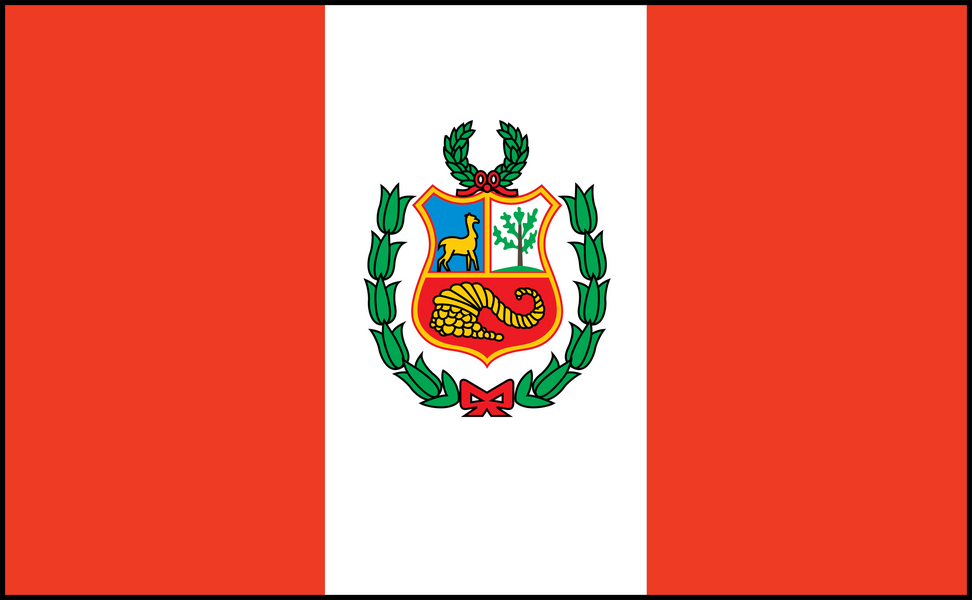
Peru Flag The first National Flag of Peru was created by General Don Jose de San Martin in 1820. Over the years, different versions have been woven. The flag of Peru was introduced in 1824 by the government.

Paraguay Flag Day 7th June Flag Day is celebrated on June 7 in Peru as this day marks the anniversary of the Battle of Arica. A battle also known as Assault and Capture of Cape Arica. The Battle of Arica was a battle in the War on the Pacific, and it occurred on June 7, 1880 between Peru and Chile.

Peru Flag The National Flag of Peru is symbolic to this South American country and can be described as having a vertical triband design featuring three vertical stripes that run the colors of red, white, red from side to side. The outer bands having the color red and the inner, central band being white.

Peru Flag The design of the National Flag of Peru uses the color red as this was the color of the war of the Incas and it is representative of the bloodshed that occurred during the fight for independence. Red also symbolizes the sacrifices of those who fought and defended Peru. The color white, which lies central to the flag’s triband design, portrays purity of feelings, freedom, social justice and peace.

The Coat of Arms of Peru The National Flag of Peru features the coat of arms, known as Escudo de Armas in Spanish. The coat of arms is an important symbol of this country’s history, geography, flora and fauna. The emblem is positioned central to the Peruvian flag and its design comprises of a cinchona tree, a cornucopia and a vicuña.

Peruvian Coat of Arms Meaning The cinchona tree stands against a white background. It is important because this type of tree is native to this part of South America, and therefore, represents the country’s flora. The coat of arms of Peru also features a cornucopia of gold with coins spilling from it. A cornucopia of gold is also known as the horn of plenty. It can be seen on the coat of arms of Peru positioned against a red background. The cornucopia is symbolic of the country’s mineral resources. A South American animal known as a vicuña, is also depicted on the coat of arms. It stands in front of a blue background and looks a little like a llama; the animal to which the vicuña is related.

Map of Peru

Geography

The geography of Peru is very interesting as the country is very large and takes on a western and central location in South America. Peru has an enviable position on the coast of the South Pacific Ocean where it spans 1.285 million km sq. Geographically, the entire country is divided into three distinct zones that includes the coastal region or Costa, the highlands of the Andes or Sierra, and the Amazon Basin, Amazon River and eastern hills or Selva. Peru and Bolivia are home to Lake Titicaca, the largest lake in South America. The country boasts many unique geographical features including waterfalls, canyons, geysers, and a stone forest.

Climate

The climate conditions of Peru differ across its mountainous regions, forest areas, coastal plains and hills. The coastal regions experience fairly moderate temperatures, high humidity and low rainfall. The mountainous regions can experience very low temperatures in comparison, particularly at high altitude, with most rainfall occurring during the summer months. The Amazon Rainforest of Peru is subject to a hot and humid climate with high rainfall for the most part.

Famous landmarks

There are several fascinating landmarks, monuments and buildings in Peru including the historical site of Machu Picchu, Temple of the Moon, the incredible Inca Trail, Moray Inca Site, the religious sites of Compania de Jesus Church and the Cathedral of Santo Domingo, Monolithic carvings of Aramu Muru and Sayhuite Monolith, Ancient Burial Sites and Shrines, the Tucume Pyramids, and the Pyramids of Caral in Lima (oldest city in the Americas).

Peru is famous for its archaeological heritage, colonial architecture and for having one of the most historical landmarks in the world; the Incan site at Machu Picchu which receives thousands of visitors every week. This South American country is steeped in history and ancient civilizations that once lived here, and is known for its natural stunning beauty. This large South American country boasts dense forests, fabulous beaches and a rich ecosystem of plants and animals, including rare species such as jaguar, puma and the spectacled bear. Paddington Bear originates from Peru and the Spectacled Bear, is in fact, the species by which the fictional Paddington Bear character is based upon.

Culture

The main languages of Peru include Spanish and Quechua. Peru has an ethnically diverse population that includes Amerindians, Europeans, Africans and Asians. Spanish is the major language spoken by people of this country.

The culture of Peru is formed by a blend of Amerindian and Spanish traditions due to their historical connections. However, these customs have also been influenced by various African, Asian and European ethnic groups that have inhabited Peru. The Incas left a legacy in Peru which has influenced art, crafts and architecture in this country for many years. Religion plays an important part in the lives of many here with the majority of Peruvian people belonging to the Roman Catholic religion. A variety of activities are enjoyed in this part of South America with art, music, sport and cuisine featuring heavily among the population.

Economy

Mining, fisheries, agriculture and trade are among the most important occupations of Peruvian people and are core to the country's economy. Peru is rich in natural resources and mineral deposits including silver, gold, copper, timber, petroleum, coal, iron ore, phosphate, potash and natural gas.

The flag

The national flag of Peru was designed by General Don Jose de San Martin and first appeared in 1824. The flag has a triband design featuring three vertical stripes colored red, white, red. The Peruvian flag can be identified by the Peruvian Coat of Arms that is located central to its overall design. The Coat of Arms of Peru is a very important symbol of this South American country's mineral wealth, geography and history. The design of the Coat of Arms consists of a cinchona tree which is native to its land, a cornucopia of gold with coins spilling from it which represents the mineral resources of Peru, and a vicuna which can be described as a type of animal that is native to the continent of South America.

Peru