
Paraguay
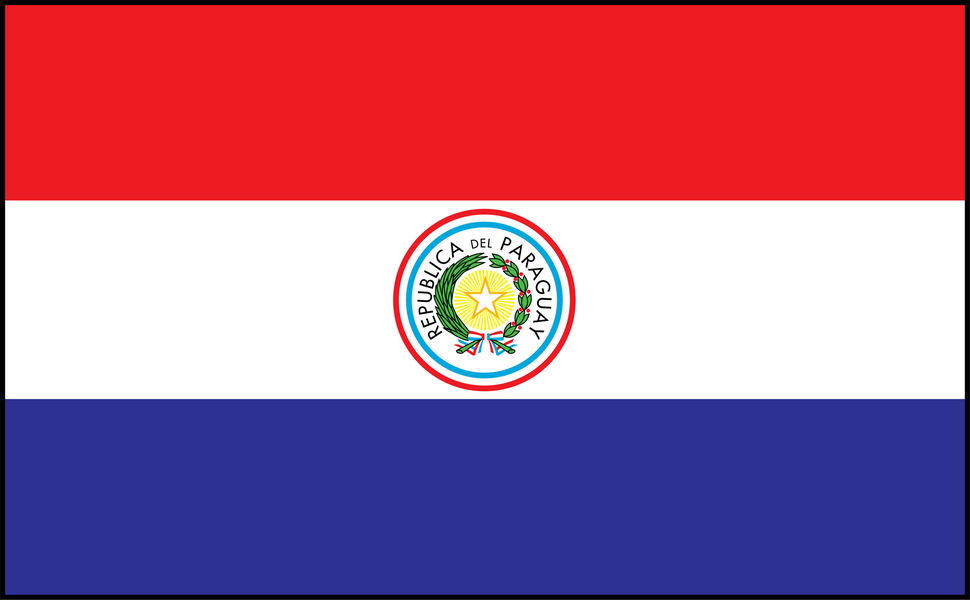
Paraguay is the only country in the world whose flag has a different design on the front and the back.
- CapitalAsuncionOn the Paraguay River, which splits the country
- PopulationAbout 6.9 millionLandlocked in the middle of the continent
- Area406,752 km2About the size of Germany and Belgium combined
- LanguagesSpanish and GuaraniAlmost everyone speaks Guarani
The Paraguay River cuts the country in two. East of it lies fertile, green, rolling farmland where around 97 per cent of Paraguayans live. West of it is the Gran Chaco: a hot, thorny, half-empty plain of scrub and swamp.
Paraguay is unusual in the Americas because an Indigenous language really did survive. Guarani is spoken by most of the population, including people with no Indigenous ancestry, and it is used on television, in shops and in parliament.
National symbols
- National bird Bare-throated bellbird
- National flower Mburucuya, the passion flower
- National anthem Paraguayos, Republica o Muerte (Translation: Paraguayans, Republic or Death)
- National day Independence Day, 14 May
Map of Paraguay
Geography
Paraguay covers 406,752 km2 and borders Bolivia, Brazil and Argentina. It is one of only two landlocked countries in South America, but ocean-going ships still reach Asuncion up the Parana and Paraguay rivers.
The east is low, rolling and fertile, with patches of Atlantic forest. The west is the Gran Chaco, flat scrubland that floods in the wet season and bakes in the dry. Paraguay has no mountains of any size; its highest point is only 842 m.
Climate
Paraguay is subtropical to tropical, hot for most of the year. Summers regularly pass 35C and the Chaco is one of the hottest places in South America, sometimes topping 45C.
Winters are mild but cold snaps can arrive suddenly from the south. The east gets good rainfall all year while the Chaco is much drier and prone to drought.
Famous landmarks
There are many impressive landmarks, monuments and buildings in Paraguay including the Friendship Bridge from Brazil to Paraguay. There are many points of interests, particularly in the capital city of Asuncion, including museums, churches, cathedrals, palaces, monuments and interesting historical sites. Some of the countries most popular attractions include the Arts Museum (Bellas Artes), Godoy Museum, La Encarnacion Church, Metropolitan Cathedral, Lop Lopez Palace, National Pantheon of the Heroes, Casa de la Independencia Museum, and Cerro Lambare (monument). There are also many interesting geographical features and natural landmarks in Paraguay including national parks, waterfalls, dams and nature reserves.
Paraguay is famous for for its long-standing history and battle for independence from Spain which was achieved in 1811. Paraguay has faced disastrous wars throughout history including the War of the Triple Alliance which occurred between the countries of Paraguay and Argentina, Brazil and Uruguay from 1865 to 1870 and resulted in the loss of around two thirds of Paraguayan males. Paraguay is famous for being the heart of South America due to its central location on the continent.
Culture
Spanish and Guarani are both official, and Paraguay is genuinely bilingual: surveys suggest more people speak Guarani at home than Spanish.
Nanduti, a fine spider-web lace, and the Paraguayan harp are distinctive national crafts and instruments. Tereré, cold mate drunk with iced herbal water, is the everyday social drink. Around 89 per cent of Paraguayans are Catholic.
Economy
Paraguay is one of the world's largest exporters of soybeans and beef, both grown on the eastern farmland, along with maize and wheat.
Electricity is the other great asset. The Itaipu and Yacyreta dams give Paraguay far more hydroelectric power than it can use, so it exports the surplus, and nearly 100 per cent of its own electricity is renewable.
The flag
Three horizontal bands of red, white and blue, taken from the French tricolour and standing for liberty. The unusual part is the emblem in the middle.
On the front is the national coat of arms: a yellow star inside a wreath of palm and olive, with the country's name. On the reverse is a completely different emblem, the treasury seal, showing a lion guarding a red liberty cap above the words "Paz y Justicia", meaning Peace and Justice.
