Ecuador

Where is Ecuador located? Ecuador belongs to the continent of South America. It is situated in the west on the coastline of the Pacific Ocean and its border countries are Colombia and Peru.

Ecuador population and size Ecuador is a coastal country, its approximate total area size is 276,841 km sq. It is estimated that this South American country has a population of around 16,817,000 people with Ecuador’s most populated region being Guayaquil with a total population of over 2,709,000 people, followed by the second most populous region, the capital city of Quito.

The capital of Ecuador The capital city of Ecuador is Quito which is positioned in the north of the country. Quito is the region with the second largest population in Ecuador with around 1,726,000 inhabitants. The city is known for its rich cultural heritage. There are several famous landmarks in the capital city of Quito including the La Compania (Church of the Society of Jesus), San Francisco Church, San Domingo Church, and Metropolitan Cathedral. Quito has a dramatic, elevated location high in the Andes. This interesting city is laden in history and has a famous ancient colonial centre which is reflective of this remarkable city's past. Built on an ancient Incan city, Quito boasts numerous landmarks, cathedrals and churches dating back to the 16th and 17th centuries.

Ecuador major cities There are numerous major cities in Ecuador, the names of the largest and most important cities and towns include the country’s capital Quito, and Guayaquil, Cuenca and Santo Domingo. The city of Guayaquil is the largest and most populous city in Ecuador. It is located on one of the most important rivers in South America, the Guayas River. Guayaquil is an notable city as it supports many businesses and services. The most important port in Ecuador is located in Guayaquil and deals with import and export.

Guayas River Facts The Guayas River has a total length of 389 km inclusive of the River Daule. The Guayas River can be found in western Ecuador and is considered the most important river on the continent of South America that does not empty into an ocean or sea. The importance of the Guayas River is portrayed by the coat of arms of Ecuador on which it features descending from the mountain of Chimborazo.

Chimborazo Facts Chimborazo is the highest mountain in Ecuador and the highest peak close to the equator. Its tallest peak is 6,263m high. Chimborazo forms part of Cordillera Occidental in central Ecuador. Cordillera Occidental refers to one of the two main mountain ranges in the Andes which can be found in Ecuador. Chimborazo is currently classed as an inactive stratovolcano that formed thousands of years ago. The volcano last erupted around 550 C.E.

Currency of Ecuador Ecuador's official currency is the U.S. Dollar which was introduced in 2001, but one of the most interesting facts is that Ecuador is the only country besides the United States that uses the U.S. Dollar as its sole currency.

Ecuador Flag The National Flag of Ecuador was first introduced in 1835, and later again in 1860. However, the final and current version, whose design features the coat of arms of Ecuador, was officially adopted in 1900.

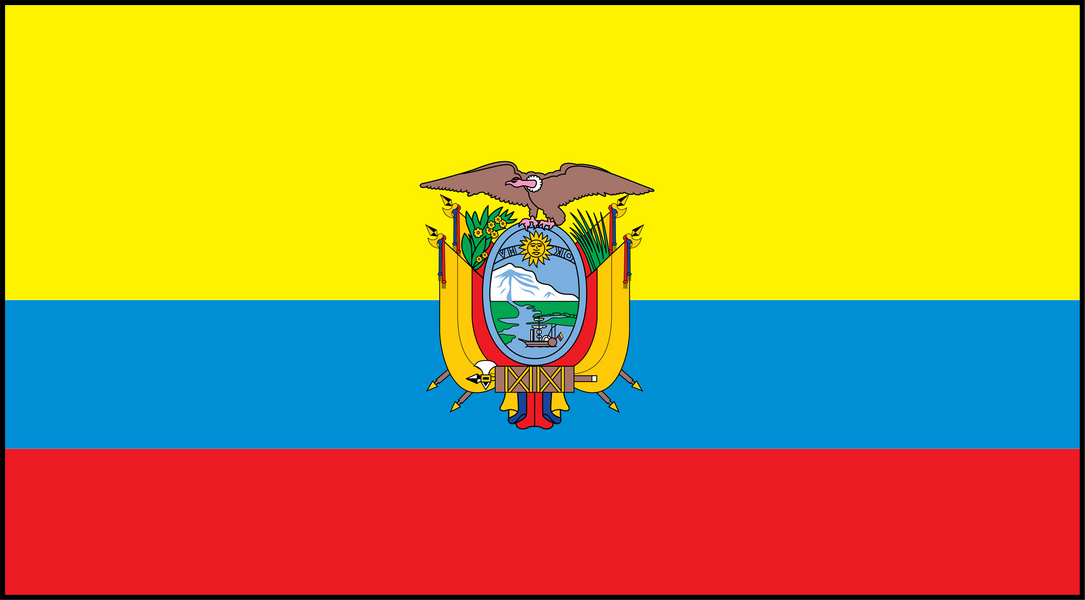
Ecuador Flag The flag of Ecuador can be described as a tricolour flag featuring three horizontal stripes which run yellow, blue, and red from top to bottom. The top, yellow band is double width and takes up half of the flag’s design. The blue and red bands are equally sized.

Ecuador Flag Ecuador uses both a civil and state flag. Unlike the state flag, the design of the civil flag does not incorporate the coat of arms. However, the state flag is commonly used, and allows the nation identifiable from its neighboring countries of South America.

Ecuador Flag The colors of the flag of Ecuador are meaningful and portray a true representation of its history, geography, culture and wealth. Yellow stands for Ecuador’s natural and mineral wealth, blue represents the ocean and skies, and red highlights the blood spilled during the country’s struggle for independence

The Coat of Arms of Ecuador The state flag of Ecuador can be identified by the coat of arms that lies central to its design. A representation of Mount Chimborazo features within the oval shield, with a river originating from its base, representing the Guayas River. The steamship, which can be seen on the coat of arms of Ecuador, is also named the Guayas, and was one of the first vessels build in Ecuador. Instead of a mast, the ship features a Caduceus, which represents trade and commerce.

The Coat of Arms of Ecuador Also featured on the Ecuadorian coat of arms is the sun which is symbolic of Ecuador’s pre-Colombian heritage, and the signs of the zodiac represent the months during which the Marxist Revolution occurred. The condor pictured on top of the coat of arms, with its wings outstretched, portrays the power and strength of the nation. The shield is surrounded by four flags of Ecuador. The laurel on the left of the coat of arms represents triumph of the republic, and the palm on the right side, represents the martyrs battle for freedom and independence. The Fasces (bundle of wood) below the shield symbolizes the dignity of the nation.

Map of Ecuador

Geography

Located on the coast of the South Pacific Ocean on the equator in north-west South America, Ecuador is officially one of the smallest countries on the continent, at just 283,561 sq km inclusive of the Galapagos Islands. The geography of Ecuador is remarkable as this country comprises parts of the Amazon Jungle, the Andean foothills and the astonishing Galapagos Islands which are rich in wildlife and are home to some of the world's most precious animal species. The country's terrain features coastal plain, central highlands and tropical rain forest. The Guayas River is located in Western Ecuador and is considered one of the most important rivers in South America. The highest mountain in Ecuador occurs at 6,263m on Chimborazo, an inactive stratovolcano. The world's highest active volcano, Cotopaxi, is located in the Andes in Chile, 50km south of the capital city of Quito.

The islands are a wildlife paradise comprising of some of the rarest plant and animal species found on Earth. The Galapagos islands are a province of Ecuador, situated in the Pacific Ocean and became famous for capturing the attention of Charles Darwin during his visit in 1835, and thus inspiring his theory of evolution. Charles Darwin studied and observed some of the most remarkable animal species found living on the Galapagos Islands.

Climate

Ecuador's climate isn't usually too hot, even though it is located on the equatorial line. Cities along the Andes region experience an average high temperature of 15.5 degrees Celsius all year round. The temperatures on the coastal region are constantly refreshed by the Humboldt Current. It may be humid, but temperatures rarely reach 35 degrees Celsius. The Amazon Jungle and Amazon Basin are the only areas of Ecuador that are consistently hot and humid.

Famous landmarks

There are a range of interesting landmarks, monuments and buildings in Ecuador including the Ciudad Mital del Mundo (Monument and Plaza marking the equator), La Compania (Church of the Socity of Jesus), Catedral Nueva (cathedral), San Francisco Church, Rumichaca natural bridge, Inca ruins at Cojitambo Canar and Ingapirca, Pambamarca Fortresses.

Ecuador is famous for for its amazing geographical features which include the Amazon Jungle, the Guayas River, Chimborazo and the incredible Galapagos Islands which were made famous by Charles Darwin during his travels. The English naturalist was captured by the wildlife and beauty that he observed and studied on the islands.

Culture

The main language spoken throughout Ecuador is the country's official language, Spanish. More than 90 percent of the population speak Spanish, or Castilian as it is also known. Another language spoken in this part of South America includes Quecha which is also classed as an official language of Ecuador.

This beautiful country of South America, whose main language is Spanish, has rich traditions and culture that centre around delicious Ecuadorian cuisine, Pasillo music which is the national genre music in Ecuador, art, literature and various sports including the country's most popular sport, football.

The flag

The national flag of Ecuador, which is characterized by three different colors, was first introduced on September 26, 1960, and is identified by having three horizontal bands which run the colors of yellow, blue and red from top to bottom. The Ecuadorian flag can be recognized by its yellow band which is the largest band on the flag and takes up the top 50 percent of its design, the remaining blue and red bands are the same size, each composing of 25 percent of the design. The state flag features the Ecuadorian Coat of Arms central to its design. The Coat of Arms is important because it symbolizes the history, geography, economy, strength and dignity of the nation. The colors of the flag are interesting as yellow was chosen to represent the country's mineral wealth, blue to portray its oceans and skies, and red to honor blood spilled during the Ecuadorian battle for independence.

Ecuador