Colombia
Where is Colombia located? Colombia is located on the continent of South America. It is situated in Northern South America, on the coast of the Caribbean Sea and the North Pacific Ocean and the names of its neighboring countries, with which it shares its borders, are Venezuela, Brazil, Peru and Ecuador
Colombia population and size Colombia is a coastal country in South America. The length of its coast with the Caribbean Sea is 1,760 km, and its coast with the North Pacific Ocean is 1,448 km. The approximate area size of this Northern South American country is 1,141,748 km sq. It is believed that the country has a population in the region of 49,330,000 inhabitants with Colombia’s most populous city being the capital of Bogota.
The capital of Colombia The capital city of Colombia is Bogota which is positioned central of the country. Bogota is the city with the highest population in Colombia and has an estimated population of 9,765,000 . The region is known for it historical charm and beauty. There are many unusual landmarks in the city of Bogota including the Gold Museum, Capitolio Nacional in Bolivar Square, Maloka Museum, Primatial Cathedral, and the Bridge of Bogota. The capital city of Bogota is located at high-altitude and can be described as an interesting city rich in history and culture, and one that is home to numerous landmarks and museums.
Colombia major cities There are a range of major cities in Colombia, the names of the largest and most important cities and towns include the country’s capital Bogota, and Medellin, Cali, Barranquilla, Bucaramanga, and Cartagena. The second largest city in Colombia is called Medellin which is situated in the Andes in the Aburra Valley. Medellin has earned several nicknames including the City of the Eternal Spring, City of Flowers and City of the Mountain. It is one of the economic centres of Colombia as the city supports numerous industries, businesses and educational departments.
Facts for Kids 1: Following the civil war and political in-fighting, the Republic of Colombia was formed and a new flag was introduced. The nine stars were removed from the previous flag, and the colors of yellow, blue and red were retained.
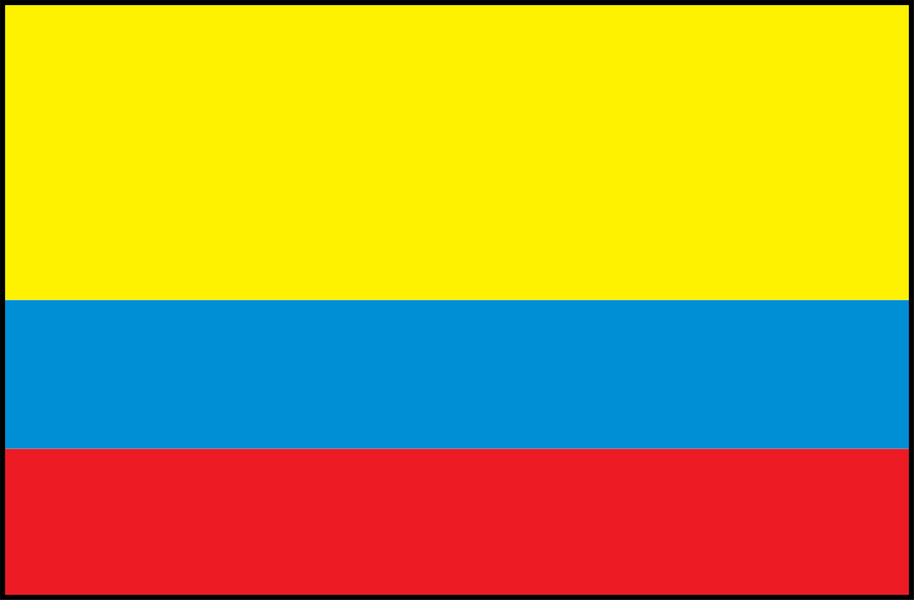
Facts for Kids 2: The National Flag of Colombia was introduced on November 26, 1861. It can be described as being a tricolor flag design as it composes three horizontal bands of different colors: yellow, blue and red. The top band is yellow and occupies the top half of the flag. The middle band is blue and takes up one quarter of its overall design and the bottom band is red and also features on one quarter of the flag's design. One of the interesting facts about the National Flag of Colombia is that it doesn’t feature horizontal bands of equal size, unlike many other flags around the world. The ratio of the horizontal bands is 2:1:1.
Facts for Kids 3: The current flag of Colombia was created originally by Francisco de Miranda, a military leader and revolutionary from Venezuela. His colors went on to inspire the flag designs of Venezuela and Ecuador. Francisco de Miranda designed the flag of Colombia using these particular colors for various reasons. A conversation with Johann Wolfgang von Goethe, a German writer and philosopher, revealed that Francisco de Miranda wanted to create a land, with primary colors that cannot be distorted. The color yellow can be described as being a warm color, and the closest to white. Blue represents serenity and distance, and red is a synthesis of the two. Another possible source of inspiration was the yellow, blue and red banner of the Burger Guard of Hamburg that Francisco de Miranda witnessed during his travels in Europe.
Facts for Kids 4: Colombia itself opted to describe the colors as: yellow for the wealth of the Colombian land, and in particular this color symbolizes the country’s gold reserves, the color blue represents the seas and rivers of Colombia, and the color red portrays the bloodshed and sacrifices made by Colombians during their battle for independence and freedom. Each color is meaningful and representative of Colombian culture, heritage, history, geography and strength.
Facts for Kids 5: The National Flag of Colombia is very important to this South American country as it is representative of its history and the endurance of its people; in particular those who fought hard to gain independence. Flag Day is celebrated on 20 July and 7 August in Colombia as these days mark significant events in history. The Colombian Declaration of Independence relates to events that happened on 20 July 1810, and the Battle of Boyacá which occurred on 7 August, 1819.
Map of Colombia
Geography
The geography of Colombia is very interesting as it is an extremely bio-diverse country located on the coast of north-west South America. Colombia has coastal borders with the Pacific Ocean and the Caribbean Sea which boast coral reefs teaming with sea life. The Andes Mountains run from North to South through the country of Colombia, and have very tall peaks as high as 18,700ft. The Amazon Rainforest occurs in the southwest region of Colombia and is home to millions of animal and plant species. Because of its varying altitudes, and the country's proximity to the equator, Colombia has many different climates and growing seasons. Its terrain ranges from flat coastal lowlands and plains to central highlands and mountainous regions.
Climate
The climate of Colombia can be described as tropical along its coastal regions and plains in the east. The highlands and mountainous areas receive a cooler climate which is determined by elevation.
Famous landmarks
There are numerous famous landmarks, monuments and interesting buildings in Colombia including the Salt Cathedral of Zipaquira, Gold Museum, National Coffee Park, La Candelaria Church, Capitolio Nacional in Bolivar Square, Maloka Museum, Primatial Cathedral, and the Bridge of Bogota.
Colombia is famous for its fabulous coffee which is home grown and exported to countries across the world! The country is also known for its lush forests, tropical climate, profound history and rich culture, its emeralds and its legendary city of El Dorado (Golden One), the lost city of gold.
Culture
The majority of Colombia's population speak Spanish which is the official language of the country. Numerous other languages can also be heard in this part of South America. The English language, for instance, is widely spoken on the island of San Andres which belongs to Colombia.
The culture of Colombia is heavily influenced by European, in particular Spanish, American, African and Caribbean traditions. The culture of this country is diverse with many of its people enjoying arts, literature, cuisine, music and sports. Football is a very popular sport in Colombia as is cycling, baseball, boxing, motorsport, and the national sport of Tejo which can be described as a team sport involving a metal puck that is launched at a target.
Economy
Colombia is home to some of the friendliest people and some of the best coffee in the world is grown here. The conditions for growing coffee are ideal in this country as it has two growing seasons each year. There are areas of Colombia that are like spring every day, cities such as Medellin for example. Colombia is one of the world's leading flower exporters as a result of its fantastic growing conditions. This country is rich in natural resources and has vast oil reserves, emeralds and gold which are core to its economy. Colombian grocery stores offer an enormous variety of fruits and vegetables which are grown locally. The variety of different fruits grown in Colombia is gigantic.
The flag
The national flag of Colombia, which can be described as a triband design, came into use on November 26, 1861, and is formed by three horizontal bands which run the colors of yellow, blue and red from top to bottom. The Colombian flag can be recognized by its top yellow band which is the flag's largest and occupies the top 50 percent of its design, the remaining two bands are equal in size, each taking up 25 percent of the overall design. The National Flag of Colombia was designed by a military leader and revolutionary from Venezuela by the name of Francisco de Miranda. The colors are highly representative of this South American country's culture, history and geography with red symbolizing bloodshed during the Colombian battle for independence, yellow representing the country's land and gold reserves, blue portraying its seas and water sources.
