
Chile
Chile is over 4,300 km long but averages only about 180 km wide, and it contains the driest desert on Earth.
- CapitalSantiagoRinged by the snow-capped Andes
- PopulationAbout 19.6 millionMost live in the mild central valley
- Shape4,300 km long, 180 km wideOne of the longest thin countries anywhere
- Driest placeAtacama DesertSome weather stations have never recorded rain
Chile is squeezed between the Andes and the Pacific, which is why it is such an extraordinary shape. Travelling from top to bottom takes you from bone-dry desert, through vineyards and forests, to glaciers and fjords near Cape Horn.
The Atacama Desert in the north is the driest non-polar place on Earth. Parts of it are so dry and so clear that the world's most powerful telescopes are built there, and NASA tests Mars rovers on its soil because it is the closest thing on Earth to Martian ground.
National symbols
- National animal Huemul, a rare Andean deer, shown with the condor on the coat of arms
- National colours Red, white and blue
- National anthem Himno Nacional de Chile (Translation: National Anthem of Chile)
- National day Independence Day, 18 September
Map of Chile
Geography
Chile covers 756,102 km2 and borders Peru, Bolivia and Argentina, with the Pacific Ocean along its entire western side. It also governs Easter Island, 3,500 km out in the Pacific.
The Andes form the eastern border and hold dozens of active volcanoes. Between the mountains and a lower coastal range lies the Central Valley, where most people and nearly all the vineyards are. In the far south the land breaks up into fjords, islands and ice fields.
Climate
Chile has almost every climate there is. The north is hyper-arid desert, the centre is Mediterranean with warm dry summers and mild wet winters, and the south is cool, wet and stormy.
The far south, near Punta Arenas, is subpolar, with strong winds off the Southern Ocean. Chile also claims a slice of Antarctica, which would make its climate range wider still.
Famous landmarks
There are a range of interesting landmarks, monuments and buildings in Chile including the Moia human carvings on Easter Island, unique churches of the Chiloe archipelago, Los Pinguinos (Penguins) Natural Monument, Cultural centre, Museum of Memory and Human Rights, National Museum of Fine Arts, Museum of pre-colombian Art, and the Humberstone and Santa Laura Saltpeter Works.
Chile is famous for being home to the world's driest non-polar desert; the Atacama Desert which occupies a total area of 128,000 km sq inclusive of the Andes. Chile is also home to the volcanic Easter Island located in the southeastern Pacific Ocean. Easter Island is renown for its historical sites of interest such as the human figures carved by the Moai. Another notable fact about Chile is that it is the world's longest north-south trending country.
Culture
Spanish is the official language, spoken quickly and with a lot of local slang. The Mapuche are the largest Indigenous group and their language, Mapudungun, is still spoken in the south.
Chile has produced two Nobel Prize-winning poets, Gabriela Mistral and Pablo Neruda, which Chileans are rightly proud of. Around 60 per cent of the population is Christian. Cueca, a handkerchief-waving courtship dance, is the national dance.
Economy
Copper is Chile's biggest export by far. The country produces roughly a quarter of all the copper mined in the world, much of it from Chuquicamata, one of the largest open-pit mines anywhere.
Chile is also a top exporter of lithium, salmon, fresh fruit and wine. Because its seasons are opposite to Europe and North America, Chilean grapes and cherries arrive in northern shops in the middle of winter.
The flag
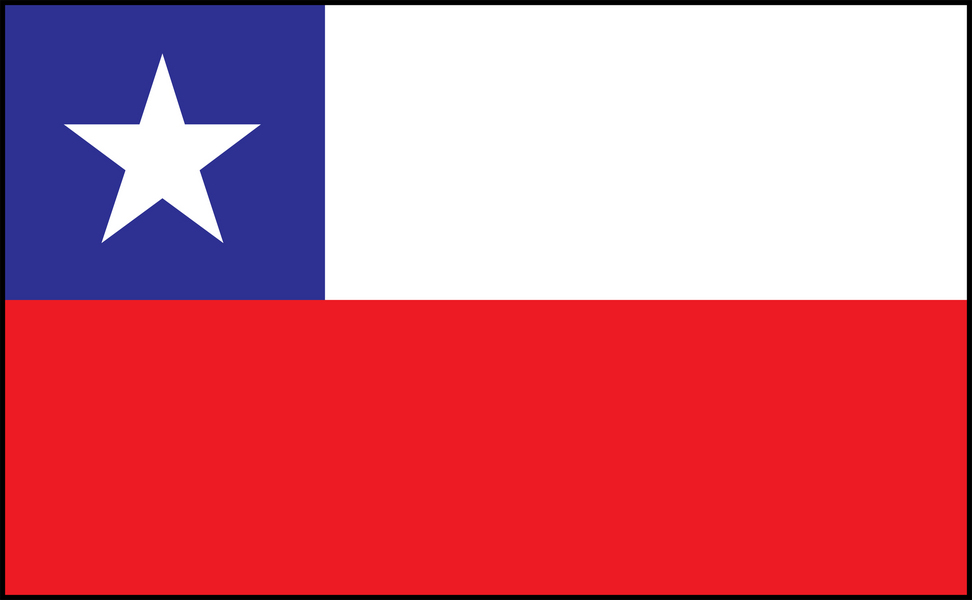
The flag is white on top and red below, with a blue square in the top left corner holding a single white star. Chileans call it La Estrella Solitaria, the Lone Star.
White stands for the snow of the Andes, blue for the sky and the Pacific, and red for the blood shed in the fight for independence from Spain. The single star represents the state guiding the country.
