Brazil
Where is Brazil located? Brazil forms part of the continent of South America. It is situated in East and Central South America, on the coast of the Atlantic Ocean and its border countries are Argentina, Bolivia, Colombia, French Guiana, Guyana, Paraguay, Peru, Suriname, Uruguay and Venezuela.
Brazil population and size Brazil is the largest country in South America. Its overall area size is 8,515,799 km sq. It is believed that the country has a population in excess of 207,953,000 inhabitants with Brazil’s most populated region being Sao Paulo at more than 21 million people, the second most populous city being Rio de Janeiro at over 12 million inhabitants, the third most populated being Belo Horizonte at over 5.7 million and the fourth most populated being the capital city of of Brasilia.
The capital of Brazil The capital of Brazil is called Brasilia, a city positioned in the centre of the country. Brasilia is the fourth most populated city in Brazil and has an approximate population of 4,155,000 . It is known for being a city of political and economical importance. There are many unusual landmarks in Brasilia including the Cathedral of Brasilia, Alvorada Palace, Planalto Palace, Square of the Three Powers, and Monumental Axis. Brasilia is situated in central-western Brazil in the highlands. The city is a political and economic centre that supports government, financial, entertainment, communication and legal services. Brasilia offers excellent transport links, including a busy international airport.
Brazil major cities There are a number of major cities in Brazil, the names of the largest and most important cities and towns include the country’s capital Brasilia, and Sao Paulo, Rio de Janeiro, Belo Horizonte, Fortaleza, Recife.
Carnival of Brazil facts The Carvival of Brazil is a huge event held annually in Rio de Janiero, dubbed the Carnival capital of the world. The popular event starts on the Friday afternoon before Ash Wednesday, marking the beginning of Lent, and sees masses of people celebrating on the streets of Rio de Janeiro. The carnival consists of a six day non-stop party involving crowds of people, and various styles of music and fantastic costumes, many being influenced by African-Brazilian cultures.
The Amazon Rainforest in Brazil The Amazon Rainforest is the largest rainforest in the world and it is located on the continent of South America. The forest is home to millions of trees, plants, wildlife species and an overall population of around 30 million people. Made up of approximately 390 billion trees, the Amazon Jungle spans across most of the Amazon Basin and occupies parts of nine countries of South America including Brazil, Peru, Columbia, Venezuela, Ecuador, Bolivia and Guyana, Suriname and French Guiana. The majority of the Amazon Rainforest stretches across Brazil, the largest country in South America. Brazil is home to approximately 60% of the Amazon Rainforest.
There are more species of trees, plants and animals found in the tropical Amazon Rainforest than anywhere else on Earth as its hot, wet climate makes it an ideal place for the growth of diverse plant species and the survival of wildlife. The Amazon Rainforest evolved over millions of years, and is very important because it provides around 20% of the world's oxygen! Deforestation is damaging the existence of certain animal and plant species that continue to be threatened with extinction as deforestation is taking place and trees are fast disappearing. The Amazon Jungle took millions of years to evolve and there is no quick way of replacing its trees.
The Amazon River in Brazil The Amazon River is 6,992km long and runs mostly through Brazil and neighboring Peru. The river is very important to the rainforest as it provides a vital water source that is essential to the survival of animals and plants. During the hottest and driest times of year, the Amazon River is subject to periods of drought which pose a massive threat to the animals and plant life of the Amazon Rainforest, placing it in danger of forest fires which can spread very quickly and cause devastation.
The following list of names cover some of the main species of trees and plants found growing in the Amazon Rainforest, 60% of which is found occupying Brazil: Kapok Tree, Ceiba Tree, Calvillia, Saprophytes, Strangler Fig, Orchids, Heliconia, Wild Yam, Cinchona Tree, Acai Palm Tree, Trumpet Tree, Suma, Lianas, Bromeliads, Candle Bush, Cocoa Tree. The lush rainforest of Brazil produces many types of produce including tropical fruit and vegetables which are supplied to food stores across the world. The types of food produced in the Amazon Rainforest of Brazil include mangoes, coconuts, lemons, citrus fruit, bananas, cinnamon, tamarind, Brazil nuts, sugar cane and cocoa beans for chocolate.
Facts for Kids 1: On 15 November, 1889, the First Brazilian Republic was formed. Four days later, on 19 November, 1889, the flag of Brazil was officially adopted. The flag is known widely as A Auriverde, which is Portuguese for ‘the yellow and green one’. Portuguese is the main language of this South American country.
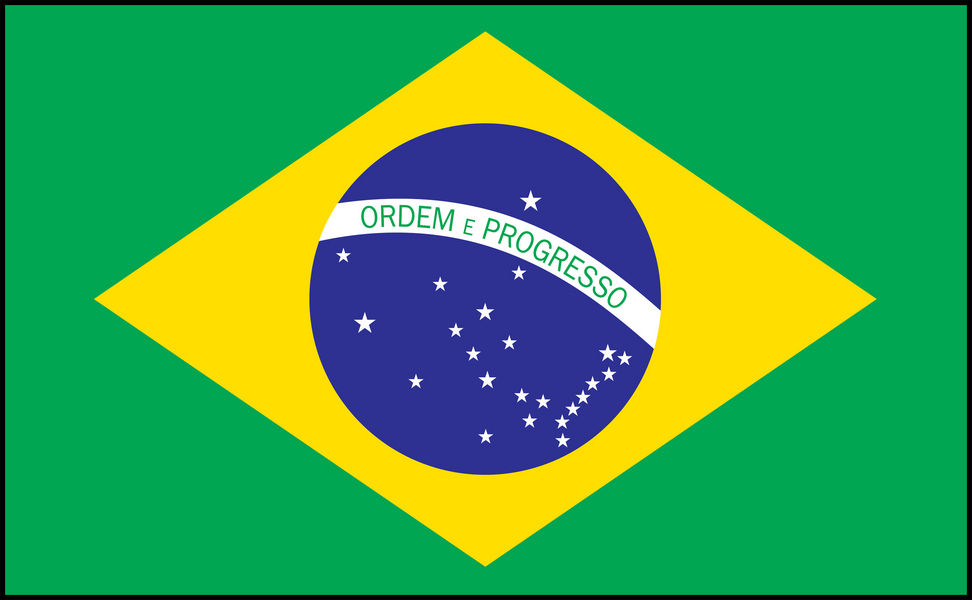
Facts for Kids 2: The flag of Brazil features a green field, adorned with a yellow rhombus (diamond), with a blue disc that portrays the night sky as it contains 27 stars of different sizes, shaped to represent a constellation in the southern sky, known as the Southern Cross. A white band arcs across the blue disc and within the white band, feature the words ‘Ordem et Progresso’ in green writing. This is Brazil’s national motto meaning ‘Order and Progress’.
Facts for Kids 3: The national motto of Brazil forms a very important part of the flag’s design and its words are capitalized to enhance its appearance. The National Motto of Brazil ‘Ordem et Progresso’ was created by the same man that designed and placed it on the National Flag of Brazil, a Brazilian mathematician and philosopher named Raimundo Teixeira Mendes (1855-1927).
Facts for Kids 4: Later versions of the National Flag of Brazil have seen the addition of stars to the blue disk that lies central to its design. The first flag began with 21 stars, the second version was introduced in 1960 and featured 22 stars, the third flag took its place in 1968 and featured 23 stars, and the current version, which was introduced in 1992, features 27 stars. The stars represent the states within Brazil, so as new states are added to Brazil, new stars are gained on the design of the flag. Since the original flag was adopted in 1889, six stars have been added. These six additional stars represents the states of Guanabara, Acre, Amapá, Roraima, Rondônia and Tocantins.
Facts for Kids 5: The colors used on the design of the Brazilian flag hold various significant meanings which symbolize the history, strength, geography and beauty of Brazil. The color green represents the Amazon Jungle (approximately 60% of the Amazon Rainforest covers Brazil), the color yellow represents the mineral wealth and gold reserves of this South American country, and the blue disc with stars was taken from the pattern of stars in the night sky above the city of Rio de Janeiro on November 15, 1889.
Map of Brazil
Geography
The geography of Brazil is interesting as it is the biggest country in South America and one of the biggest in the world geographically. Brazil spans across areas central and north of the continent, and stretches across the east coast where it is met by the North and South Atlantic Ocean. With a coastline of more than 7,367 km, Brazil is larger than Italy, Portugal, Japan, Spain, Indonesia and South Africa combined. The geography of Brazil is quite diverse and is formed by hills, mountains, plains, forests, rivers, highlands and scrublands. The Amazon Rainforest and the Amazon River have a huge presence in Brazil.
The Amazon Rainforest, which occurs majorly across Brazil, is dominated by tall broadleaf trees which grow to around 30-45 meters tall and form the canopy of the forest. Some less common tree species, such as the Kapok Tree, can be found growing above the rainforest canopy, in the emergent layer, reaching 45-55 meters tall and sometimes higher! The climate of the Amazon Rainforest can be described as hot and wet with high temperatures above 18 degrees Celsius (64 degrees F) all year round due to its proximity to the equator. Rainfall in the Amazon Rainforest is high, annually it receives around 150cm to 300cm of rain which is important for the survival of its lush vegetation and animal life. The Amazon Rainforest biome has a thriving rich, lush vegetation which is determined by its tropical hot and wet climate.
Climate
For the most part, the climate of Brazil can be described as tropical, however, southern regions have a more temperate climate characterized by milder conditions. In fact, some areas in South Brazil can experience the occasional frost and floods. Some areas of the north can become arid and prone to droughts.
Famous landmarks
There are numerous incredible landmarks, monuments and buildings of interest in Brazil including the Christ the Redeemer, Teatro Amazonas (opera house), Niteroi Contemporary Art Museum, Cathedral of Brailia, Arcos da Lapa (aqueduct), The Maracana Stadium (largest stadium in the world), Alvorada Palace, Planalto Palace, Square of the Three Powers, and Monumental Axis.
Brazil is famous for having some of the best footballers in the world, some of the most iconic landmarks, and being the capital carnival of the world as well as one of the most popular tourist destinations in South America.
Brazil is a very popular tourist destination as this South American country has fabulous beaches, stunning scenery, great nightlife and many points of interest including numerous historical and religious landmarks such as the statue of Christ the Redeemer. The capital city of Brazil is Brasilia, but the bustling city of Sao Paulo is in fact the most populous and largest city in Brazil, and the rest of the South America. Brazil has the world's tenth largest economy and the ninth largest in terms of purchasing power. This wonderful South American country is truly a paradise enriched in culture, natural environments, extensive natural resources and wildlife diversity. Rio de Janeiro is a amazing city that boasts many tourist attractions including Christ the Redeemer, the famous Copacabana Beach, carnivals, firework displays and amazing parties.
Culture
The main language of Brazil is Portuguese but a mixture of different languages are spoken throughout this multicultural country. Although the official language of Brazil is Portuguese, 82% of the population speak English. Spanish makes up around 10.7%, with Asian and Pacific Island languages also being spoken. The languages of Italian, German, Amerindian, and Japanese are also spoken in Brazil, the largest nation in South America.
Brazil is a multicultural country influenced by the cultures of societies from across the world, in particular, the Portuguese with whom they share powerful colonial connections. In terms of religion, Brazil is the largest Catholic country and has the second highest Christian population. The importance of religion is reflected by the colossal iconic statue of Christ the Redeemer which overlooks the bustling city of Rio de Janiero, and is considered one of the New Seven Wonders of the World. The culture and traditions of Brazil centre heavily around music, dance, literature, cinema, art, theatre, cuisine and sports. The most popular sport in Brazil is football and the country boasts some of the world's best footballers, and the Brazilian Men's National Team which ranks among the best football teams in the entire world.
The flag
The national flag of Brazil, which incorporates four colors, first appeared on November 19, 1889, and can be described as having a green background adorned with a yellow rhombus and a blue disc containing 27 stars of varying size. The original design composed of 21 stars which represents the states within Brazil. The amount of stars have since been increased as new states have been added. The Brazilian flag can be identified by the national motto of Brazil that features on the blue disc. The words Ordem et Progresso mean Order and Progress. The National Flag of Brazil was designed by Raimundo Teixerira Mendes and is known by the name A Auriverde meaning the yellow and green one. The flag represents the history, geography and strength of the nation. Brazil was a colony of Portugal until independence was gained in 1822, but after independence was established, the country initially became a republic. The color green symbolizes the Amazon Rainforest of which 60 percent is present in Brazil, yellow portrays the country's gold reserves and mineral sources, the blue disc depicts the night sky above the city of Rio de Janeiro on November 15, 1889.
