Bolivia

Where is Bolivia located? Bolivia forms part of the continent of South America. It is positioned in Western-central South America, where it is landlocked by five countries. The names of its border countries are Brazil, Paraguay, Argentina, Chile and Peru.

Bolivia population and size Bolivia is a landlocked country in South America. It is estimated that the area size of this Western-central South American country is 1,098,581 km sq. It is predicted that the country has a population of approx. 10,985,000 people with Bolivia’s most populous city being Santa Cruz at over 2.1 million people followed by El Ato, La Paz, Cochabamba, Oruro then the capital city of of Sucre.

The capital of Bolivia The capital city of Bolivia is Sucre which is situated in the west of the country. Sucre is the sixth most populous city in Bolivia and has an approximate population of 259,000 inhabitants. The region is known for its architecture and historical points of interest. There are a range of unusual landmarks in the country's capital city including the Estadio Patria Sports Stadium, National Library, Archbishop's Palace, Metropolitan Cathedral, The House of Freedom, government buildings, churches and chapels. Sucre is the situated in south-central Bolivia in an elevated position. The city was founded by Spanish colonials in the 1500s and is the constitutional capital of Bolivia. Sucre has been known by various names throughout history including Charcas, La Plata, Chuquisaca, and La Ciudad Blanca. There are a number of notable historical landmarks and important buildings located in Sucre including the Sports Stadium, Estadio Patria, the country's second largest football and Olympic Stadium. Football is a very popular sport in this part of South America.

Bolivia major cities There are numerous major cities in Bolivia, the names of the largest and most important cities and towns include the country’s capital Sucre, and Santa Cruz, El Alto, La Paz and Cochabamba. Santa Cruz de la Sierra is the largest and most populous city in Bolivia. Santa Cruz is located in eastern Bolivia on the Pirai River. The city supports many businesses and is therefore, very important to the economy of Bolivia. Santa Cruz is home to the majority of the country's population. Many points of interest can be found in this city including historical sites, museums, religious buildings and art galleries.

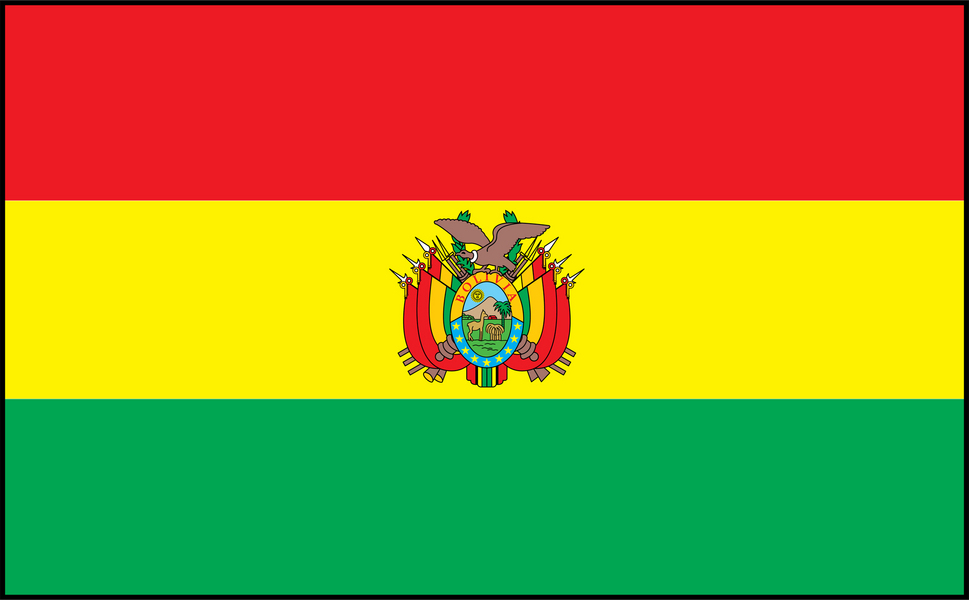
Bolivia Flag Bolivia began its fight for independence in 1809, with a new Bolivian Republic being declared on August 6, 1825. This South American country finally adopted the national flag in 1851. The National Flag of Bolivia can be described as a horizontal tricolor flag. The color of the stripes, from top to bottom, are red, yellow and green.

Bolivia Flag There are numerous reasons why these colors were chosen to feature on the flag. Some say that red stands for bloodshed, and in particular the Bolivian soldiers who fought for the country’s independence and freedom, and in subsequent conflicts. The color green symbolizes the nation’s fertility, and yellow represents the country’s mineral deposits.

Bolivia Flag Like many nations, Bolivia also has a formal State Flag, which features the coat of arms of Bolivia central to its design.

The Coat of Arms of Bolivia The coat of Arms of Bolivia has a complex design that is highly representative of the country’s history, struggle for independence, geography and resources. The coat of arms features a central crest and is encircled by a border which incorporates ten stars positioned around the bottom half. The stars represent the nine departments of Bolivia, and also Litoral, which was annexed by Chlie in 1879. Within the border, the coat of arms features the silver mountain, Pitosi, with the sun rising behind it. An Alpaca stands next to a tree and a wheat sheaf. An Alpaca can be described as a type of mammal related to the llama. It is a long-haired animal that originates from the continent of South America.

The Coat of Arms of Bolivia Six Bolivian flags, three on either side, surround the central logo. A pair of crossed cannons also feature on the coat of arms, symbolizing Bolivia’s struggle for independence. In addition to the cannon, four muskets also appear on the coat of arms. An axe and a red Phrygian hood are also depicted and represent liberty. The laurel branches are a symbol of peace, and the Andean condor highlights a willingness to defend the nation.

Map of Bolivia

Geography

The geography of Bolivia is very diverse and can be split into three regions: Andean, Sub-Andean and Llanos. There are some very interesting geographical features found in this South American country as its landscape incorporates extensive rain forest areas including the Amazon Rainforest, the Amazon Basin, Rio de la Plata Basin, Central Basin, the tropical savanna of Chiquitania, valleys, major rivers including the Paraguay River, Gran Choco, mountains (namely the Andes), and lakes including Lake Titicaca which is the biggest lake in South America. Altitudes vary significantly across this country from from 90 to 6,542 metres above sea level. The world's largest salt pan Salar de Uyuni is located in Bolivia.

Climate

The climate of Bolivia changes from one climatic zone to another. The elevation of the land ranges extensively across the country resulting in varying temperatures and weather conditions. At higher elevation, temperatures are typically cooler. Summer occurs from the month of November to March, and the winter season takes over from April through to October. The climate conditions during wintertime are much colder. The climate conditions range across the landscape from subtropical and temperate to cold desert-polar conditions with strong winds.

Famous landmarks

There are many incredible landmarks, monuments and buildings in Bolivia including the Isla del Sol (Inca Palace), Tiwanaku (Inca site: pyramid and temple), Jesuit Missions of Chiquitos, Yungas Road (the world's most dangerous road), Estadio Patria Sports Stadium, National Library, Archbishop's Palace, Metropolitan Cathedral, The House of Freedom, government buildings, churches and chapels.

Bolivia is famous for being one of the most bio-diverse countries in South America. The country comprises of many rich ecosystems which are home to thousands of plant and animals species including mammals, birds, amphibians, reptiles and fish.

Culture

The main languages of Bolivia include Spanish, Quechua and Aymara. The official language is Spanish which is spoken by the majority of the population, however, Bolivia is a multicultural country and many different languages are spoken among its people including the indigenous languages of Quecha and Aymara.

Bolivia has a rich culture and the people of this country pride themselves in the fields of art, cuisine, sport, literature and music. Culture and traditions are strongly influenced by the Aymara and the Quechua. Music plays a large part in important festivals, dances and carnivals which are a regular occurance in Bolivia. Many celebrations are accompanied by the cuisine of Bolivia which often takes on a Spanish twist. Sport is enjoyed by many across the country with football being the most popular type of sport

When it comes to religion, the majority of people living in Bolivia are Roman Catholic, but at the same time, protestant denominations are increasing rapidly.

Economy

Bolivia is a democratic republic and is divided into nine departments. It is a developing country and its economy is supported mainly by activities such as agriculture, forestry, fishing, mining, and manufacturing good such as textiles, clothing, refined metals, and refined petroleum. One of the country's main sources of income comes from its tourist industry.

The flag

The national flag of Bolivia, which can be described as having a tricolor design, came into use on October 31, 1851, and is formed by three horizontal stripes which appear in the colors of red, yellow and green from top to bottom. The Bolivian flag can be recognized by the Bolivian Coat of Arms that lies central to the flag's design. The colors red, yellow and green, and the Coat of Arms of Bolivia provide a powerful representation of the history, strength, struggle for independence, geography and resources of this South American country, and its hope for peace. The design of the Coat of Arms is complex and incorporates a central crest, 10 stars, Pitosi Mountain, the Sun, an Alpaca, a wheat sheaf, 6 Bolivian flags, crossed cannons, four muskets, an axe, a red Phrygian hood, laurel branches and the Andean condor.

Bolivia