
Vanuatu
Vanuatu is a chain of 83 volcanic islands where you can walk right up to the rim of an active volcano and watch lava fountain into the night sky.
- CapitalPort VilaOn the island of Efate
- PopulationAbout 330,000Spread across 65 inhabited islands
- Area12,189 km2Roughly the size of Northern Ireland
- LanguagesOver 100 spokenThe most languages per person on Earth
The 83 islands sit in a Y shape running roughly north to south. Nine of the volcanoes are still active. Mount Yasur on Tanna has been erupting more or less continuously for hundreds of years and is one of the few volcanoes in the world you can safely stand beside.
Vanuatu is also where bungee jumping came from. On Pentecost island, men build wooden towers up to 30 m high and jump from them with vines tied to their ankles, a ceremony called land diving that is meant to guarantee a good yam harvest.
National symbols
- National plant Namele fern, whose leaves signal peace
- National colours Red, black, green and yellow
- National anthem Yumi, Yumi, Yumi (Translation: We, We, We)
- National day Independence Day, 30 July
Map of Vanuatu
Geography
Vanuatu covers 12,189 km2 of land east of Australia and north-east of New Caledonia, with no land borders. The islands stretch about 1,300 km from north to south.
Nearly all the islands are volcanic, steep and forested, with narrow coastal strips where the villages sit. The highest point is Mount Tabwemasana at 1,877 m on Espiritu Santo. The country lies right on the Ring of Fire, where the Australian plate slides under the Pacific plate.
Climate
Vanuatu is tropical, warm and humid, typically 22C to 30C. The wet season runs from November to April and the drier, cooler season from May to October.
Cyclones are the great danger. Cyclone Pam in 2015 damaged or destroyed most buildings on several islands, and storms of that strength arrive every few years.
Culture
Bislama, English and French are all official, a legacy of the odd period when Britain and France governed the islands jointly. Bislama is the language everyone shares, and over 100 local languages are spoken beyond it.
Kastom, meaning traditional custom, still shapes village life: chiefs, ceremonies, dances and rules about land. Around 80 per cent of people are Christian, often practised alongside kastom beliefs.
Economy
Most families farm for themselves, growing yams, taro, coconuts and kava. Kava, copra, cocoa and beef are the main things sold abroad.
Tourism brings in real money, with cruise ships calling at Port Vila and divers coming for the wreck of the SS President Coolidge, a huge liner sunk in the Second World War that now sits in shallow water off Espiritu Santo.
The flag
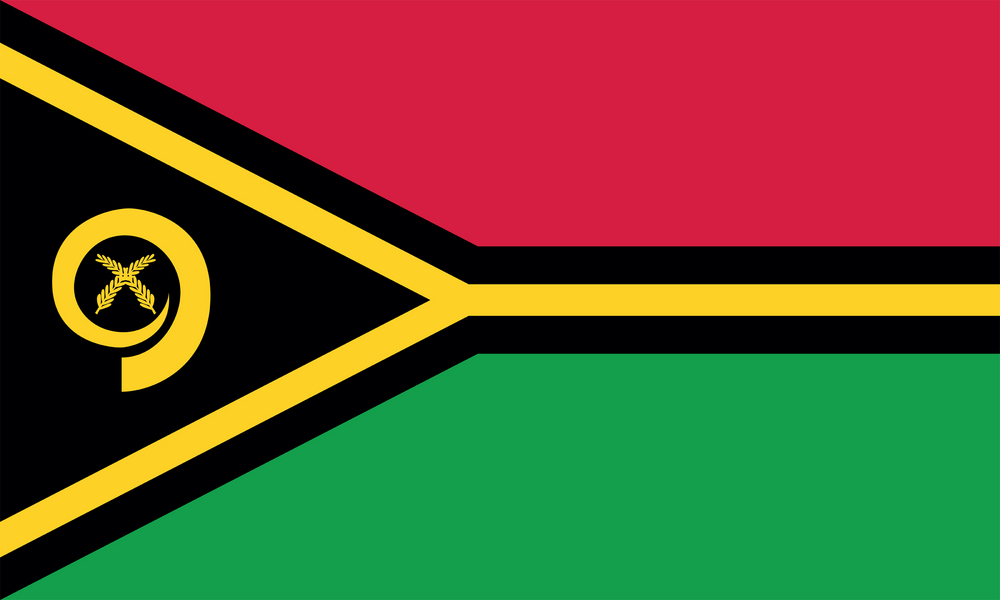
A black triangle at the left holds a yellow boar's tusk curled around two crossed namele fern leaves. The tusk stands for prosperity and the fern leaves for peace.
A yellow Y shape lies on its side across the flag, echoing the shape the islands make on a map. Red above stands for the blood shared by people and animals, green below for the richness of the land, and black for the Melanesian people.