
Papua New Guinea
Papua New Guinea has more languages than any other country on Earth, over 800 of them, because its mountains kept villages apart for thousands of years.
- CapitalPort MoresbyOn the south coast, reachable mostly by air
- PopulationAbout 10 millionAround 85 per cent live in rural villages
- Area462,840 km2Shares its island with Indonesia
- LanguagesOver 800 spokenMore than any other country
Papua New Guinea takes up the eastern half of New Guinea, the second largest island in the world, plus around 600 smaller islands. A spine of steep mountains runs down the middle, rising above 4,000 m, and thick rainforest covers most of the rest.
Those mountains are the reason for the languages. Valleys were cut off from each other by ridges and rivers, so communities developed separately for thousands of years and each ended up with its own tongue. Today people from different valleys often talk to each other in Tok Pisin, a shared language built partly from English.
National symbols
- National bird Raggiana bird of paradise
- National colours Red, black, white and gold
- National anthem O Arise, All You Sons
- National day Independence Day, 16 September
Map of Papua New Guinea
Geography
Papua New Guinea covers 462,840 km2 on the eastern half of New Guinea, sharing a land border with Indonesia. Around 600 islands belong to it as well, including New Britain and Bougainville.
The Owen Stanley Range and the central highlands run through the middle, topping out at Mount Wilhelm, 4,509 m. The country sits on the Pacific Ring of Fire, so earthquakes and active volcanoes are part of normal life. The Sepik and Fly rivers wind through vast swampy lowlands.
Climate
Most of the country is hot and very wet all year, which is exactly what rainforest needs. Coastal areas stay around 30C with heavy monsoon rain from December to March.
The highlands are a surprise: at 2,000 m and above the air is cool and nights can be genuinely cold, so highland farmers grow sweet potato rather than the coconuts and sago of the coast.
Culture
Tok Pisin, English and Hiri Motu are the official languages, but over 800 local languages are spoken day to day. That is roughly one in every eight languages on the planet, in a country of about 10 million people.
Most people belong to Christian churches, often blended with older beliefs about ancestors and spirits. Sing-sings are huge gatherings where clans arrive in feathered headdresses and painted faces to dance and show who they are.
Economy
Mining and gas dominate the money side of the economy. Gold, copper and liquefied natural gas are the main exports, mostly to Australia, Japan and China.
Most people, though, do not work in mines at all. They grow their own food on small family plots, a way of living called subsistence farming, and sell coffee, cocoa, palm oil or copra (dried coconut) for cash on the side.
The flag
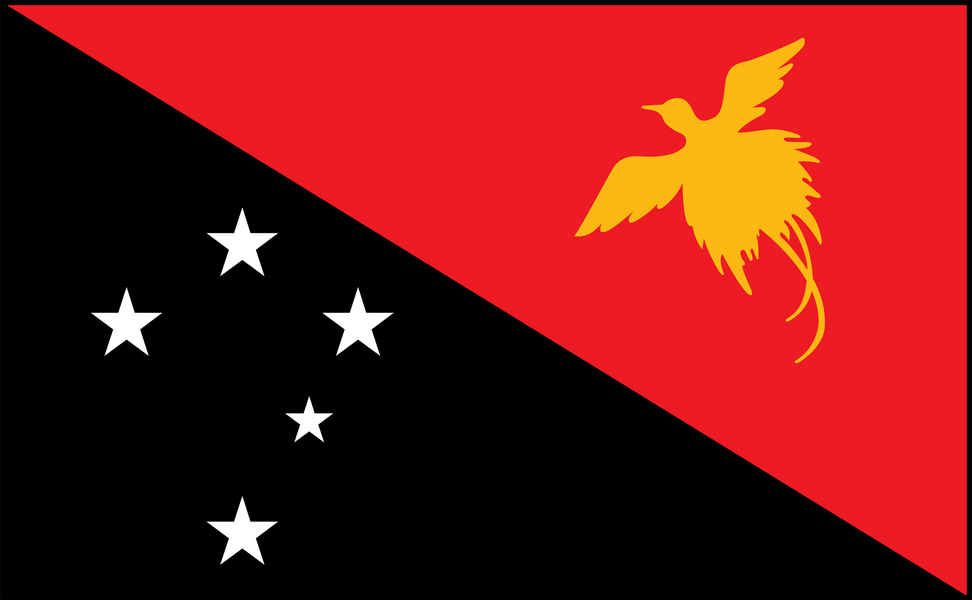
The flag is split diagonally from top right to bottom left. The bottom half is black and carries a golden Raggiana bird of paradise in flight. The top half is red and shows five white stars in the shape of the Southern Cross.
The design was chosen in 1971 from an entry by a 15-year-old schoolgirl, Susan Karike. Red, black and gold were already the colours used across the country in traditional art and decoration.