
Palau
Palau made every visitor sign a promise to protect the environment, stamped into their passport, and it was the first country to ban sunscreen that harms coral.
- CapitalNgerulmudOne of the least populated capitals on Earth
- PopulationAbout 18,000Most live on Koror
- Area459 km2Around 340 islands
- Marine sanctuary80 per cent of its watersNo fishing allowed at all
Palau is a cluster of around 340 islands at the western edge of the Pacific. The Rock Islands are the famous ones: hundreds of round green limestone mounds rising straight out of turquoise water, undercut at the base by the sea.
Palau protects its ocean harder than almost anywhere. Eighty per cent of its waters are a no-fishing sanctuary, and since 2020 sunscreens containing chemicals that bleach coral have been illegal.
National symbols
- National colours Blue and yellow
- National anthem Belau rekid (Translation: Our Palau)
- National day Independence Day, 1 October
- National emblem The bai, a traditional meeting house with a painted gable
Map of Palau
Geography
Palau covers 459 km2 in the western Pacific, about 900 km east of the Philippines, with no land borders. Babeldaob is by far the largest island and holds the capital.
The Rock Islands are made of ancient coral limestone lifted above the sea and then eaten away at water level, which gives them their mushroom shape. The reefs around Palau hold more than 1,300 species of fish and 700 kinds of coral.
Climate
Palau is tropical and warm all year, around 27C to 31C, with high humidity and very little seasonal variation.
Rain is heavy, roughly 3,800 mm a year, and heaviest between July and October. Palau sits at the edge of the typhoon belt, so it is hit less often than the Philippines but not never.
Culture
Palauan and English are the official languages. Palauan society is matrilineal, meaning clan membership and titles pass through mothers, and senior women choose which men hold chiefly titles.
Most Palauans are Christian, though a local faith called Modekngei, blending Christian and traditional beliefs, is still followed. Storyboards, carved wooden panels that retell legends, are a distinctive Palauan art form.
Economy
Tourism is the main industry, and diving is the reason most people come. Palau deliberately aims at fewer, higher-spending visitors rather than mass tourism, to protect the reefs.
Fishing and financial support from the United States under a Compact of Free Association make up most of the rest of the economy.
The flag
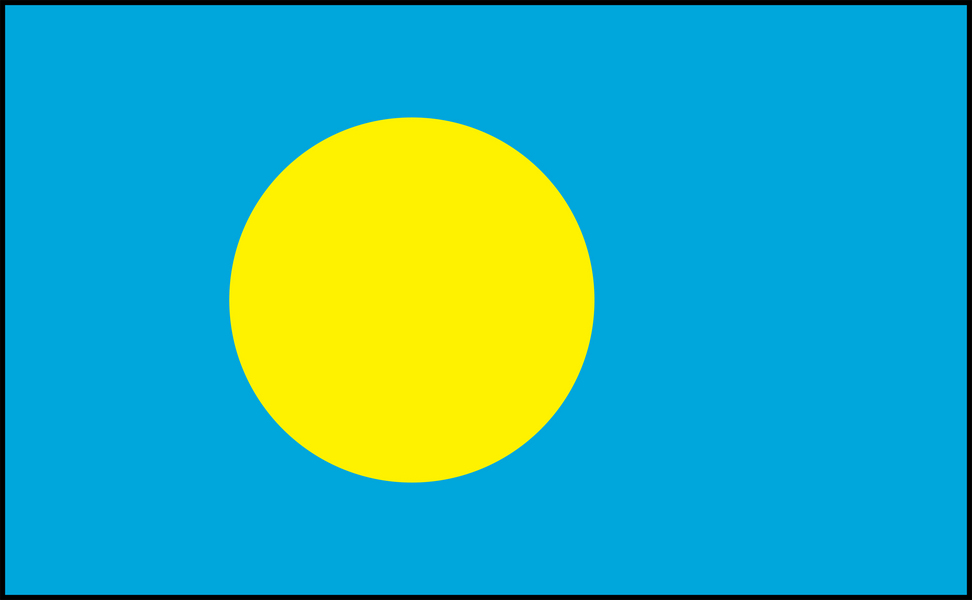
The flag is a plain light blue rectangle with a large yellow disc slightly left of centre.
The disc is the full moon, not the sun. Palauans traditionally judged the best time for fishing, planting and ceremonies by the moon, so the full moon stands for peace and the right moment to act. Blue is the ocean and independence.