
New Zealand
New Zealand is two long, mountainous islands in the South Pacific, so far from anywhere else that birds took over the jobs mammals do everywhere else.
- CapitalWellingtonThe windiest capital city in the world
- PopulationAbout 5.2 millionOutnumbered roughly 5 to 1 by sheep
- Area270,469 km2About the same size as the United Kingdom
- LanguagesEnglish, Maori, NZ Sign LanguageAll three are official
New Zealand has two main islands. The North Island is warmer and holds most of the people, plus a belt of volcanoes and bubbling hot springs around Rotorua. The South Island is colder, emptier and split down the middle by the Southern Alps, which are still growing taller as two tectonic plates grind together.
No land mammals except bats ever reached New Zealand on their own. With nothing hunting them from the ground, birds like the kiwi, the kakapo and the huge extinct moa lost the ability to fly. That worked perfectly until humans arrived with rats, cats and stoats, which is why New Zealand now runs some of the toughest wildlife protection programmes anywhere.
National symbols
- National bird Kiwi, a flightless night bird with nostrils on the tip of its beak
- National colours Black, white and silver
- National anthems God Defend New Zealand and God Save the King, both official
- National day Waitangi Day, 6 February
Map of New Zealand
Geography
New Zealand lies about 2,000 km south-east of Australia across the Tasman Sea, with no land borders. It covers 270,469 km2 across the North Island, the South Island and hundreds of smaller ones.
The Southern Alps run almost the length of the South Island and include Aoraki, or Mount Cook, at 3,724 m. New Zealand sits directly on the boundary between the Pacific and Australian plates, so it gets thousands of earthquakes a year, most too small to feel.
Climate
The climate is mild and wet, with no extreme heat and no extreme cold in most places. The far north is close to subtropical, while the southern mountains hold snow and glaciers all year.
The west coast of the South Island is one of the wettest places on Earth, catching over 6,000 mm of rain a year, while land just over the mountains to the east can be almost dry. Seasons are reversed from Europe, so July is the middle of winter.
Culture
English, Maori and New Zealand Sign Language are all official languages. Maori people arrived from Polynesia around 750 years ago and Maori words, place names and traditions run right through everyday New Zealand life.
The haka, a fierce chanted challenge with stamping and slapping, is performed by the All Blacks rugby team before every match, and rugby is close to a national obsession. Around half of New Zealanders report no religion, and about 37 per cent are Christian.
Economy
New Zealand lives largely off its farms. It is the largest exporter of dairy products in the world, and lamb, beef, wool, kiwifruit, apples and wine all go abroad in quantity.
Tourism is the other giant. Millions of visitors come for the mountains, the fjords at Milford Sound and the film locations used for The Lord of the Rings, which were shot across both islands.
The flag
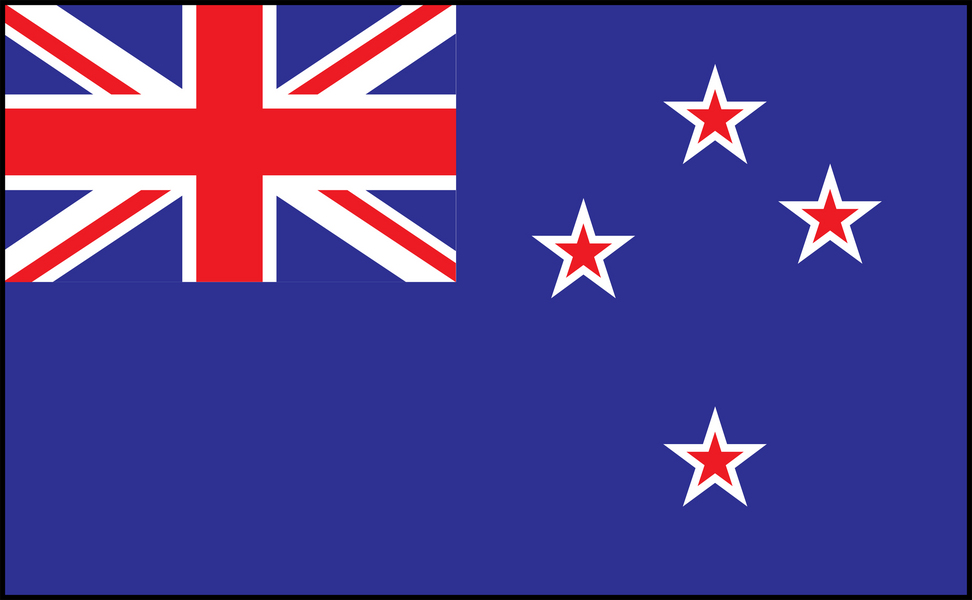
The New Zealand flag is dark blue with the British Union Flag in the top left, a reminder of British rule. On the right are four red stars with white outlines, arranged as the Southern Cross.
It looks very like the Australian flag, and the two are often confused. The differences are that New Zealand has four stars, not six, and they are red instead of white. In 2016 New Zealanders voted on whether to change the flag to a silver fern design, and chose to keep the old one.