
Marshall Islands
The Marshall Islands are 29 coral atolls where the United States tested 67 nuclear bombs, including one that vaporised an entire island.
- CapitalMajuroA narrow atoll you can cycle across in minutes
- PopulationAbout 42,000Spread over 24 inhabited atolls
- Land area181 km2Across nearly 2 million km2 of ocean
- CurrencyUnited States dollarA legacy of American administration
The Marshall Islands are 29 atolls and five single islands in the central Pacific. Like Kiribati, almost all of the land is low coral barely 2 m above the sea, so the country is right at the front line of rising sea levels.
Between 1946 and 1958 the United States tested nuclear weapons at Bikini and Enewetak atolls. The Castle Bravo test in 1954 was the largest bomb America ever detonated. Bikini remains too contaminated to live on, and the people moved off it have never been able to return permanently.
National symbols
- National colours Blue, orange and white
- National anthem Forever Marshall Islands
- National day Constitution Day, 1 May
- National plant Coconut palm, the source of food, drink, rope and roofing
Map of Marshall Islands
Geography
The Marshall Islands have 181 km2 of land spread across nearly 2 million km2 of the central Pacific, with no land borders. There are 29 atolls and 5 separate islands, arranged in two rough chains.
Every island is low coral. The average height above sea level is around 2 m and the highest point is only about 10 m, on Likiep. Kwajalein Atoll encloses the largest lagoon in the world.
Climate
The climate is tropical, hot and humid throughout the year, usually 25C to 31C, with the sea keeping temperatures steady.
The wet season runs from May to November. The northern atolls are noticeably drier than the southern ones, and droughts there can force emergency water shipments.
Culture
Marshallese and English are both official. Marshallese is spoken at home by nearly everyone and belongs to the same family as Fijian and Samoan.
Land is passed down through mothers rather than fathers, so women hold a great deal of authority over property. Almost everyone is Christian, and weaving fine mats and baskets from pandanus leaves remains an important skill.
Economy
The economy leans heavily on the United States. Under an agreement called the Compact of Free Association, America provides funding and defends the islands, and runs a missile testing range on Kwajalein.
Beyond that, fishing licences, copra, coconut oil and a ship registry (many foreign ships fly the Marshallese flag) bring in most of the remaining income.
The flag
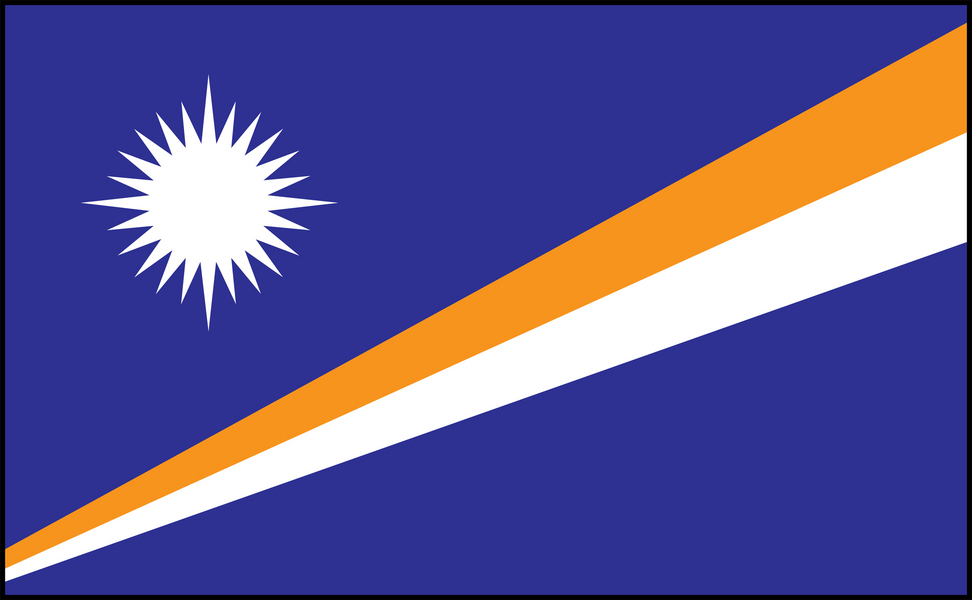
The flag is deep blue for the Pacific Ocean, crossed by two widening stripes running from the bottom left to the top right: orange above white.
Orange stands for courage and the Ratak or sunrise island chain, white for peace and the Ralik or sunset chain. The white star in the corner has 24 points, one for each of the electoral districts, and its four longer points form a cross for Christianity.