
Kiribati
Kiribati is spread across an area of ocean bigger than India, but all its land squashed together would fit inside a small city.
- CapitalTarawaA thin ring of coral around a lagoon
- PopulationAbout 130,000Most crowded onto South Tarawa
- Land area811 km2Scattered over 3.5 million km2 of sea
- Highest pointAbout 81 mOn Banaba; most islands rise barely 3 m
Kiribati is made of 33 coral atolls and reef islands. An atoll is a ring of low coral around a lagoon, built up on the rim of a sunken volcano, and almost all of Kiribati is only a couple of metres above the waves.
That makes Kiribati one of the countries most threatened by rising seas. Salt water is already spoiling wells and gardens on some islands, and the government has bought land in Fiji in case people one day need somewhere to move to.
National symbols
- National bird Great frigatebird, which appears on the flag
- National colours Red, white, blue and gold
- National anthem Teirake Kaini Kiribati (Translation: Stand Up, Kiribati)
- National day Independence Day, 12 July
Map of Kiribati
Geography
Kiribati has 811 km2 of land scattered across roughly 3.5 million km2 of the central Pacific, with no land borders. The islands fall into three groups: the Gilbert, Phoenix and Line Islands.
Nearly every island is a low coral atoll, rarely more than 3 m above sea level. The only exception is Banaba, a raised island of old coral that reaches about 81 m. Kiritimati, in the Line Islands, is the largest coral atoll in the world by land area.
Climate
Kiribati is hot and humid all year, generally 26C to 32C, with little seasonal change because it lies on the equator.
Rainfall varies enormously between island groups. The northern islands are wet, the ones near the equator can go through long droughts, and El Nino years flip the pattern completely.
Culture
Gilbertese and English are the official languages, and Gilbertese is what people speak at home. Extended family and the village meeting house, the maneaba, are at the centre of community life.
Around 96 per cent of people are Christian, mostly Catholic or Protestant. Traditional dancing, with sharp bird-like head and arm movements, is performed at every important gathering.
Economy
Kiribati has very little to sell. Copra and fish are the main exports, and the country earns a great deal by selling fishing licences to foreign fleets that want access to its enormous sea area.
The country also has a sovereign fund built from phosphate mining on Banaba, which ran out in 1979. The money from that mining still helps pay for government today.
The flag
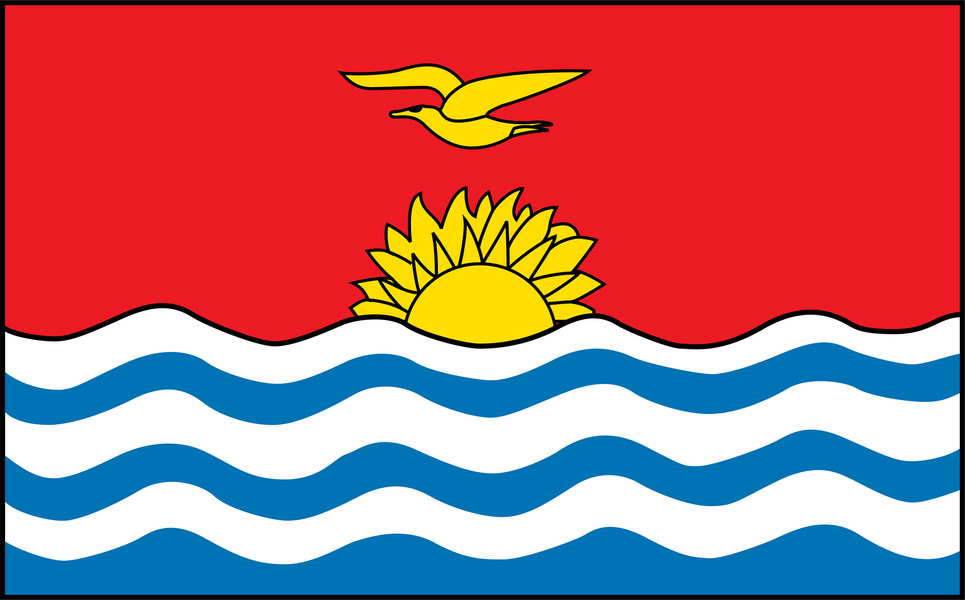
The top half of the flag is red with a golden frigatebird flying above a golden rising sun with 17 rays.
The bottom half shows three wavy white lines on blue, standing for the Pacific Ocean and for the three island groups. The frigatebird stands for power and freedom, and the sun for Kiribati sitting astride the equator.