
Australia
Australia is the only country in the world that is also a whole continent, and almost everything living on it is found nowhere else.
- CapitalCanberraChosen as a compromise between Sydney and Melbourne
- PopulationAbout 26 millionMost people live within 50 km of the coast
- Area7,692,060 km2Sixth largest country on Earth
- CurrencyAustralian dollarNotes are made of plastic, not paper
Australia is enormous and mostly empty. The middle of the country, which Australians call the Outback, is hot red desert and scrubland where hardly anybody lives. Nearly everyone crowds onto a thin green strip around the edge, which is why Sydney, Melbourne, Brisbane and Perth are all coastal cities.
Because Australia broke away from the other continents around 30 million years ago, its animals evolved on their own. That is why it has kangaroos, koalas, wombats and the duck-billed platypus, and why so many of them carry their babies in a pouch.
National symbols
- National animals Red kangaroo and emu, both of which appear on the coat of arms because neither can walk backwards
- National colours Green and gold, taken from the golden wattle flower
- National anthem Advance Australia Fair
- National day Australia Day, 26 January
Map of Australia
Geography
Australia sits between the Indian and Pacific Oceans and has no land borders at all. It covers 7,692,060 km2, which makes it the sixth largest country in the world, but around 70 per cent of it is desert or semi-desert.
The highest point is Mount Kosciuszko at 2,228 m, which is short for a country this size. The lowest is Lake Eyre, 15 m below sea level, and it is usually a dry salt pan rather than a lake. The Great Dividing Range runs down the entire east coast and catches the rain, which is why the east is green and the middle is not.
Climate
Australia is the driest inhabited continent on Earth. The north has a tropical climate with a wet season and a dry season, the middle is hot desert, and the south is mild enough for vineyards and snow in the mountains.
Because Australia is south of the equator, the seasons are flipped: Christmas falls in summer and often gets spent at the beach. Bushfires are a serious danger in the hot months, and long droughts can last for years.
Culture
English is the main language. Aboriginal and Torres Strait Islander peoples have lived in Australia for at least 65,000 years, making theirs one of the oldest continuous cultures on Earth, and around 150 Indigenous languages are still spoken.
Roughly 44 per cent of Australians are Christian and about 39 per cent say they have no religion. Nearly one in three Australians was born in another country, so cities like Melbourne and Sydney are among the most multicultural in the world.
Economy
Australia sells the world what is under its ground. It is the biggest exporter of iron ore and one of the biggest for coal, gold, natural gas and bauxite (the rock aluminium is made from). Most of it is dug out of Western Australia and shipped to Asia.
Farming matters too, especially wheat, beef and wool, and Australia is one of the largest wool producers on Earth. Tourism is the other big earner, built on the reef, the beaches and Uluru.
The flag
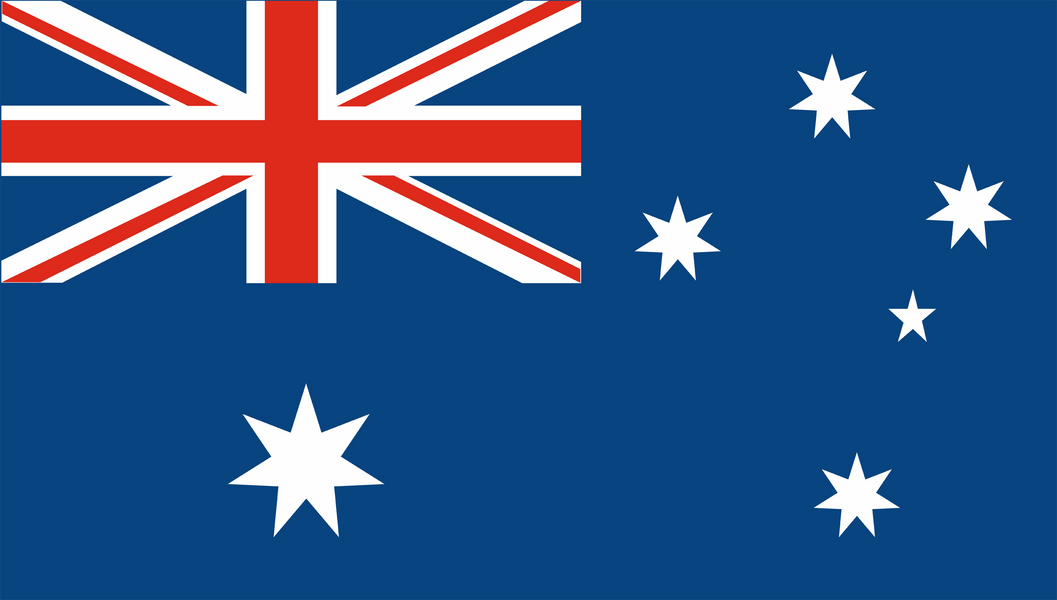
The Australian flag is dark blue with the British Union Flag in the top left corner, showing the country was once a British colony. Below it is the large white Commonwealth Star with seven points, one for each of the six states plus one for the territories.
On the right are five white stars in the pattern of the Southern Cross, a constellation you can only see properly from the southern half of the world. Sailors used it to find south long before compasses were reliable.