
United States
The United States is a country of 50 states that stretches from the Atlantic to the Pacific, plus Alaska in the Arctic and Hawaii in the middle of the ocean.
- CapitalWashington, D.C.Not part of any state
- PopulationAbout 335 millionThird most populous country in the world
- Area9,833,520 km2Third or fourth largest, depending how you count
- States50Plus one federal district and five territories
The mainland United States has almost every landscape there is: the Appalachian Mountains in the east, the enormous flat Great Plains through the middle, the Rocky Mountains in the west, deserts in the south-west and rainforest along the Pacific north-west coast.
Two states sit apart from the rest. Alaska, bought from Russia in 1867, is by far the largest state and reaches into the Arctic. Hawaii is a chain of volcanic islands roughly 4,000 km out in the Pacific and is the only US state made entirely of islands.
National symbols
- National bird Bald eagle
- National colours Red, white and blue
- National anthem The Star-Spangled Banner
- National day Independence Day, 4 July
Map of United States
Geography
The United States covers 9,833,520 km2 and borders Canada to the north and Mexico to the south, with the Atlantic, Pacific and Arctic Oceans and the Gulf of Mexico around it.
The Rocky Mountains run down the west, the older and lower Appalachians down the east, and the Great Plains fill the space between. The Mississippi River system drains most of the interior. Denali in Alaska is the highest point at 6,190 m, and Death Valley is the lowest at 86 m below sea level.
Climate
The country is so large that it holds almost every climate. Alaska is Arctic, Florida and Hawaii are tropical, the south-west is hot desert, the north-east has cold snowy winters and the Pacific north-west is mild and rainy.
The flat middle of the country is where warm air from the Gulf meets cold air from Canada, which is why the United States gets more tornadoes than anywhere else on Earth, around 1,200 a year. Hurricanes strike the southern and eastern coasts between June and November.
Culture
English is the main language although the country has no official language at national level. Spanish is spoken by over 40 million people.
The United States has taken in more immigrants than any other nation, and its music has spread worldwide: jazz, blues, country, rock and roll and hip hop all began here. About 63 per cent of Americans are Christian and around 29 per cent report no religion.
Economy
The United States has the largest economy in the world. Its strength is in services: technology, finance, healthcare and entertainment, with Silicon Valley and Hollywood both American inventions.
It is also a farming superpower, the largest exporter of maize and soybeans, and since about 2018 the biggest oil producer on Earth thanks to shale drilling.
The flag
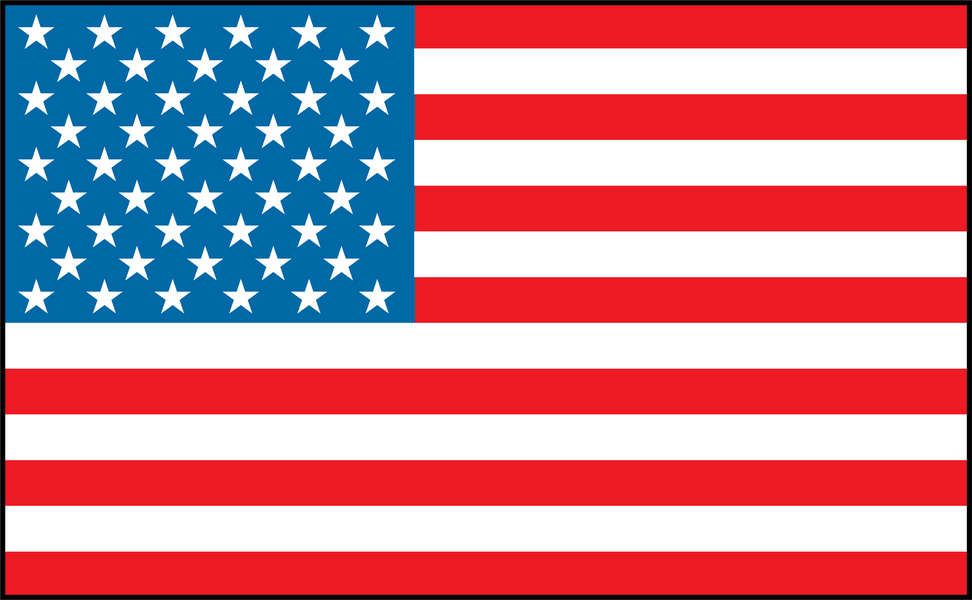
The flag has 13 horizontal stripes, alternating red and white, one for each of the original colonies that declared independence from Britain in 1776.
In the top left corner, a blue rectangle holds 50 white stars, one for every state. The design changes whenever a state joins, and it has been altered 27 times. The current version dates from 1960, when Hawaii became the fiftieth state.