
Trinidad and Tobago
Trinidad and Tobago invented the steelpan, the only entirely new acoustic instrument created anywhere in the twentieth century.
- CapitalPort of SpainOn the north-west coast of Trinidad
- PopulationAbout 1.4 millionTwo islands, one country
- Area5,130 km2Trinidad is much the larger island
- InventionThe steelpanMade from oil drums in the 1930s and 40s
Trinidad lies only 11 km off the coast of Venezuela and was once joined to South America, which is why its plants and animals are South American rather than Caribbean. Tobago, 30 km to the north-east, is smaller, quieter and ringed by reef.
The steelpan was developed in Trinidad in the 1930s and 40s, when people found that hammering dents into the end of a discarded oil drum produced different notes. It grew into a full orchestral instrument, and steelband competitions are the centrepiece of Carnival.
National symbols
- National birds Scarlet ibis and cocrico, one from each island
- National flower Chaconia, the wild poinsettia
- National anthem Forged from the Love of Liberty
- National day Independence Day, 31 August
Map of Trinidad and Tobago
Geography
Trinidad and Tobago covers 5,130 km2 and has no land borders, lying just off the north-east coast of Venezuela at the southern end of the Caribbean.
Trinidad has three low mountain ranges, the highest being El Cerro del Aripo at 940 m, with plains and swamps between them. Tobago is a single ridge of hills, and its Main Ridge Forest Reserve, protected since 1776, is one of the oldest legally protected forests in the world.
Climate
The islands are tropical, warm all year at around 24C to 32C, with a dry season from January to May and a wet season from June to December.
Trinidad and Tobago lie south of the main hurricane belt, so direct hits are rare compared with the rest of the Caribbean, though heavy rain and flooding are common.
Culture
English is the official language, and Trinidadian Creole is widely spoken. The population is split fairly evenly between people of Indian and of African descent, with a large mixed population as well.
That mix means Diwali, Eid and Christmas are all national holidays. The food reflects it too: doubles, a curried chickpea sandwich in fried bread, is the national street food. Around 55 per cent are Christian and around 18 per cent Hindu.
Economy
Oil and especially natural gas dominate. Trinidad and Tobago is one of the largest exporters of liquefied natural gas in the Americas and a major producer of ammonia and methanol.
That makes it one of the wealthiest countries in the Caribbean, and unlike its neighbours it does not depend heavily on tourism, though Tobago attracts visitors for its beaches and reefs.
The flag
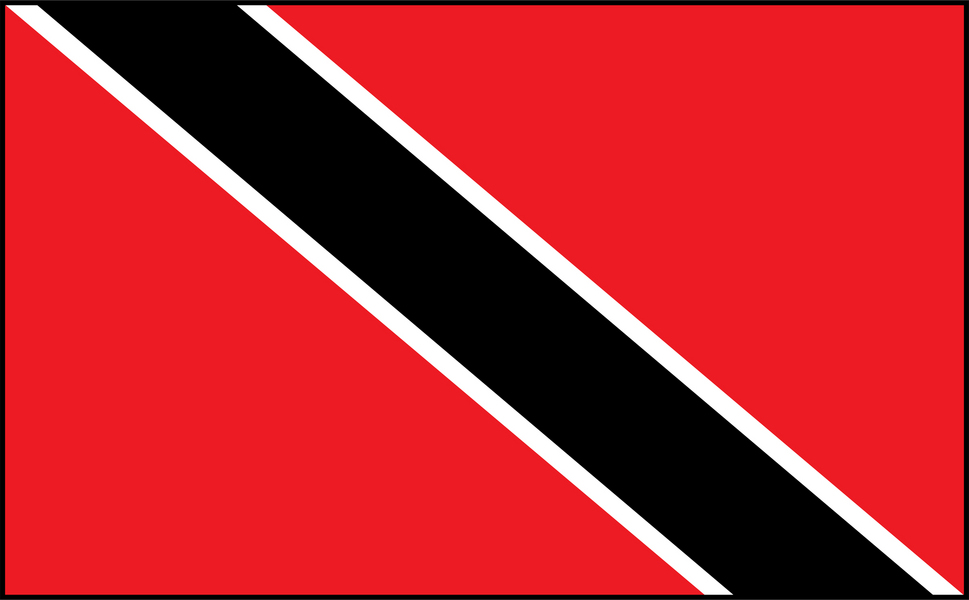
A red field with a black diagonal band, edged in white, running from the top left corner to the bottom right.
Red stands for the sun and the warmth of the people, black for the strength and unity of the land and the wealth beneath it, and white for the sea and for equality. Together the three colours are said to represent earth, water and fire.