
Saint Vincent and the Grenadines
Saint Vincent and the Grenadines is one main island plus a chain of 32 smaller ones, and its volcano erupted violently as recently as 2021.
- CapitalKingstownKnown for its arched stone walkways
- PopulationAbout 110,000Spread over 9 inhabited islands
- Area389 km2One main island plus 32 islands and cays
- La SoufriereErupted in 2021Forced around 20,000 people to evacuate
Saint Vincent is the large volcanic island at the north, steep and forested, dominated by La Soufriere volcano. Trailing south from it are the Grenadines: small, low, dry islands with white beaches and clear water, including Bequia, Mustique and Union Island.
La Soufriere erupted explosively in April 2021, covering the northern half of Saint Vincent in ash and forcing tens of thousands from their homes. It had also erupted in 1902 and 1979.
National symbols
- National bird Saint Vincent amazon parrot, found nowhere else
- National tree Soufriere tree
- National anthem Saint Vincent, Land So Beautiful
- National day Independence Day, 27 October
Map of Saint Vincent and the Grenadines
Geography
The country covers 389 km2 and has no land borders, lying in the Windward Islands between Saint Lucia and Grenada.
Saint Vincent is volcanic and steep, rising to La Soufriere at 1,234 m, an active volcano. The Grenadines to the south are much smaller and flatter, mostly coral and old volcanic rock, and the waters between them are among the best sailing grounds in the Caribbean.
Climate
The islands are tropical, warm all year at around 24C to 30C, cooled by trade winds.
The dry season runs January to May and the wet season June to November, which overlaps hurricane season. The mountainous interior of Saint Vincent gets far more rain than the Grenadines, which are noticeably dry.
Culture
English is the official language, with Vincentian Creole spoken day to day. The Garifuna, descended from Caribs and Africans, originated here before most were deported to Central America in 1797.
Around 82 per cent of the population is Christian. Vincy Mas, the national carnival, takes place in late June and July. Cricket and football are the main sports.
Economy
Tourism, especially yachting around the Grenadines, is the largest earner, with Mustique attracting very wealthy visitors.
Bananas were once the dominant export and are still grown, along with arrowroot, of which Saint Vincent is one of the world's main producers. Money sent home from abroad is significant.
The flag
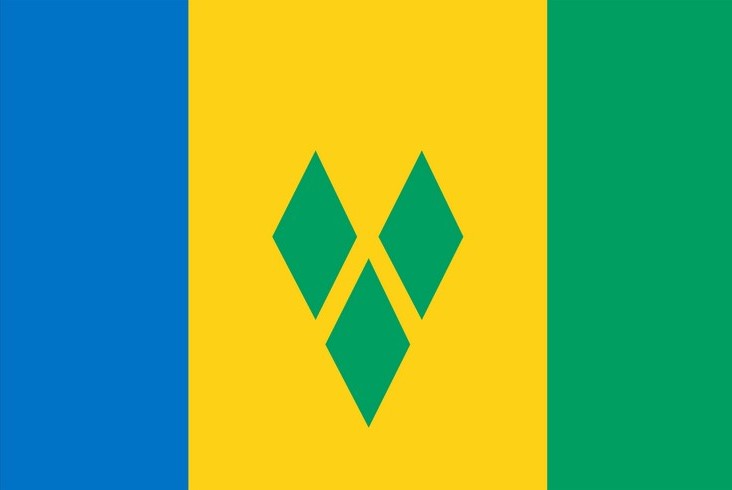
Three vertical bands: blue for the sky and sea, gold for the sand, warmth and spirit of the people, and green for the lush vegetation.
On the gold band sit three green diamonds arranged in a V, standing for Vincent. They also represent the islands as gems, which is why the country is nicknamed the Gems of the Antilles.