
Saint Kitts and Nevis
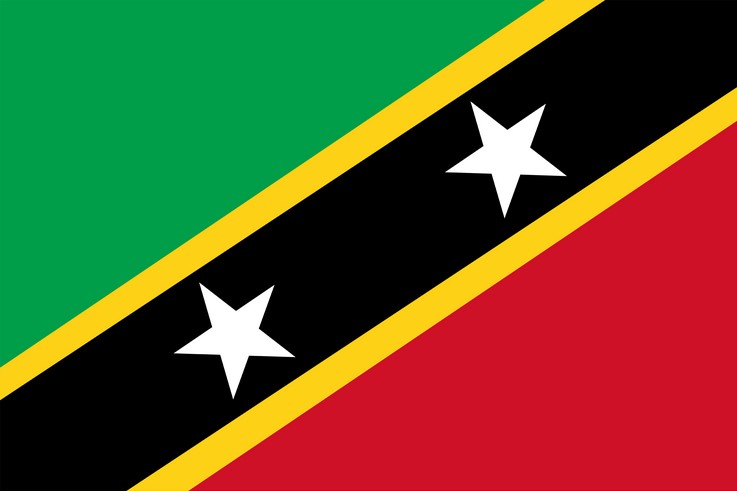
Saint Kitts and Nevis is the smallest country in the Americas by both area and population, and it was the first British colony in the Caribbean.
- CapitalBasseterreOn Saint Kitts
- PopulationAbout 47,000The smallest population in the Americas
- Area261 km2The smallest country in the Americas
- Founded1623The first English colony in the Caribbean
The country is two volcanic islands separated by a 3 km channel called The Narrows. Saint Kitts is the larger, with the dormant volcano Mount Liamuiga rising to 1,156 m and a crater lake in its summit. Nevis is smaller and almost circular, dominated by a single peak usually wrapped in cloud.
Saint Kitts was where England founded its first Caribbean colony in 1623, and France settled soon after, so the island was shared and fought over for a century and a half. Brimstone Hill Fortress, built by enslaved Africans over a hundred years, still stands 230 m above the sea.
National symbols
- National bird Brown pelican
- National flower Poinciana, the flamboyant tree
- National anthem O Land of Beauty!
- National day Independence Day, 19 September
Map of Saint Kitts and Nevis
Geography
Saint Kitts and Nevis covers 261 km2 and has no land borders, lying in the Leeward Islands of the eastern Caribbean.
Both islands are volcanic. Mount Liamuiga on Saint Kitts is the highest point at 1,156 m and has a crater lake at its summit. Nevis Peak reaches 985 m. The two are separated by The Narrows, a shallow channel about 3 km wide.
Climate
The islands are tropical, warm all year at around 24C to 30C, moderated by trade winds.
The wet season runs May to November, overlapping hurricane season, and the higher slopes are noticeably wetter and cooler than the coast.
Culture
English is the official language and Saint Kitts Creole is spoken informally. Most people are of West African descent.
Around 75 per cent are Christian, mainly Anglican and Methodist. Carnival runs from Christmas to early January, and the Nevis version, Culturama, takes place in summer. Cricket is the leading sport.
Economy
The sugar industry, which ran for 350 years, closed in 2005. Tourism replaced it, along with offshore financial services.
The country pioneered citizenship by investment in 1984, offering a passport in exchange for investment in the country, and it remains a significant source of government income.
The flag
A black diagonal band edged with yellow runs from the bottom left to the top right, dividing a green triangle at the top left from a red triangle at the bottom right.
Green stands for the fertile land, red for the struggle against slavery and colonialism, yellow for year-round sunshine and black for the African heritage of the people. The two white stars stand for hope and liberty, and for the two islands.