
Panama
Panama is where the Americas pinch together into a strip barely 60 km wide, and a canal cut through it lets ships skip a 13,000 km voyage around South America.
- CapitalPanama CityA skyline of towers beside the canal entrance
- PopulationAbout 4.5 millionRoughly half live in and around the capital
- Canal length82 kmLinks the Atlantic and Pacific Oceans
- CurrencyBalboa and US dollarBoth are legal tender at par
Panama is the narrowest point of the land bridge joining North and South America, which is why the canal was built here. Ships are lifted 26 m up into a man-made lake by giant locks, cross the isthmus, then are lowered back down on the other side.
The canal opened in 1914 after decades of work and enormous loss of life, mostly to malaria and yellow fever. Around 14,000 ships pass through it each year, and Panama took full control of it from the United States in 1999.
National symbols
- National bird Harpy eagle, one of the most powerful birds of prey alive
- National flower Flor del Espiritu Santo, the holy ghost orchid
- National anthem Himno Istmeno (Translation: Isthmus Hymn)
- National day Separation Day, 3 November
Map of Panama
Geography
Panama covers 75,417 km2 and borders Costa Rica and Colombia, with the Caribbean Sea to the north and the Pacific Ocean to the south. At its narrowest the country is only about 60 km across.
Mountains run along much of its length, rising to the Baru volcano at 3,475 m. The Darien Gap on the Colombian border is such dense roadless swamp and jungle that it breaks the Pan-American Highway, the only gap in a road running from Alaska to Argentina.
Climate
Panama is tropical, hot and humid all year, generally 24C to 32C, with the Caribbean side wetter than the Pacific side.
The dry season runs roughly December to April. Panama lies just south of the main hurricane track, so it is hit far less often than its northern neighbours, which is part of why the canal was safe to build here.
Culture
Spanish is the official language and English is widely used in business. Seven Indigenous peoples live in Panama, and the Guna of the San Blas islands govern themselves.
Guna women make molas: layered fabric panels cut and stitched into bold patterns of animals and shapes, now collected worldwide as art. Around 85 per cent of Panamanians are Christian.
Economy
The canal is the centre of everything. Tolls, plus the huge free trade zone at Colon and the shipping registry (more ships fly the Panamanian flag than any other), make Panama a trade and services economy.
Banking, copper mining and tourism follow. Bananas, coffee and shrimp are the main agricultural exports.
The flag
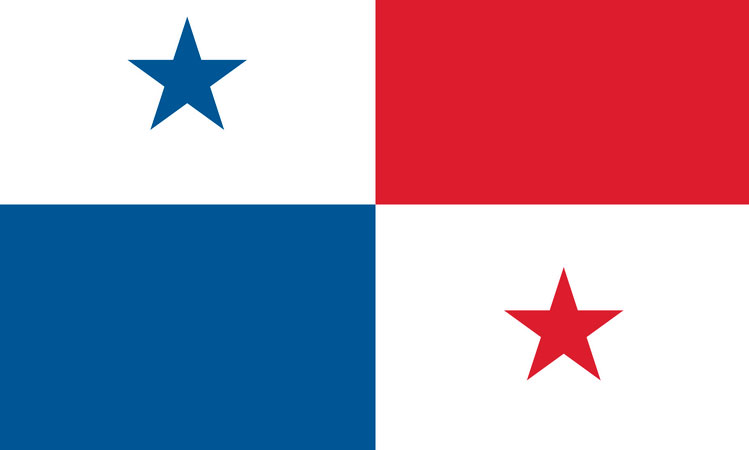
The flag is divided into four equal rectangles. The top left is white with a blue star, the top right is plain red, the bottom left is plain blue, and the bottom right is white with a red star.
Blue and red stood for Panama's two main political parties, and the white between them for the peace they agreed to keep. The blue star represents purity and honesty in public life, and the red star authority and law.