
Nicaragua
Nicaragua is the largest country in Central America, and its biggest lake contains an island made of two volcanoes joined together.
- CapitalManaguaOn the shore of Lake Managua
- PopulationAbout 7 millionMostly on the Pacific side
- Area130,373 km2The largest country in Central America
- Lake Nicaragua8,264 km2The largest lake in Central America
A chain of volcanoes runs down the Pacific side of Nicaragua, and beside them lie two great lakes, Managua and Nicaragua. Ometepe island rises out of Lake Nicaragua and is formed from two volcanoes whose lava flows eventually joined into a figure of eight.
The Caribbean side is completely different: a wide, wet, thinly populated coastal plain covered in rainforest, where English Creole and Indigenous Miskito are spoken more than Spanish.
National symbols
- National bird Turquoise-browed motmot, called the guardabarranco
- National flower Sacuanjoche, the frangipani
- National anthem Salve a ti, Nicaragua (Translation: Hail to Thee, Nicaragua)
- National day Independence Day, 15 September
Map of Nicaragua
Geography
Nicaragua covers 130,373 km2 and borders Honduras and Costa Rica, with the Pacific Ocean to the west and the Caribbean Sea to the east.
A volcanic chain runs parallel to the Pacific coast beside a low depression holding Lake Managua and Lake Nicaragua. Central highlands rise behind, and the eastern half slopes away into the flat, forested Mosquito Coast.
Climate
The Pacific side is hot with a clear dry season from November to April. The central highlands are cooler and more comfortable.
The Caribbean side is one of the wettest places in Central America, with over 4,000 mm of rain a year in places and no real dry season. Hurricanes strike the Caribbean coast most years.
Culture
Spanish is the official language. On the Caribbean coast, Creole English, Miskito and other Indigenous languages have official status regionally.
Nicaragua is proud of the poet Ruben Dario, who changed Spanish poetry worldwide. Baseball is the national sport, unusually for Central America. Around 85 per cent of Nicaraguans are Christian.
Economy
Farming is the backbone: coffee, beef, sugar, peanuts and beans are the main exports, along with gold from mines in the north.
Clothing factories in free trade zones supply the United States. Nicaragua is one of the poorer countries in the Americas, and money sent home from abroad is an important source of income for many families.
The flag
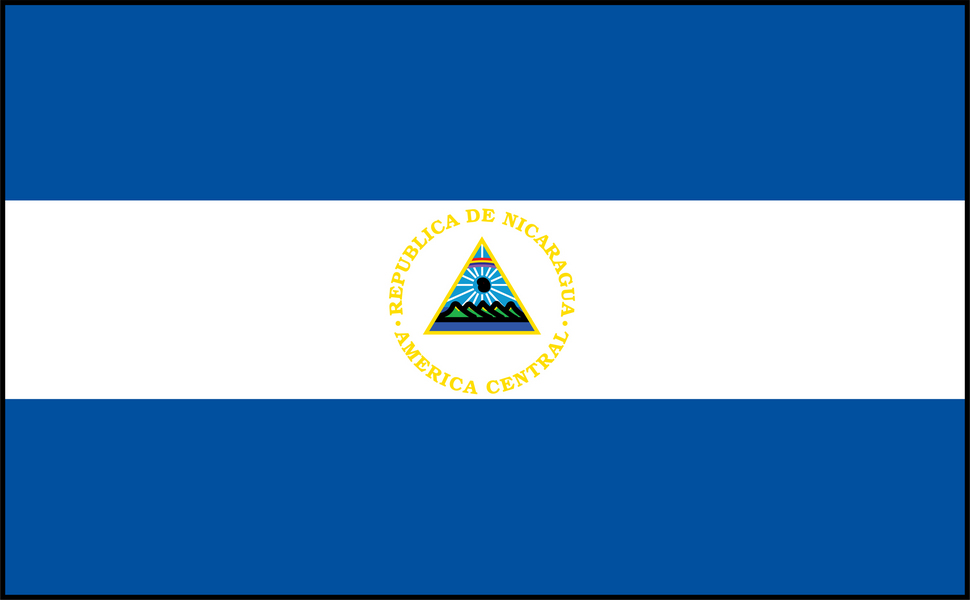
Two blue horizontal bands with white between them, matching the flag of the old Central American federation. The blue stands for the two oceans and the white for the land between them.
The coat of arms in the centre is a triangle containing five volcanoes standing in the sea, a red liberty cap, and a rainbow arching over the top. The triangle stands for equality, and the rainbow for peace.