
Mexico
Mexico gave the world chocolate, chillies, tomatoes, maize and avocados, and it holds the ruins of some of the greatest cities of the ancient Americas.
- CapitalMexico CityBuilt on the ruins of the Aztec capital Tenochtitlan
- PopulationAbout 129 millionThe largest Spanish-speaking country on Earth
- Area1,964,375 km2Third largest in Latin America
- LanguagesSpanish plus 68 IndigenousAll recognised as national languages
Mexico is mostly high ground. A great central plateau sits between two mountain ranges, the Sierra Madre Occidental and Oriental, and Mexico City itself is over 2,200 m above sea level. To the south lie tropical forests, and two long peninsulas reach out: Baja California in the north-west and Yucatan in the south-east.
Before the Spanish arrived in 1519, Mexico was home to the Olmec, Maya, Zapotec, Toltec and Aztec civilisations. They built stone pyramids, tracked the stars closely enough to predict eclipses, and invented a writing system and a calendar.
National symbols
- National bird Golden eagle
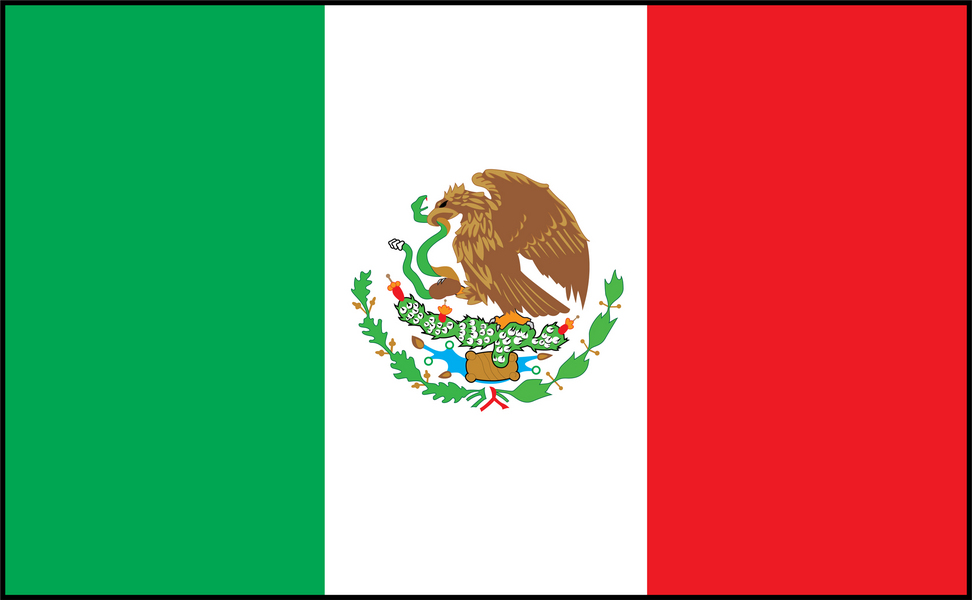
- National colours Green, white and red
- National anthem Himno Nacional Mexicano (Translation: Mexican National Anthem)
- National day Independence Day, 16 September
Map of Mexico
Geography
Mexico covers 1,964,375 km2 and borders the United States to the north and Guatemala and Belize to the south, with the Pacific Ocean to the west and the Gulf of Mexico and Caribbean Sea to the east.
Two mountain chains frame a high central plateau. The highest point is the volcano Pico de Orizaba at 5,636 m. The Yucatan Peninsula is flat limestone riddled with cenotes: deep natural sinkholes filled with clear fresh water, which the Maya treated as sacred.
Climate
The Tropic of Cancer cuts across Mexico, so the north is largely desert and dry scrub while the south is tropical. Altitude matters as much as latitude: Mexico City stays mild all year despite being in the tropics.
The rainy season runs from May to October across most of the country. Hurricanes can strike both coasts, and Mexico sits on active fault lines, so earthquakes are a real danger in the capital.
Culture
Spanish is the main language, and Mexico has more Spanish speakers than any other country. Alongside it, 68 Indigenous languages are officially recognised, including Nahuatl and Maya.
The Day of the Dead, on 1 and 2 November, is when families build altars, decorate graves with marigolds and remember relatives who have died. It is a celebration rather than a mourning. Around 78 per cent of Mexicans are Catholic.
Economy
Mexico manufactures on a huge scale, especially cars and electronics, much of it in factories near the American border that supply the United States.
It is also a leading exporter of avocados, tomatoes, berries and tequila, which by law can only be made from blue agave grown in specific regions. Oil, silver and tourism to Cancun and the Riviera Maya complete the picture.
The flag
Three vertical bands of green, white and red. Green originally stood for independence, white for the Catholic faith and red for union, though the meanings are now usually given as hope, unity and the blood of national heroes.
The centre carries the coat of arms: a golden eagle standing on a prickly pear cactus, holding a rattlesnake in its beak and claw. This is the Aztec legend of where to found their capital, and the sign was said to have appeared on an island in Lake Texcoco, exactly where Mexico City now stands.