
Jamaica
Jamaica gave the world reggae music, and for an island of under 3 million people it has produced an extraordinary number of the fastest sprinters in history.
- CapitalKingstonThe seventh largest natural harbour in the world
- PopulationAbout 2.8 millionThird largest island in the Caribbean
- Area10,991 km2About the size of Northern Ireland
- Sprint recordsWorld records in the 100 mHeld by Jamaican athletes
Jamaica is mountainous, with the Blue Mountains rising to 2,256 m in the east and limestone hills covering much of the rest. The Cockpit Country in the north-west is a maze of sinkholes and steep cone-shaped hills, so difficult to cross that escaped enslaved people, the Maroons, held out there against British forces and won their freedom by treaty.
Music runs through everything. Ska came first, then rocksteady, then reggae in the late 1960s, and Bob Marley carried it worldwide. Dancehall grew out of it later and still shapes pop music globally.
National symbols
- National bird Red-billed streamertail hummingbird, called the doctor bird
- National fruit Ackee, which is poisonous until it ripens and opens by itself
- National anthem Jamaica, Land We Love
- National day Independence Day, 6 August
Map of Jamaica
Geography
Jamaica covers 10,991 km2 and has no land borders. It lies about 145 km south of Cuba in the Caribbean Sea, and is the third largest island in the Caribbean.
The Blue Mountains in the east reach 2,256 m at Blue Mountain Peak. Most of the rest of the island is limestone, worn into caves, sinkholes and the strange rounded hills of the Cockpit Country. Narrow coastal plains hold the towns and beaches.
Climate
Jamaica is tropical, warm all year at around 25C to 32C on the coast, and noticeably cooler in the Blue Mountains where it can drop below 10C at night.
There are two rainy peaks, in May and October. Hurricane season runs June to November, and Jamaica has been hit hard several times, notably by Hurricane Gilbert in 1988.
Culture
English is the official language, and Jamaican Patois, an English-based creole with West African grammar, is what people speak among themselves.
Rastafari began in Jamaica in the 1930s and shaped reggae, its language and its imagery. Around 68 per cent of Jamaicans are Christian. Jerk cooking, meat rubbed with allspice and scotch bonnet chilli and smoked slowly over pimento wood, is a Jamaican invention.
Economy
Tourism is the largest earner, focused on the north coast resorts around Montego Bay, Negril and Ocho Rios.
Bauxite and alumina, used to make aluminium, have been mined for decades. Sugar, rum, coffee and yams are exported, and money sent home by Jamaicans abroad is a major part of the economy.
The flag
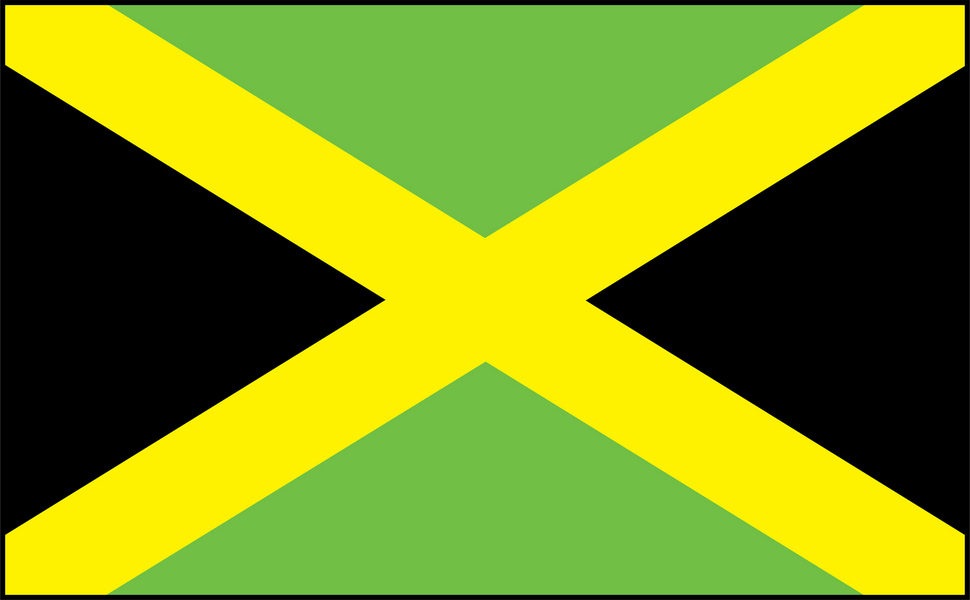
A gold diagonal cross splits the flag into four triangles: green at the top and bottom, black at the left and right.
Gold stands for sunshine and the country's natural wealth, green for the land and hope, and black for the strength and creativity of the people in overcoming hardship. It is the only national flag in the world containing none of the colours red, white or blue.