
Honduras
Honduras has the second largest barrier reef in the world just off its coast, and the ruined Maya city of Copan is covered in the finest stone carving the Maya ever made.
- CapitalTegucigalpaSet in a mountain valley about 1,000 m up
- PopulationAbout 10.6 millionMostly in the western highlands
- Area112,492 km2Second largest country in Central America
- ReefMesoamerican Barrier ReefSecond largest reef system on Earth
Honduras is mountainous almost everywhere, with narrow coastal plains on the Caribbean in the north and a short Pacific coast in the south. The interior is a jumble of ridges and valleys, and most Hondurans live in the western highlands.
Copan, near the Guatemalan border, was a Maya city famous for sculpture. Its hieroglyphic stairway carries the longest Maya inscription ever found, over 2,000 glyphs telling the story of the city's kings.
National symbols
- National bird Scarlet macaw
- National flower Orchid Rhyncholaelia digbyana
- National anthem Himno Nacional de Honduras
- National day Independence Day, 15 September
Map of Honduras
Geography
Honduras covers 112,492 km2 and borders Guatemala, El Salvador and Nicaragua, with a long Caribbean coast to the north and a short Pacific one on the Gulf of Fonseca.
Around 80 per cent of the country is mountainous, rising to Cerro Las Minas at 2,870 m. The Mosquitia region in the east is a huge, thinly populated area of rainforest, swamp and savannah, sometimes called the Little Amazon of Central America.
Climate
The Caribbean lowlands are hot and wet all year. The highlands where most people live are much more comfortable, around 16C to 25C, because of the altitude.
The rainy season runs from May to November on the Pacific side and is longer on the Caribbean side. Hurricanes are a major hazard: Hurricane Mitch in 1998 destroyed a large part of the country's infrastructure.
Culture
Spanish is the official language. Indigenous groups including the Lenca, Miskito and Chorti keep their own languages, and the Garifuna, descended from Africans and Caribs, have their own language and music along the north coast.
Garifuna punta music and dance is recognised by UNESCO. Around 87 per cent of Hondurans are Christian, and football is the dominant sport.
Economy
Coffee is the largest export, grown on shaded highland slopes, and Honduras is one of the biggest coffee producers in Central America. Bananas, palm oil, shrimp and melons follow.
Clothing assembly plants supply the American market and employ large numbers of people. As in its neighbours, money sent home from Hondurans working abroad is a huge part of national income.
The flag
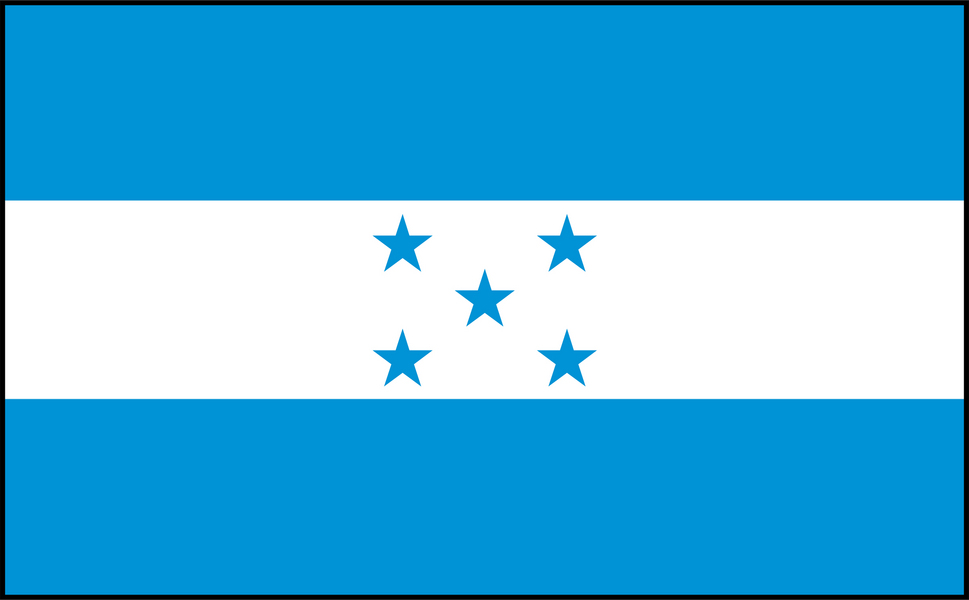
Two blue horizontal bands with a white one between them, the blue standing for the Caribbean Sea and the Pacific Ocean on either side of the country.
Five blue stars sit in an X pattern on the white band. They represent the five nations of the old Federal Republic of Central America, Honduras, Guatemala, El Salvador, Nicaragua and Costa Rica, and the hope that they might one day unite again.