
El Salvador
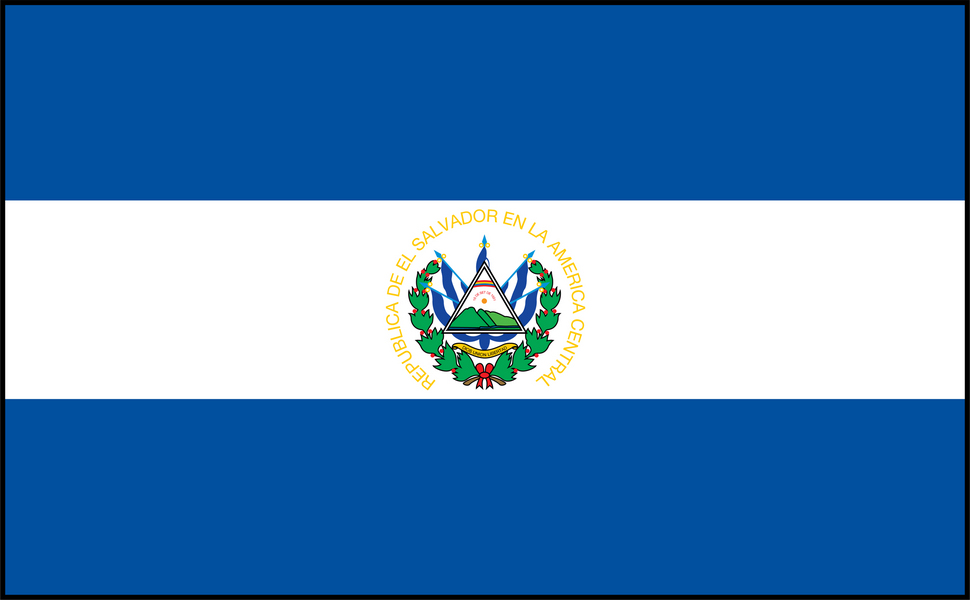
El Salvador is the smallest country in Central America and the only one with no Caribbean coast, and it is nicknamed the land of volcanoes.
- CapitalSan SalvadorOverlooked by the San Salvador volcano
- PopulationAbout 6.3 millionThe most densely populated country on the mainland Americas
- Area21,041 km2Smallest country in Central America
- VolcanoesAbout 20 potentially activeTwo appear on the coat of arms
El Salvador is small, crowded and volcanic. Two mountain ranges run east to west with a central plateau between them where most people live, and volcanoes rise along the southern range. The soil they produce is rich, which is why the country has been farmed intensively for centuries.
It is the only Central American country with no Caribbean coastline: the whole coast faces the Pacific. That coast has become well known among surfers for long, consistent right-hand waves.
National symbols
- National bird Torogoz, the turquoise-browed motmot
- National flower Izote, the yucca flower, whose petals are eaten in omelettes
- National anthem Himno Nacional de El Salvador
- National day Independence Day, 15 September
Map of El Salvador
Geography
El Salvador covers 21,041 km2 and borders Guatemala and Honduras, with the Pacific Ocean to the south. It has no Caribbean coast.
Two mountain ranges run across the country with a central plateau between. The southern range is volcanic, and Santa Ana is the highest point at 2,381 m. Lake Ilopango fills a huge volcanic crater whose eruption around 431 AD may have affected climate worldwide.
Climate
El Salvador is tropical, hot on the coastal plain and milder on the central plateau where most people live, around 22C to 28C.
The rainy season runs May to October and the dry season November to April. Sitting on a plate boundary, the country gets frequent earthquakes, and it is also exposed to Pacific storms and landslides.
Culture
Spanish is the official language. Nahuat, related to the Aztec language, survives with only a small number of elderly speakers, and there are efforts to teach it to children.
Pupusas, thick corn flatbreads stuffed with cheese, beans or pork, are the national dish and have their own national day. Around 84 per cent of Salvadorans are Christian.
Economy
El Salvador uses the US dollar as its currency, adopted in 2001. Clothing and textile factories are the largest exporters, supplying American brands.
Coffee and sugar remain important crops. As with its neighbours, money sent home by Salvadorans living in the United States is enormous, worth around a quarter of the entire economy.
The flag
Two blue horizontal bands with white between them, the standard Central American design, with blue for the Pacific Ocean and the sky and white for peace.
The coat of arms in the centre shows a triangle for equality, containing five volcanoes rising from the sea for the five original Central American states, a red liberty cap, and a rainbow. Around it runs the motto "Dios, Union, Libertad", meaning God, Union, Liberty.