
Dominican Republic
The Dominican Republic shares its island with Haiti, and it produces more Major League baseball players per person than any other country.
- CapitalSanto DomingoThe oldest continuously inhabited European city in the Americas
- PopulationAbout 11.3 millionShares Hispaniola with Haiti
- Area48,671 km2The eastern two thirds of Hispaniola
- Highest pointPico Duarte, 3,098 mThe highest mountain in the Caribbean
The Dominican Republic takes up the eastern two thirds of Hispaniola. It has the highest mountain in the whole Caribbean, Pico Duarte, and also the lowest point, Lake Enriquillo, a salt lake 46 m below sea level with crocodiles living in it.
Santo Domingo was founded in 1496 and is the oldest permanently occupied European settlement in the Americas. Its old quarter has the first cathedral, first university and first hospital built in the New World.
National symbols
- National bird Palmchat, which builds huge shared nests
- National flower Bayahibe rose
- National anthem Himno Nacional Dominicano
- National day Independence Day, 27 February
Map of Dominican Republic
Geography
The Dominican Republic covers 48,671 km2 and borders only Haiti, with the Atlantic Ocean to the north and the Caribbean Sea to the south.
Four mountain ranges cross the country. The Cordillera Central holds Pico Duarte at 3,098 m, the highest point in the Caribbean. Between the ranges lie fertile valleys, and the coast has long stretches of white sand that support the tourist industry.
Climate
The climate is tropical and warm all year, generally 23C to 31C, with sea breezes making the coast comfortable. The mountains are noticeably cooler and can even see frost at the top.
The rainy season runs from May to November, which is also hurricane season. The north coast gets more rain than the drier south-west.
Culture
Spanish is the official language. Dominican culture mixes Spanish, African and Taino roots, and merengue and bachata, both born here, are danced across Latin America.
Around 68 per cent of Dominicans are Catholic. Carnival in February fills the streets with masked devil characters called diablos cojuelos, who chase people with inflated bladders on strings.
Economy
Tourism is the largest industry, centred on Punta Cana and the north coast, and the country receives more visitors than any other Caribbean nation.
Mining matters too: the Pueblo Viejo gold mine is one of the largest in the world. Sugar, cocoa, coffee, tobacco and medical equipment made in free trade zones are the other main exports.
The flag
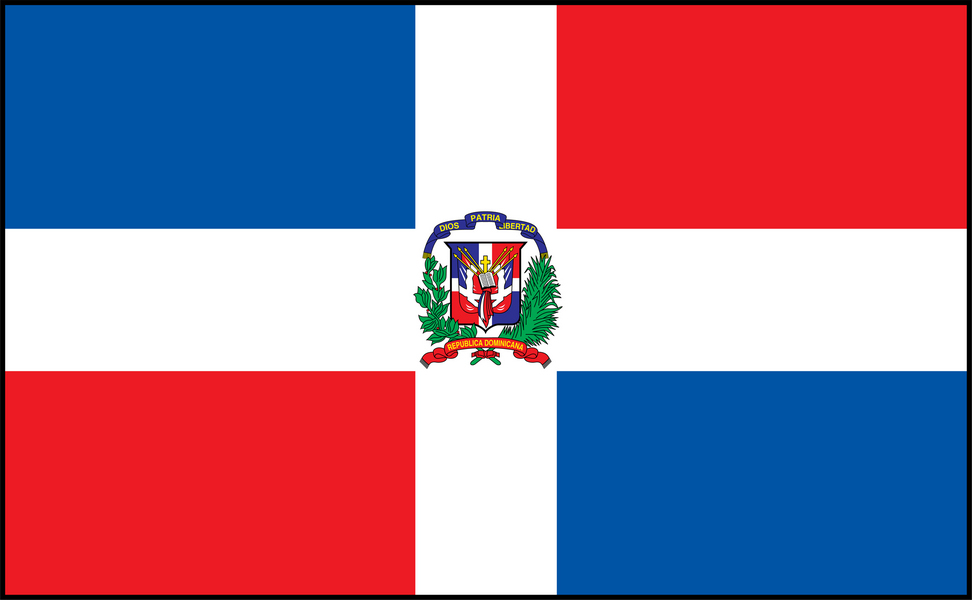
A white cross divides the flag into four rectangles: blue and red on the top row, red and blue below. The white cross stands for salvation, blue for liberty and red for the blood of heroes.
At the centre sits the coat of arms, showing an open Bible with a cross above it, flanked by a laurel branch and a palm frond. It is the only national flag in the world with a Bible on it.