
Cuba
Cuba is the largest island in the Caribbean, and its capital is full of 1950s American cars kept running for over 70 years.
- CapitalHavanaFounded by the Spanish in 1519
- PopulationAbout 11 millionThe most populous Caribbean island
- Area109,884 km2Largest island in the Caribbean
- LiteracyAround 99.8 per centOne of the highest rates in the world
Cuba is long and narrow, about 1,250 km from end to end but rarely more than 100 km wide. Most of it is gentle farmland and rolling hills, with mountains in the south-east where the Sierra Maestra rises to 1,974 m.
After the revolution of 1959, the United States placed a trade embargo on Cuba which is still largely in place. One visible result is that Cubans could not buy new American cars, so they kept the old ones going, rebuilding engines by hand for decade after decade.
National symbols
- National bird Cuban trogon, which has the flag colours in its feathers
- National flower Mariposa, a white ginger lily
- National anthem La Bayamesa
- National day Triumph of the Revolution, 1 January
Map of Cuba
Geography
Cuba covers 109,884 km2 and has no land borders. It lies about 145 km south of Florida, with the Gulf of Mexico to the west, the Atlantic to the north and the Caribbean Sea to the south.
Alongside the main island are the Isla de la Juventud and around 4,000 small keys and islets. The Sierra Maestra in the south-east holds the highest point, Pico Turquino, at 1,974 m. Elsewhere the land is mostly flat and good for farming.
Climate
Cuba is tropical, warm all year, typically 20C to 32C, with a dry season from November to April and a wet season from May to October.
Hurricanes are a serious threat between June and November. Cuba has built one of the most effective hurricane evacuation systems anywhere, and loses far fewer lives to storms than its neighbours.
Culture
Spanish is the official language. Cuban culture blends Spanish and West African roots, which is where its music comes from: son, rumba, mambo, cha-cha-cha and salsa all have Cuban origins.
Baseball, not football, is the national sport. Around half the population is Christian, mostly Catholic, and Santeria, a religion blending Yoruba beliefs from West Africa with Catholic saints, is widely practised.
Economy
Sugar cane dominated the Cuban economy for two centuries and is still grown, though production has fallen a long way. Tobacco for cigars, nickel and rum are the other traditional exports.
Today the biggest earners are medical services provided abroad, tourism, and money sent home by Cubans living overseas. The economy is largely state-run, and shortages of food, fuel and medicine are common.
The flag
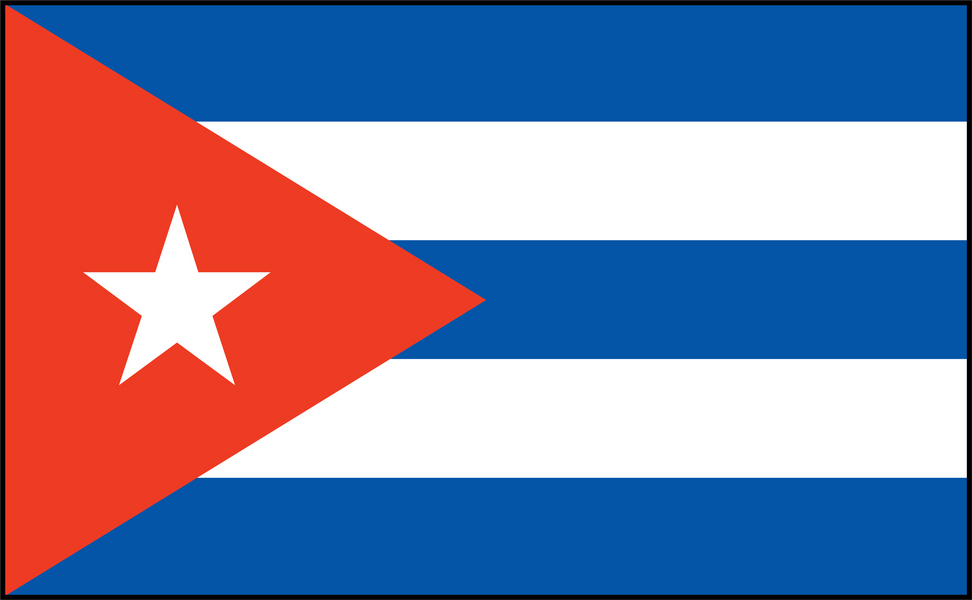
Three blue stripes and two white ones run horizontally, with a red triangle at the left-hand edge holding a single white five-pointed star.
The three blue stripes stood for the three regions Cuba was divided into under Spanish rule, and the white for the purity of the independence cause. The red triangle represents the blood shed for freedom, and the lone star gave Cuba its nickname, La Estrella Solitaria.