
Costa Rica
Costa Rica abolished its army in 1949 and spent the money on schools and hospitals instead, and it holds around 5 per cent of all the species on Earth.
- CapitalSan JoseIn the fertile Central Valley
- PopulationAbout 5.2 millionOne of the most stable countries in Latin America
- ArmyNone since 1949Abolished by the constitution
- BiodiversityAbout 5 per cent of all speciesOn 0.03 per cent of the world's land
Costa Rica is a narrow bridge of land between Nicaragua and Panama, with mountains and volcanoes running down its spine and rainforest, cloud forest and beaches on either side. Because it sits where North and South American wildlife meet, and has habitats from sea level to 3,800 m, it packs in an astonishing number of species.
In 1949, after a short civil war, Costa Rica wrote the abolition of its army into the constitution. The country has had no military for over 70 years, and puts a large share of its budget into education and healthcare instead.
National symbols
- National bird Yiguirro, the clay-coloured thrush
- National flower Guaria morada, a purple orchid
- National anthem Noble Patria, Tu Hermosa Bandera (Translation: Noble Homeland, Your Beautiful Flag)
- National day Independence Day, 15 September
Map of Costa Rica
Geography
Costa Rica covers 51,100 km2 and borders Nicaragua and Panama, with the Pacific Ocean to the west and the Caribbean Sea to the east.
Volcanic mountain chains run down the middle, rising to Cerro Chirripo at 3,821 m, and include active volcanoes such as Arenal and Poas. Between the ranges lies the Central Valley, where most Costa Ricans live and where the coffee grows.
Climate
Costa Rica is tropical, but altitude changes everything. The coasts are hot and humid while the Central Valley stays a pleasant 22C to 27C all year, which is why most people settled there.
The dry season runs from December to April on the Pacific side. The Caribbean coast is wet nearly all year. Cloud forests like Monteverde are permanently damp and cool, wrapped in mist that the trees drink directly.
Culture
Spanish is the official language. Costa Ricans call themselves Ticos, and their national saying is "pura vida", meaning pure life, used as hello, goodbye, thanks and no worries all at once.
Around 71 per cent of Costa Ricans are Christian, mostly Catholic. The country has one of the highest life expectancies in the Americas, and the Nicoya Peninsula is one of the world's few "blue zones" where unusual numbers of people live past 90.
Economy
Costa Rica moved away from relying on crops alone. Medical devices and microchips are now its largest exports, made in factories near San Jose.
Coffee, bananas and pineapples still matter, and Costa Rica is the world's biggest pineapple exporter. Ecotourism is the other pillar, built on national parks that cover about a quarter of the country.
The flag
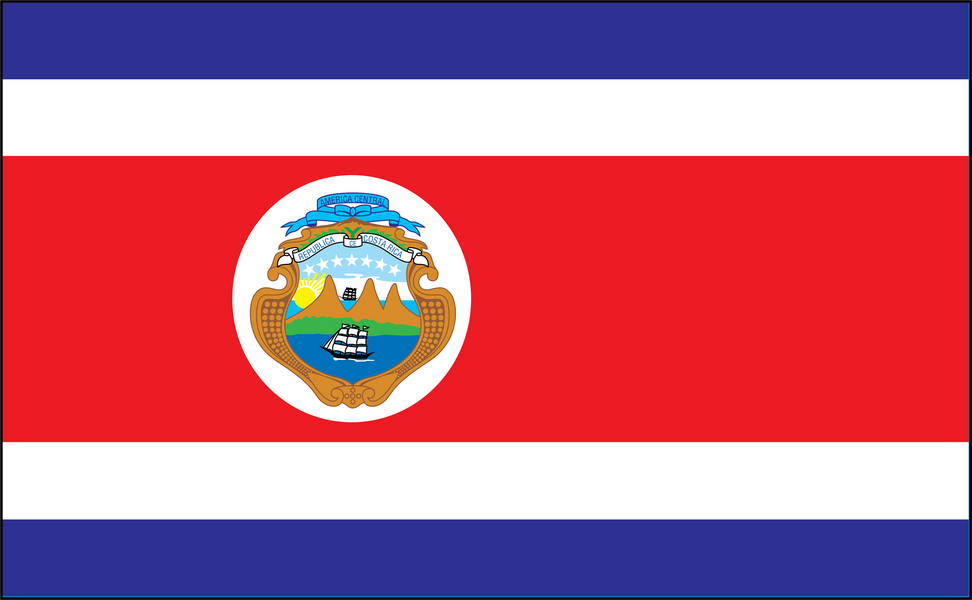
Five horizontal bands: blue, white, red, white, blue, with the red band twice the height of the others. Blue stands for the sky and opportunity, white for peace and wisdom, and red for the warmth of the people.
The red band was added in 1848 in sympathy with the French Revolution. The state version carries the coat of arms in a white oval, showing three volcanoes between two oceans, with merchant ships and seven stars for the seven provinces.