
Canada
Canada has the longest coastline of any country on Earth, more than 200,000 km, and more lakes than the rest of the world put together.
- CapitalOttawaChosen partly because it was easy to defend
- PopulationAbout 40 millionMost live within 160 km of the US border
- Area9,984,670 km2Second largest country in the world
- CoastlineOver 200,000 kmThe longest of any country
Canada is the second largest country on Earth but one of the emptiest. Almost everyone lives in a thin band along the southern border, because the north is a vast region of forest, tundra and frozen islands where very few people can live.
Between the Rocky Mountains in the west and the Atlantic in the east lie prairies, the Canadian Shield of ancient rock and boreal forest, and the Great Lakes, which Canada shares with the United States.
National symbols
- National animal Beaver, along with the Canadian horse
- National colours Red and white
- National anthem O Canada
- National day Canada Day, 1 July
Map of Canada
Geography
Canada covers 9,984,670 km2 and shares the longest land border in the world, 8,891 km, with the United States. Three oceans surround it: the Atlantic, Pacific and Arctic.
The Rocky Mountains run down the west, and Mount Logan in the Yukon is the highest point at 5,959 m. Central Canada is prairie, the north is tundra and Arctic islands, and the Canadian Shield, some of the oldest rock on the planet, wraps around Hudson Bay.
Climate
Winters are long and cold across most of the country, and much of Canada spends months under snow. Temperatures below minus 30C are normal on the prairies and in the north.
Summers are warm in the south, often reaching the high twenties. The Pacific coast around Vancouver is the mild exception, rainy but rarely freezing. The Arctic north stays frozen for most of the year and never gets truly warm.
Culture
English and French are both official languages. Quebec is majority French-speaking, and road signs, packaging and government services across the country appear in both languages.
Canada was one of the first countries to adopt official multiculturalism as policy. First Nations, Inuit and Metis peoples were here long before Europeans arrived. Ice hockey is the national winter sport and lacrosse the national summer sport.
Economy
Canada is a resource giant: oil from the Alberta oil sands, natural gas, timber from its vast forests, and metals including nickel, uranium, gold and potash.
It is also a major exporter of wheat and canola from the prairies, and produces around 70 per cent of the world's maple syrup, almost all of it from Quebec.
The flag
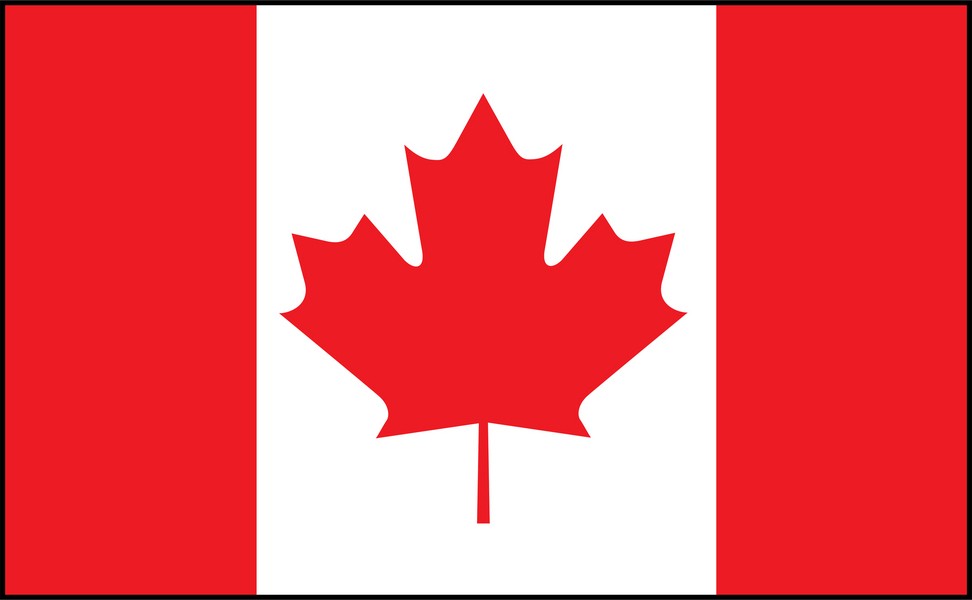
The Canadian flag has a red vertical band on each side and a white square in the middle holding a single red maple leaf with 11 points.
It is called the Maple Leaf and only dates from 1965. Before that, Canada used a flag based on the British ensign. The maple leaf had already been a Canadian symbol for over a century, and the 11 points have no particular meaning: they simply looked clearest when the flag was flapping in a wind tunnel test.