
Belize
Belize is the only country in Central America where English is the official language, and the Great Blue Hole off its coast is a perfectly round sinkhole 300 m across.
- CapitalBelmopanBuilt inland in 1970 after a hurricane wrecked the old capital
- PopulationAbout 410,000The smallest population in Central America
- Area22,966 km2Roughly the size of Wales
- LanguageEnglishThe only Central American country where it is official
Belize was British Honduras until 1973, which is why it speaks English while all its neighbours speak Spanish. It is small, thinly populated and heavily forested, with the Maya Mountains in the south and flat swampy land along the coast.
Just offshore lies the Belize Barrier Reef, part of the second largest reef system in the world. In the middle of it is the Great Blue Hole, a near-perfect circle of deep blue water 300 m wide and 125 m deep, formed when a cave roof collapsed during the last ice age.
National symbols
- National bird Keel-billed toucan
- National animal Baird's tapir, known locally as the mountain cow
- National anthem Land of the Free
- National day Independence Day, 21 September
Map of Belize
Geography
Belize covers 22,966 km2 and borders Mexico and Guatemala, with the Caribbean Sea to the east.
The north is flat and swampy, the south rises into the Maya Mountains, topping out at Doyle's Delight at 1,124 m. Offshore lie around 450 small islands called cayes, plus three of the four coral atolls found in the whole Atlantic Ocean.
Climate
Belize is tropical, hot and humid, generally 24C to 31C, with sea breezes cooling the coast.
The dry season runs February to May and the wet season June to November, which is also hurricane season. Hurricanes have hit hard enough to move the capital: Belmopan was built inland after Hurricane Hattie destroyed much of Belize City in 1961.
Culture
English is official, and Belizean Creole is spoken by most people day to day. Spanish, Garifuna, three Mayan languages and German (spoken by Mennonite farming communities) are all in everyday use.
The Garifuna, descended from Africans and Caribs, have a drumming and dance tradition recognised by UNESCO. Around 73 per cent of Belizeans are Christian, and Belize is a member of both Caricom and the Central American system.
Economy
Tourism is the biggest industry, built on diving the barrier reef, exploring Maya sites like Caracol and Xunantunich, and cruise ships calling at Belize City.
Sugar, bananas, citrus and marine products are the main exports. Belize also protects large tracts of forest and reef, which limits development but keeps the tourism draw intact.
The flag
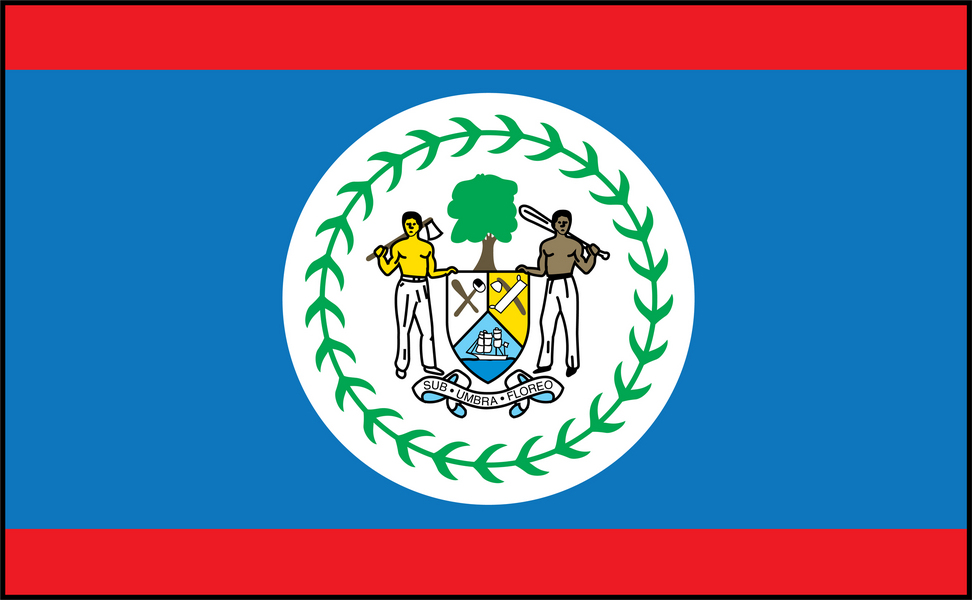
A royal blue field with a narrow red stripe along the top and bottom edges, and a large white disc in the centre.
Inside the disc, two woodcutters stand either side of a mahogany tree with their tools, one of African and one of mixed descent, under the motto "Sub Umbra Floreo", meaning I flourish in the shade. It is the only national flag showing human beings as its main feature.