
Bahamas
The Bahamas is around 700 islands and 2,400 tiny cays, and the sea between them is so clear and shallow that astronauts use it as a landmark from orbit.
- CapitalNassauOn New Providence island
- PopulationAbout 410,000Only about 30 islands are inhabited
- IslandsAbout 700Plus roughly 2,400 cays and rocks
- Dean's Blue Hole202 m deepOne of the deepest blue holes in the world
The Bahamas is not one island but a long archipelago stretching about 800 km, starting just 80 km off Florida. The islands are low and flat, made of limestone and sand rather than volcanic rock, and the highest point in the whole country is only 63 m.
The water is the main attraction. Vast shallow banks of pale turquoise surround the islands, dropping suddenly into deep blue trenches. Blue holes, flooded vertical caves formed during past ice ages, riddle the limestone.
National symbols
- National bird Caribbean flamingo
- National flower Yellow elder
- National anthem March On, Bahamaland
- National day Independence Day, 10 July
Map of Bahamas
Geography
The Bahamas covers 13,880 km2 of land spread across the western Atlantic, with no land borders. The nearest neighbours are the United States to the north-west and Cuba to the south.
All the islands are low and flat, built from limestone laid down by coral and shells. Mount Alvernia on Cat Island is the highest point at only 63 m. Andros, the largest island, has the third longest barrier reef in the world along its eastern edge.
Climate
The climate is subtropical, warm all year at around 21C to 32C, with the Gulf Stream keeping winters mild.
The wet season runs May to October, which overlaps hurricane season. Hurricane Dorian in 2019 stalled over Abaco and Grand Bahama as a category 5 storm and caused catastrophic damage.
Culture
English is the official language, with Bahamian Creole widely spoken. Most Bahamians are of West African descent, from people brought during the slave trade.
Junkanoo is the great national festival, held on Boxing Day and New Year's Day, with parades of costumed dancers, cowbells, goatskin drums and brass. Around 93 per cent of Bahamians are Christian.
Economy
Tourism is the economy, accounting for roughly half of everything the country earns. Cruise ships call at Nassau in enormous numbers, and Paradise Island resorts draw visitors from the United States.
Offshore banking and financial services are the second pillar. The Bahamas grows very little food and imports most of what it eats.
The flag
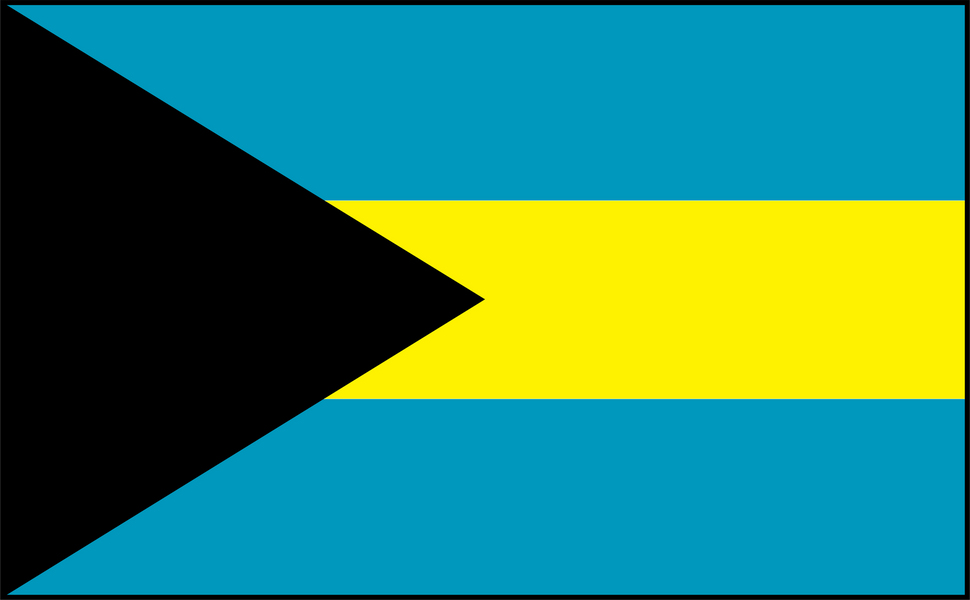
Three horizontal bands, aquamarine at top and bottom with gold in the middle, and a black triangle set against the left-hand edge.
The aquamarine stands for the sea, the gold for the sun and the sandy beaches, and the black triangle for the strength and unity of the Bahamian people, pointing towards the islands and their resources.