
Antigua and Barbuda
Antigua is said to have 365 beaches, one for every day of the year, and its Barbuda neighbour has one of the largest frigatebird colonies on Earth.
- CapitalSt. John'sA busy cruise ship port
- PopulationAbout 94,000Two main islands
- Area442 km2Antigua is the larger island
- BeachesSaid to be 365One for every day of the year
Antigua is low and rolling rather than mountainous, with a deeply indented coastline full of bays and natural harbours. That made it valuable to the Royal Navy, and Nelson's Dockyard in English Harbour is the only working Georgian naval dockyard left anywhere in the world.
Barbuda, 40 km to the north, is flat, dry and very thinly populated. Its lagoon holds a colony of several thousand magnificent frigatebirds, where the males inflate huge red throat pouches to attract mates.
National symbols
- National bird Magnificent frigatebird
- National flower Dagger log, the agave flower
- National anthem Fair Antigua, We Salute Thee
- National day Independence Day, 1 November
Map of Antigua and Barbuda
Geography
Antigua and Barbuda covers 442 km2 and has no land borders, lying in the eastern Caribbean at the meeting point of the Leeward Islands.
Antigua is mostly low limestone and coral with a volcanic south-western corner rising to Mount Obama at 402 m. Barbuda is flat coral island, almost entirely under 40 m. A third island, Redonda, is an uninhabited rocky outcrop.
Climate
The islands are tropical, warm all year at around 25C to 30C, with steady trade winds. They are among the drier Caribbean islands because there are few mountains to force rain out of the air.
The wet season runs June to November and coincides with hurricane season. Water shortages are a recurring problem and Antigua relies partly on desalination.
Culture
English is the official language and Antiguan Creole is widely spoken. Most people are of West African descent.
Around 77 per cent are Christian. Carnival in late July and early August celebrates the abolition of slavery in 1834. Sailing Week at Nelson's Dockyard is one of the biggest regattas in the Caribbean, and cricket is a passion.
Economy
Tourism is the dominant industry, providing well over half of the economy, with cruise ships, resorts and yachting all significant.
Offshore financial services and a citizenship-by-investment programme, where people can gain a passport by investing in the country, provide additional government income.
The flag
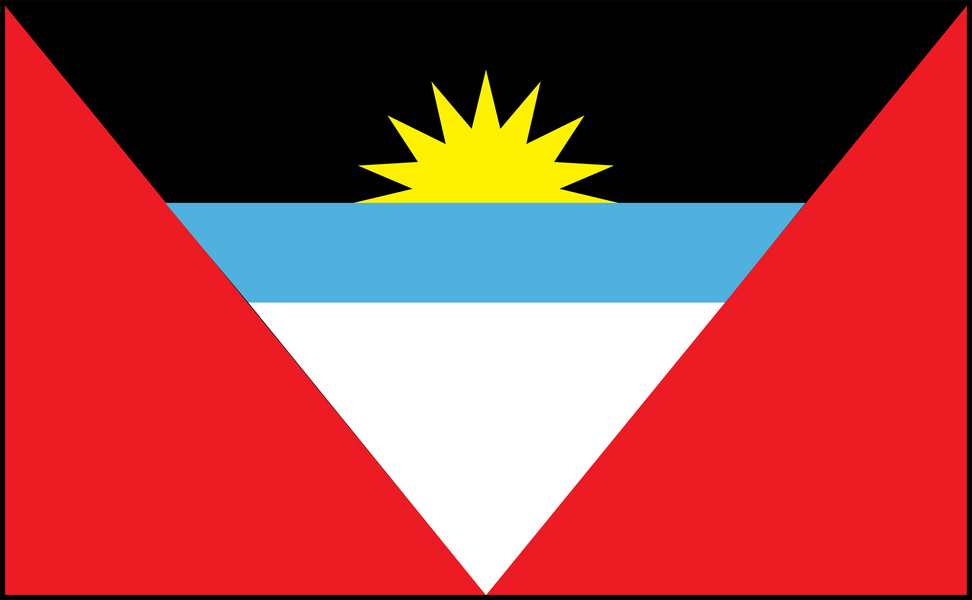
A red field with a large inverted triangle in the centre. Inside the triangle, from top to bottom, run black, light blue and white bands.
Rising out of the black band is a golden sun, marking the dawn of a new era at independence. Black stands for the African heritage of the people, blue for hope and the sea, white for the sand, and red for the energy of the people. The V shape stands for victory.