
Ukraine
Ukraine has some of the richest farmland on Earth, a deep black soil called chernozem, which is why it is known as the breadbasket of Europe.
- CapitalKyivFounded over 1,500 years ago
- PopulationAbout 38 millionReduced sharply by war and displacement
- Area603,550 km2The largest country entirely within Europe
- Black soilAbout a quarter of world reservesExceptionally fertile chernozem
Ukraine is mostly flat, open steppe and farmland, with the Carpathian Mountains in the west and the Crimean Mountains in the south. The Dnipro River runs the length of the country to the Black Sea.
Its soil is the reason it matters so much to the world's food supply. Chernozem is deep, dark and full of organic matter, and Ukraine holds roughly a quarter of the world's reserves of it. Before 2022 Ukraine supplied a large share of global exports of sunflower oil, wheat, maize and barley.
National symbols
- National symbol Tryzub, a golden trident used since medieval times
- National flower Sunflower, and the guelder rose
- National anthem Shche ne vmerla Ukrainy (Translation: Ukraine Has Not Yet Perished)
- National day Independence Day, 24 August
Map of Ukraine
Geography
Ukraine covers 603,550 km2 and borders Russia, Belarus, Poland, Slovakia, Hungary, Romania and Moldova, with the Black Sea and Sea of Azov to the south.
Most of the country is flat plain and steppe. The Carpathian Mountains in the far west rise to Hoverla at 2,061 m. The Dnipro River flows around 1,000 km through Ukraine and is dammed in several places for hydroelectric power.
Climate
Ukraine has a continental climate: cold winters, warm summers and rainfall spread across the year. Kyiv averages around minus 3C in January and 20C in July.
The southern Black Sea coast, including Crimea, is milder and closer to Mediterranean, which is why it was long used as a holiday region. The eastern steppe is drier and can suffer summer droughts.
Culture
Ukrainian is the official language, written in Cyrillic. Russian is also widely spoken, especially in the east and south, though use of Ukrainian has grown sharply since 2014.
Pysanky, intricately patterned wax-decorated Easter eggs, are a distinctive Ukrainian craft going back thousands of years. Borscht, a beetroot soup, is on the UNESCO heritage list as Ukrainian. Around 78 per cent of Ukrainians are Christian, mostly Orthodox.
Economy
Agriculture is central: wheat, maize, barley, rapeseed and above all sunflower oil, plus iron ore and steel from the industrial east.
Russia's full-scale invasion in 2022 caused enormous damage to industry, ports and infrastructure, and disrupted grain exports through the Black Sea, which pushed up food prices in many countries that depend on Ukrainian wheat.
The flag
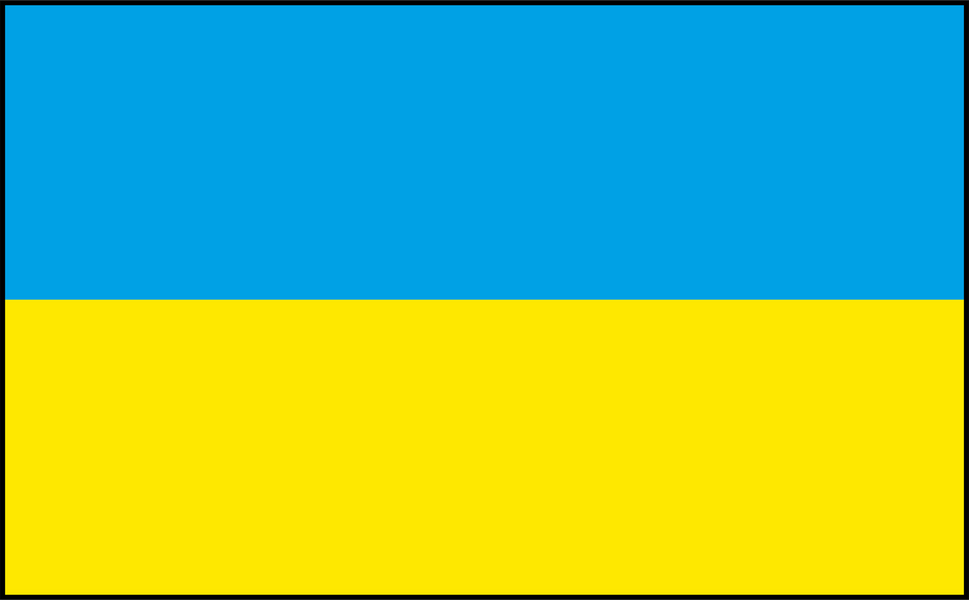
Two equal horizontal bands, blue above and yellow below. It is one of the simplest national flags in the world and one of the most literal.
The blue is the sky and the yellow is a field of ripe wheat beneath it, a direct picture of the Ukrainian landscape. The colours were used by Ukrainian movements from the 1800s, banned under Soviet rule, and restored in 1991.