
Slovenia
Slovenia is around 60 per cent forest, making it one of the greenest countries in Europe, and it has a heart-shaped lake with an island church in the middle.
- CapitalLjubljanaA car-free city centre
- PopulationAbout 2.1 millionOne of the smaller EU countries
- Area20,271 km2Around 60 per cent forest
- CoastlineAbout 47 kmOne of the shortest in Europe
Slovenia packs an unusual amount into a small space: the Julian Alps in the north-west, karst caves in the south-west, a short Adriatic coast, and rolling vineyards in the east. You can ski in the morning and swim in the sea the same afternoon.
The word karst, used worldwide for limestone landscapes full of caves and sinkholes, comes from the Kras region of Slovenia. Postojna Cave has over 24 km of passages and its own underground railway.
National symbols
- National animal Carniolan honeybee
- National flower Carnation
- National anthem Zdravljica (Translation: A Toast)
- National day Statehood Day, 25 June
Map of Slovenia
Geography
Slovenia covers 20,271 km2 and borders Italy, Austria, Hungary and Croatia, with a 47 km stretch of Adriatic coast.
The Julian Alps in the north-west include Triglav at 2,864 m, the country's highest peak and its national symbol. The south-west is classic karst: limestone riddled with caves, sinkholes and underground rivers. Forest covers around 60 per cent of the country.
Climate
Slovenia has three climates in a small space: alpine in the mountains, continental in the centre and east, and Mediterranean along the short coast.
Ljubljana averages around 0C in January and 21C in July. The mountains get heavy snow and support ski resorts, while the coast at Piran stays noticeably milder all year.
Culture
Slovene is the official language, and Italian and Hungarian are co-official in border areas. Slovene has a dual grammatical number, a separate form used for exactly two of something, which very few living languages still have.
Beekeeping is a national tradition: the Carniolan bee comes from here, painted beehive front panels are a folk art, and Slovenia proposed World Bee Day, now marked on 20 May. Around 73 per cent of Slovenes are Catholic.
Economy
Slovenia has the highest income per person of the countries that were part of Yugoslavia. Its economy is built on manufacturing: cars and car parts, pharmaceuticals, electrical equipment and machinery.
The port of Koper handles cargo for much of central Europe. Tourism focuses on Lake Bled, the Alps, the caves and the small coastal towns.
The flag
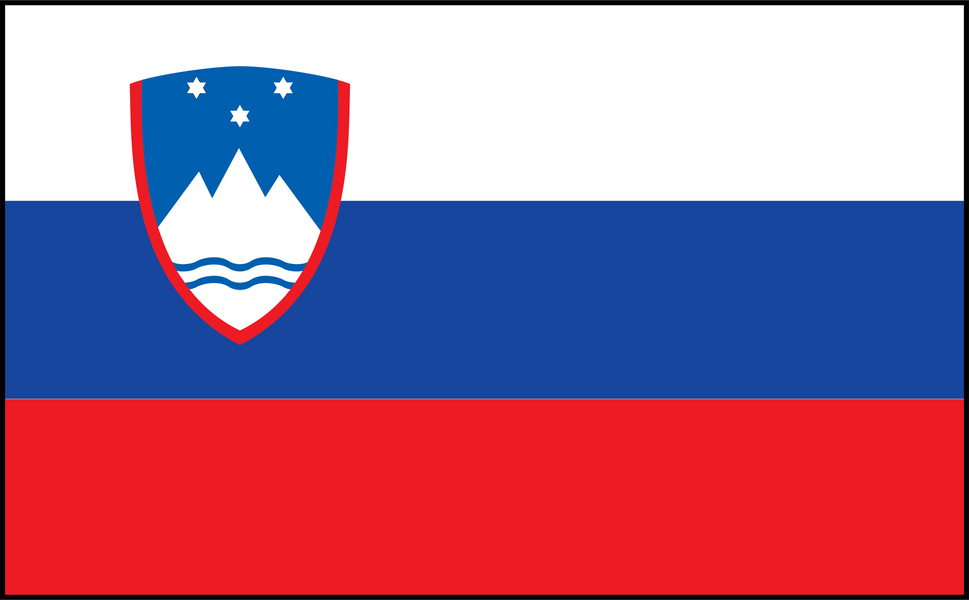
Three horizontal bands of white, blue and red, the pan-Slavic colours, with the coat of arms towards the flagpole spanning the white and blue bands.
The shield shows Mount Triglav in white on blue, with two wavy lines beneath it for the country's rivers and its short stretch of sea, and three gold six-pointed stars above from the coat of arms of the medieval Counts of Celje.