
Slovakia
Slovakia builds more cars per person than any other country in the world.
- CapitalBratislavaThe only capital bordering two countries
- PopulationAbout 5.4 millionLandlocked in central Europe
- Area49,035 km2Mostly mountainous
- CarsMost per person on EarthAround 1 million built a year
Slovakia is a mountainous country north of Hungary. The Carpathians cross it, and the High Tatras in the north are the smallest high-alpine range in the world: sharp granite peaks over 2,600 m packed into an area only about 26 km long.
Bratislava is unusual among capitals. It sits right on the borders with Austria and Hungary, and Vienna is only about 55 km away, which makes them the two closest capital cities in Europe.
National symbols
- National animal Brown bear
- National flower Rose
- National anthem Nad Tatrou sa blyska (Translation: Lightning Over the Tatras)
- National day Constitution Day, 1 September
Map of Slovakia
Geography
Slovakia covers 49,035 km2 and borders the Czech Republic, Poland, Ukraine, Hungary and Austria. It is landlocked.
The Carpathian Mountains cover most of the country. The High Tatras in the north reach Gerlachovsky stit at 2,655 m, the highest point in the whole Carpathian range. The Danube forms part of the southern border and the lowlands beside it are the main farming region.
Climate
Slovakia has a continental climate with warm summers and cold winters, and altitude changes it sharply: the Tatras keep snow into late spring.
The southern lowlands are warmest and driest, while the mountains are cold and wet. Bratislava averages around 0C in January and 21C in July.
Culture
Slovak is the official language, closely related to Czech: Slovaks and Czechs generally understand each other without difficulty.
Fujara, a very long shepherd's flute played by holding it upright beside the body, is a Slovak invention on the UNESCO heritage list. Around 62 per cent of Slovaks are Catholic. Folk costume, embroidery and painted village houses, especially at Cicmany, are a strong tradition.
Economy
Car manufacturing is dominant: Volkswagen, Kia, Peugeot and Jaguar Land Rover all build vehicles in Slovakia, and the sector produces roughly a million cars a year.
Electronics, steel and machinery follow. Slovakia adopted the euro in 2009 and gets a large share of its electricity from nuclear power.
The flag
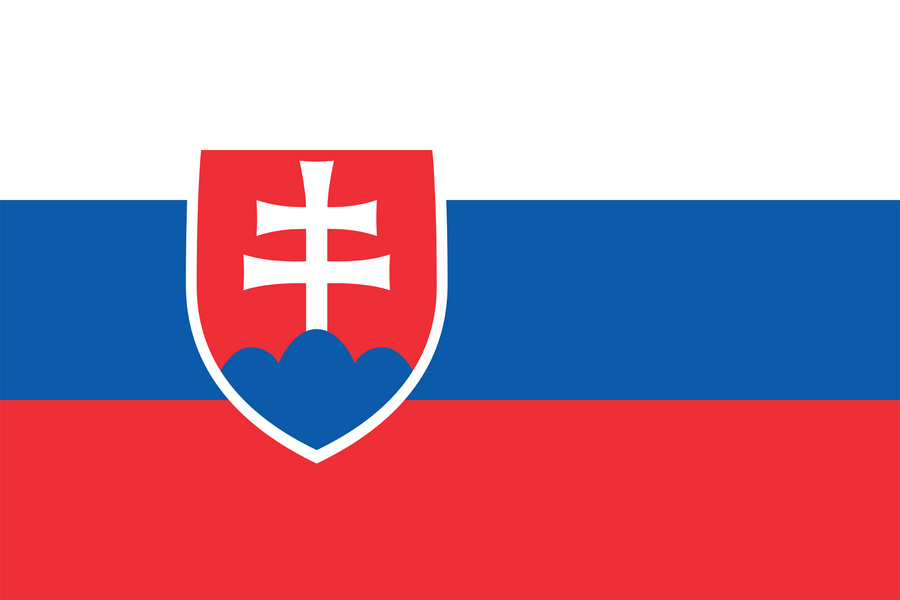
Three horizontal bands of white, blue and red, the pan-Slavic colours in the same order as Russia's flag.
Because that made the flag identical to Russia's, the Slovak coat of arms was placed towards the flagpole side. It shows a white double cross standing on three blue hills, representing the mountain ranges Tatra, Matra and Fatra.