
Romania
Romania is home to Transylvania, the Carpathian Mountains, and roughly half of all Europe's brown bears.
- CapitalBucharestOnce called the Little Paris of the East
- PopulationAbout 19 millionSixth most populous in the EU
- Area238,397 km2Twelfth largest in Europe
- Brown bearsAround 6,000Roughly half of Europe's population
The Carpathian Mountains curve through Romania in an arc, dividing the country into three historic regions: Transylvania inside the arc, Wallachia to the south and Moldavia to the east. The Danube forms much of the southern border before spreading into a huge delta on the Black Sea.
Transylvania has castles, fortified churches and dense old forest, and it became famous worldwide because Bram Stoker set Dracula there. The real Vlad the Impaler, on whom the character was loosely based, was a Wallachian prince known for extreme brutality against invading Ottoman armies.
National symbols
- National bird Great white pelican
- National flower Dog rose
- National anthem Desteapta-te, romane! (Translation: Awaken Thee, Romanian!)
- National day Great Union Day, 1 December
Map of Romania
Geography
Romania covers 238,397 km2 and borders Ukraine, Moldova, Bulgaria, Serbia and Hungary, with a Black Sea coast to the south-east.
The Carpathians form an arc through the middle, rising to Moldoveanu at 2,544 m. Inside the arc lies the Transylvanian Plateau, and outside it are the plains of Wallachia and Moldavia. The Danube ends its 2,850 km journey here, forming a 4,000 km2 delta.
Climate
Romania has a temperate continental climate with four clear seasons: cold snowy winters and hot summers. Bucharest can pass 35C in July and drop below minus 10C in January.
The mountains are much cooler and hold snow for months, supporting ski resorts. The Black Sea coast is milder, and the eastern plains can be dry enough to suffer summer droughts.
Culture
Romanian is the official language and is a Romance language, descended from Latin like French, Spanish and Italian. That makes it unusual in a region surrounded by Slavic and Hungarian speakers.
The painted monasteries of Bucovina have their outside walls covered in bright biblical frescoes that have survived 500 years of weather. Around 86 per cent of Romanians are Orthodox Christian. Hungarian is spoken by a large minority in Transylvania.
Economy
Romania has grown rapidly since joining the EU in 2007. Car manufacturing is significant, with Dacia and Ford both producing here.
It also has a strong technology sector: Romania has one of the fastest internet speeds in Europe and a large software industry. Agriculture on the fertile plains produces maize, wheat and sunflowers.
The flag
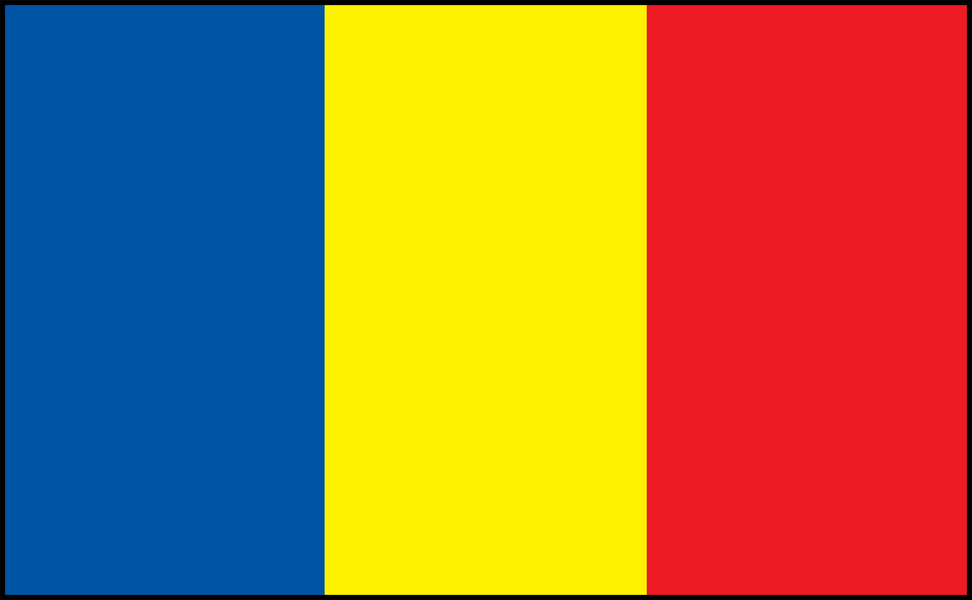
Three vertical bands of blue, yellow and red, of equal width, in the same layout as the French and Belgian flags.
The colours come from the old principalities that formed Romania: blue and yellow from Moldavia, red and yellow from Wallachia. The flag is nearly identical to Chad's, the only difference being a slightly darker blue on the Chadian version, and the two countries have argued about it at the United Nations.