
Portugal
Portuguese sailors were the first Europeans to reach India by sea and to sail round the world, and Portugal supplies around half the world's cork.
- CapitalLisbonThe oldest city in western Europe after Athens
- PopulationAbout 10.5 millionPlus the Azores and Madeira
- Area92,212 km2Including two Atlantic island groups
- CorkAbout half of world supplyFrom cork oak forests in the south
Portugal occupies the western edge of the Iberian Peninsula, with the Atlantic on two sides and Spain on the other. The north is green, hilly and rainy, while the southern Alentejo is a wide, hot plain of cork oaks and wheat.
In the 1400s and 1500s Portugal led the Age of Discovery. Vasco da Gama sailed round Africa to India in 1498, and a Portuguese expedition led by Ferdinand Magellan made the first voyage around the world. That is why Portuguese is spoken in Brazil, Angola, Mozambique and beyond.
National symbols
- National bird Barcelos rooster, a brightly painted folk symbol
- National colours Green and red
- National anthem A Portuguesa (Translation: The Portuguese Song)
- National day Portugal Day, 10 June
Map of Portugal
Geography
Portugal covers 92,212 km2 and borders only Spain, with the Atlantic Ocean to the west and south. The Azores and Madeira, both volcanic island groups out in the Atlantic, are part of the country.
The Tagus River divides the country: north of it the land is mountainous and green, rising to Serra da Estrela at 1,993 m, while south of it lie rolling plains. Ponta do Pico in the Azores is the highest point in Portuguese territory at 2,351 m.
Climate
Portugal has a Mediterranean climate with Atlantic influence: mild wet winters and warm dry summers. The north is noticeably wetter and cooler than the south.
The Algarve in the south gets over 300 days of sunshine a year. Madeira has a subtropical climate and stays mild all year, while the Azores are wetter and cloudier, sitting in the middle of the Atlantic.
Culture
Portuguese is the official language and is spoken by around 260 million people worldwide, mostly in Brazil. Mirandese, spoken in a small area in the north-east, is also official.
Fado is the national music: melancholy songs about longing, usually sung with a Portuguese guitar, and recognised by UNESCO. Around 80 per cent of Portuguese people are Catholic. Azulejos, painted blue and white tiles, cover buildings across the country.
Economy
Tourism is a leading industry, focused on Lisbon, Porto and the Algarve beaches. Portugal has also become popular with people working remotely from abroad.
Portugal is the world's largest cork producer. Port wine, made in the Douro Valley, is one of the oldest protected wine regions on Earth. Textiles, footwear, paper and car parts are important manufactured exports, and Portugal now generates a very high share of its electricity from renewables.
The flag
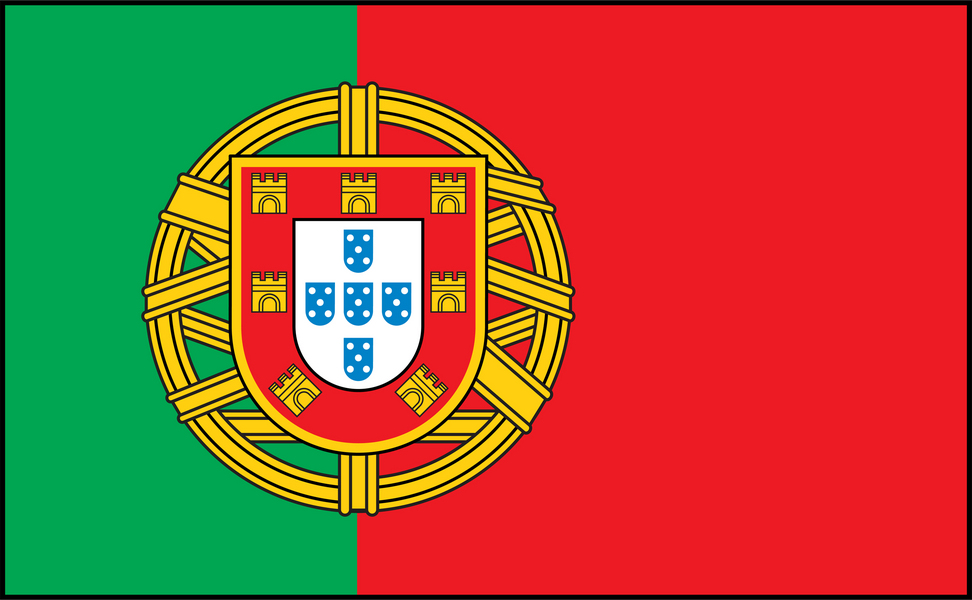
A green band at the left, taking up two fifths, and a red band making up the rest. Green was said to stand for hope and red for the blood of those who died for the country.
Where the colours meet sits an armillary sphere, an old navigation instrument of metal rings used to model the movements of the stars. It is a direct reference to Portugal's age of exploration, and on top of it sits the national shield with seven castles and five blue shields.