
Norway
Norway has over 1,100 fjords, and in the far north the sun does not set at all for weeks in summer or rise for weeks in winter.
- CapitalOsloAt the head of a long fjord
- PopulationAbout 5.5 millionSpread along an enormous coastline
- Area385,207 km2Long and narrow, over 1,750 km end to end
- CoastlineOver 100,000 kmCounting all the fjords and islands
Norway runs up the western edge of Scandinavia, and about a third of it lies inside the Arctic Circle. Glaciers in the last ice age gouged deep U-shaped valleys that flooded when the ice melted, creating the fjords: narrow sea inlets with cliffs rising over 1,000 m on either side.
Because the country is so far north, daylight is extreme. In Tromso the sun stays above the horizon from late May to late July, and below it from late November to late January, when the sky glows blue at midday and the northern lights appear.
National symbols
- National animal Elk, and the fjord horse
- National bird White-throated dipper
- National anthem Ja, vi elsker dette landet (Translation: Yes, We Love This Country)
- National day Constitution Day, 17 May
Map of Norway
Geography
Norway covers 385,207 km2 and borders Sweden, Finland and Russia, with the Norwegian Sea, North Sea and Barents Sea along its western and northern coasts.
The country is mountainous, with the Scandinavian Mountains running its length and Galdhopiggen the highest point at 2,469 m. Sognefjord is the longest fjord in Norway at 205 km and reaches 1,308 m deep. Svalbard, high in the Arctic, is Norwegian territory.
Climate
Norway is far milder than its latitude suggests, because the North Atlantic Current carries warm water up the coast. Coastal ports stay ice-free all year even north of the Arctic Circle.
Inland and in the mountains it is much colder, with heavy snow and long winters. Bergen on the west coast is one of the rainiest cities in Europe, with rain on around 230 days a year.
Culture
Norwegian has two official written forms, Bokmal and Nynorsk, and Sami languages are official in the north where the Indigenous Sami people herd reindeer.
The Vikings sailed from here between about 800 and 1050 AD, reaching Britain, Russia, Iceland and North America. Friluftsliv, meaning open-air living, is a national value: getting outdoors in all weather. Around 65 per cent of Norwegians belong to the Church of Norway.
Economy
Oil and gas from the North Sea transformed Norway from a modest fishing nation into one of the richest countries in the world after discoveries in the late 1960s.
Norway is also the world's largest producer of farmed Atlantic salmon, and nearly all its electricity comes from hydroelectric power. Around 80 per cent of new cars sold in Norway are now electric, the highest share anywhere.
The flag
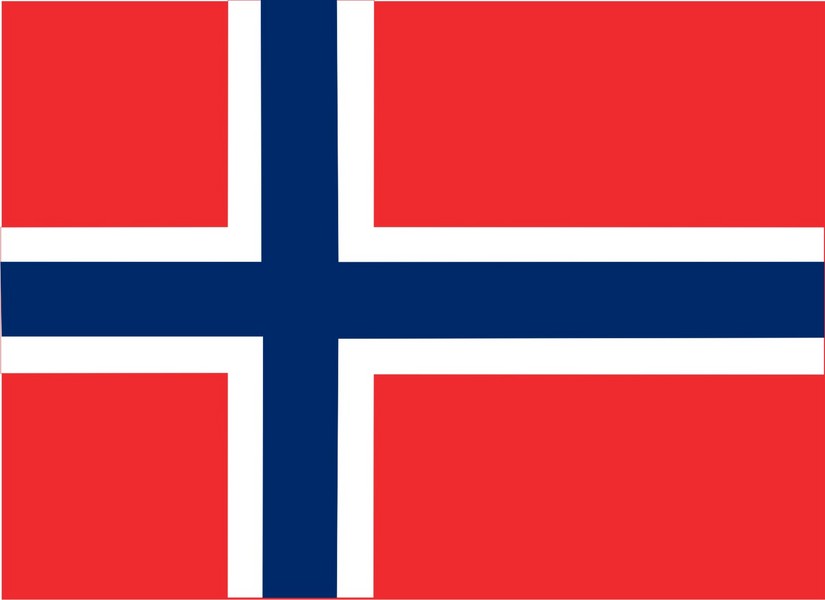
A red field with a blue cross outlined in white, in the Nordic cross layout where the vertical arm sits closer to the flagpole.
The red and white came from Denmark, which ruled Norway for centuries, and the blue from Sweden, which ruled it afterwards. The colours also deliberately echoed the French tricolore, the flag of liberty, when the design was adopted in 1821.