
Montenegro
Montenegro means black mountain, and for a country smaller than Wales it manages to fit in fjord-like bays, canyons and 2,500 m peaks.
- CapitalPodgoricaThough Cetinje is the historic royal capital
- PopulationAbout 620,000One of Europe's smallest countries
- Area13,812 km2Coast, canyons and high mountains
- Tara CanyonAbout 1,300 m deepThe deepest canyon in Europe
Montenegro packs an extraordinary range into a small space. The Bay of Kotor in the south-west is a deep winding inlet ringed by mountains that looks like a fjord, though it was actually carved by a river. Inland, the Durmitor massif rises above 2,500 m.
The Tara River has cut a canyon around 1,300 m deep, the deepest in Europe and second deepest in the world after the Grand Canyon. Its water is clean enough to drink straight from the river in places.
National symbols
- National animal Golden eagle
- National flower Mimosa
- National anthem Oj, svijetla majska zoro (Translation: Oh, Bright Dawn of May)
- National day Statehood Day, 13 July
Map of Montenegro
Geography
Montenegro covers 13,812 km2 and borders Croatia, Bosnia and Herzegovina, Serbia, Kosovo and Albania, with a 293 km Adriatic coastline.
Behind a narrow coastal strip the land rises steeply into the Dinaric Alps. Bobotov Kuk in the Durmitor range reaches 2,523 m. The Tara Canyon is around 1,300 m deep and 82 km long. Lake Skadar, shared with Albania, is the largest lake in the Balkans.
Climate
The coast has a Mediterranean climate with hot dry summers and mild wet winters, and Budva and Kotor fill with visitors in summer.
The mountains are alpine, with heavy snow and long cold winters. Crkvice, in the mountains just behind the Bay of Kotor, is one of the wettest inhabited places in Europe, with over 4,000 mm of rain a year.
Culture
Montenegrin is the official language, closely related to Serbian, Bosnian and Croatian. Both Latin and Cyrillic alphabets are used.
Around 72 per cent of Montenegrins are Orthodox Christian and around 19 per cent Muslim. The gusle, a single-stringed instrument played with a bow, accompanies epic poems recounting historic battles. Water polo is a national passion and Montenegro is one of the strongest teams in the world.
Economy
Tourism is the largest industry, based on the Adriatic coast, Kotor and the mountain national parks, and it makes up around a fifth of the economy.
Aluminium production, hydroelectric power and agriculture are the other significant sectors. Montenegro uses the euro even though it is not in the eurozone, having adopted it unilaterally.
The flag
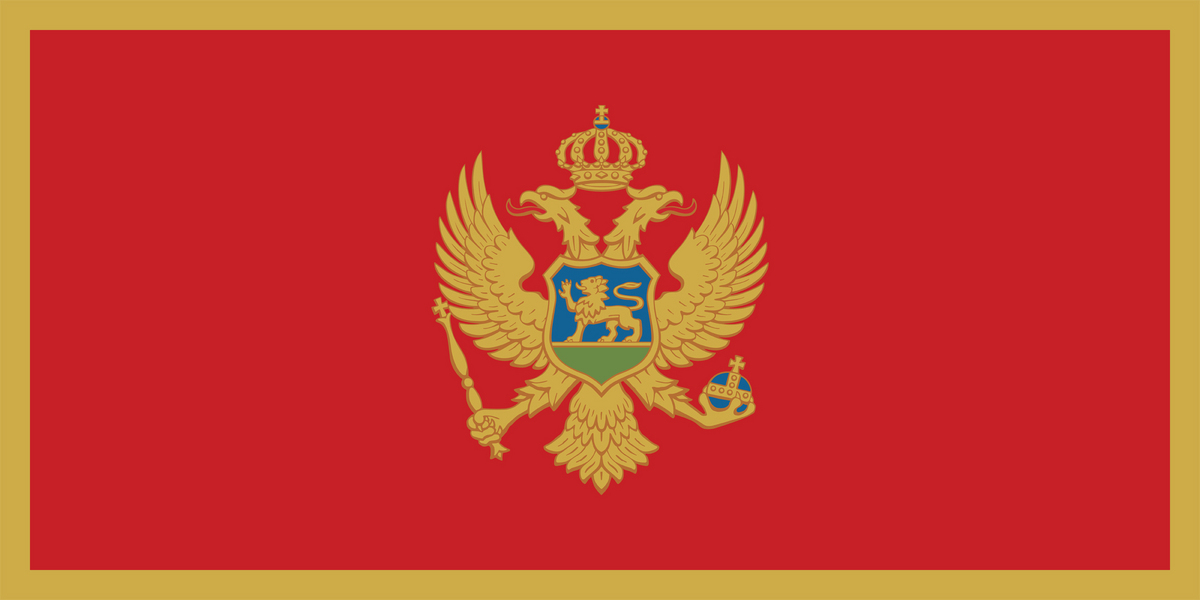
A red field with a gold border, carrying the national coat of arms in the centre.
The arms show a gold double-headed eagle wearing a crown, holding a sceptre and orb, with a shield on its chest bearing a gold lion on a green field. The design comes from the royal standard of King Nikola I, who ruled Montenegro until 1918.