
Moldova
Moldova has the largest wine cellars in the world: an underground city of tunnels with around 200 km of racks holding nearly two million bottles.
- CapitalChisinauOn the Bic River
- PopulationAbout 2.5 millionOne of Europe's smallest populations
- Area33,846 km2Landlocked between Romania and Ukraine
- Wine cellarsAbout 200 km of tunnelsThe largest in the world at Milestii Mici
Moldova is a small, landlocked country of rolling hills and rich black soil squeezed between Romania and Ukraine. Around three quarters of the land is farmed, more than almost anywhere in Europe.
The wine industry runs on old limestone mines. At Milestii Mici, tunnels cut for building stone were converted into cellars, and the collection of nearly two million bottles holds a Guinness world record. You drive through it by car.
National symbols
- National bird Great spotted woodpecker
- National flower Dog rose
- National anthem Limba noastra (Translation: Our Language)
- National day Independence Day, 27 August
Map of Moldova
Geography
Moldova covers 33,846 km2 and borders only Romania and Ukraine. It is landlocked, though it has a tiny 430 m stretch of Danube frontage giving it access to the Black Sea by river.
The land is gently rolling hills and plains, with the highest point, Balanesti, only 430 m. The Dniester and Prut rivers form much of the eastern and western borders. The soil is chernozem, the same deep black earth as Ukraine's.
Climate
Moldova has a moderately continental climate with warm summers and relatively mild winters, which suits vines and orchards.
Summers average around 20C to 25C and can pass 35C, and winters hover near freezing with limited snow. Rainfall is modest and droughts are a recurring risk for farmers.
Culture
Romanian is the official language, and Moldovans and Romanians speak essentially the same language. Russian is also widely spoken, especially in cities.
Moldovan folk music features the pan pipes and the violin, and the doina, a free-flowing lament, is on the UNESCO heritage list. Around 90 per cent of Moldovans are Orthodox Christian.
Economy
Agriculture is the backbone: wine, sunflowers, maize, wheat, fruit and walnuts. Moldova is one of the more agricultural economies in Europe.
Wine is the flagship export, sold mainly to Romania, Poland and the Czech Republic. Textiles and money sent home by Moldovans working abroad are the other main sources of income.
The flag
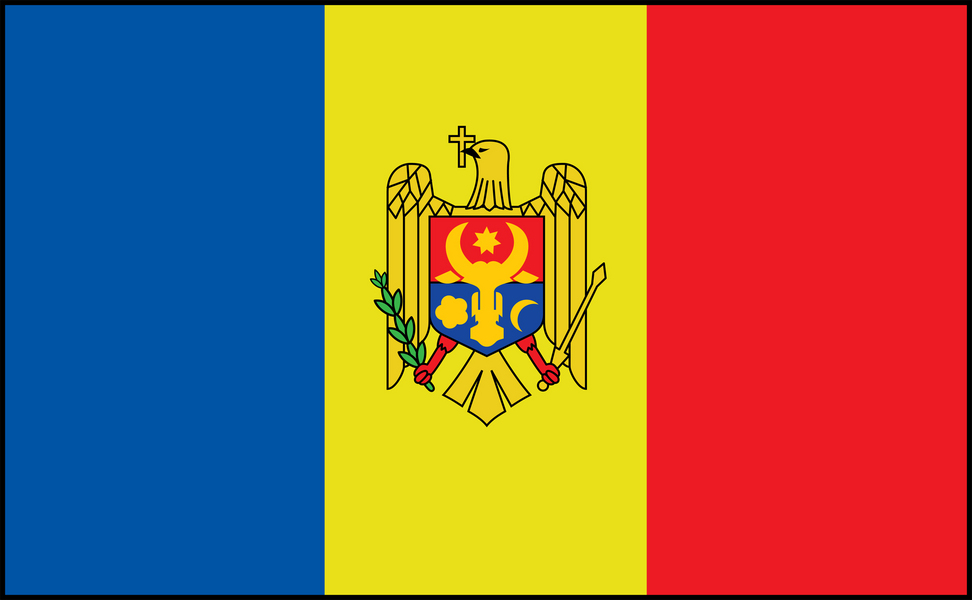
Three vertical bands of blue, yellow and red, the same colours and layout as Romania's flag, reflecting the shared language and history.
The Moldovan coat of arms in the centre shows an eagle holding a cross in its beak, an olive branch and a sceptre in its claws, and on its chest a shield with an aurochs head, an extinct wild ox that has been the emblem of Moldova since the Middle Ages.