
Malta
Malta has temples older than the pyramids of Egypt, and it is one of the most densely populated countries on Earth.
- CapitalVallettaThe smallest capital city in the EU
- PopulationAbout 540,000On just 316 km2
- Area316 km2Three inhabited islands
- Megalithic templesAround 5,600 years oldOlder than the Egyptian pyramids
Malta is a small archipelago in the middle of the Mediterranean, between Sicily and North Africa. Three islands are inhabited: Malta, Gozo and Comino. There are no rivers, no mountains and very few trees, just limestone, terraced fields and dense towns.
Its position made it strategically priceless, so almost everybody has ruled it: Phoenicians, Romans, Arabs, the Knights of St John, the French and the British. Malta became independent in 1964.
National symbols
- National animal Pharaoh hound
- National flower Maltese centaury
- National anthem L-Innu Malti (Translation: The Maltese Hymn)
- National day Independence Day, 21 September
Map of Malta
Geography
Malta covers 316 km2 and has no land borders, lying about 80 km south of Sicily in the central Mediterranean.
The islands are made of limestone, low and mostly flat, with the highest point, Ta' Dmejrek, only 253 m. There are no permanent rivers or lakes at all. The coast alternates between sheer cliffs and deep natural harbours, which is why the Grand Harbour at Valletta was so prized.
Climate
Malta has a hot Mediterranean climate with long dry summers, often above 32C, and mild wet winters that rarely drop below 10C.
It is one of the sunniest countries in Europe, with around 3,000 hours of sunshine a year. Water is genuinely scarce and much of Malta's drinking water comes from desalination.
Culture
Maltese and English are both official. Maltese is the only Semitic language written in the Latin alphabet: it descends from Arabic but has absorbed a great deal of Italian and English vocabulary.
Around 82 per cent of Maltese people are Catholic, and village festas honouring patron saints fill the summer with brass bands and fireworks. Malta has more churches per square kilometre than almost anywhere.
Economy
Tourism is a leading industry, drawing several times the country's own population in visitors each year. Malta is also a popular filming location, standing in for ancient and Mediterranean settings.
Financial services, online gaming and shipping registration are major sectors. Malta joined the EU in 2004 and adopted the euro in 2008.
The flag
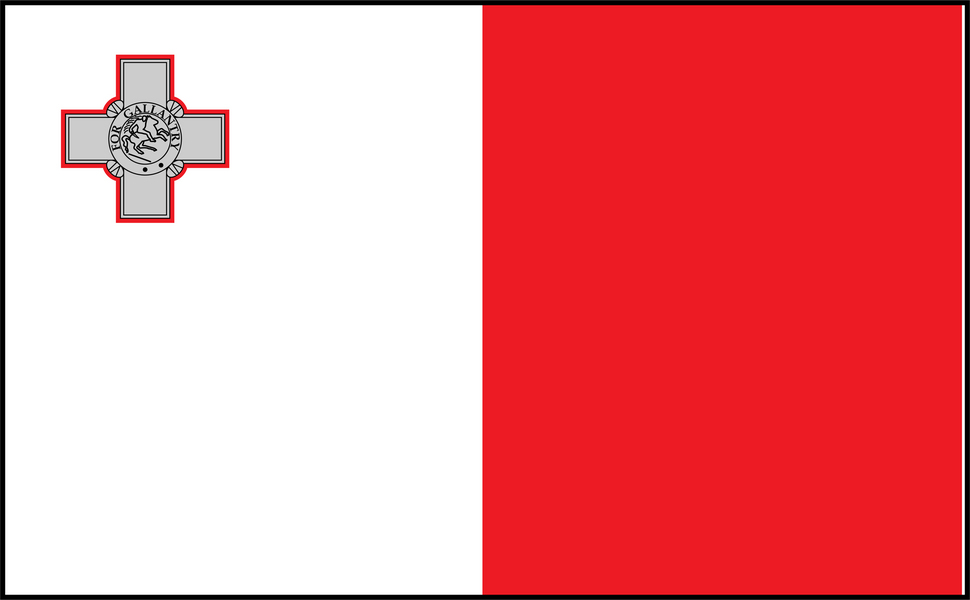
The flag is divided vertically, white on the flagpole side and red on the other. The colours are said to date from the Norman period in the 1000s.
In the top left corner is the George Cross, edged in red. King George VI awarded the medal to the whole island in 1942 for the bravery of its people under sustained aerial bombardment, and it has appeared on the flag ever since.