
North Macedonia
North Macedonia changed its name in 2019 to settle a 27-year argument with Greece over who could use the word Macedonia.
- CapitalSkopjeBirthplace of Mother Teresa
- PopulationAbout 1.8 millionLandlocked in the southern Balkans
- Area25,713 km2Mountains and river valleys
- Name change2019From Macedonia to North Macedonia
North Macedonia is a landlocked, mountainous country in the southern Balkans. The Vardar River cuts through the middle from north to south, and most towns and farmland sit in its valley.
When the country became independent from Yugoslavia in 1991 it called itself Macedonia. Greece objected, because its own northern region is also called Macedonia and Alexander the Great came from there. The dispute blocked the country from joining NATO and the EU for decades, until the 2018 Prespa Agreement settled on North Macedonia.
National symbols
- National animal Lion, and the Balkan lynx
- National flower Poppy
- National anthem Denes nad Makedonija (Translation: Today Over Macedonia)
- National day Independence Day, 8 September
Map of North Macedonia
Geography
North Macedonia covers 25,713 km2 and borders Kosovo, Serbia, Bulgaria, Greece and Albania. It is landlocked.
The country is mountainous, with over 50 peaks above 2,000 m and Mount Korab the highest at 2,764 m, shared with Albania. The Vardar valley runs through the middle. Lake Ohrid and Lake Prespa in the south-west are both very ancient and shared with neighbours.
Climate
The climate is between Mediterranean and continental: hot dry summers, often above 35C in the Vardar valley, and cold winters with snow in the mountains.
The country sits in a rain shadow behind the mountains to the west, so rainfall is relatively low and summers can be dry. Lake Ohrid moderates the climate around its shores.
Culture
Macedonian is the official language, a South Slavic language written in Cyrillic and closely related to Bulgarian. Albanian is co-official, spoken by around a quarter of the population.
The Ohrid region has hundreds of small Byzantine churches with medieval frescoes and icons. Around 46 per cent of the population is Orthodox Christian and around 32 per cent Muslim. Tavce gravce, baked beans in a clay dish, is the national dish.
Economy
The economy is small and open, with manufacturing in free economic zones producing car parts, chemicals and machinery for the European market.
Agriculture is important, especially tobacco, grapes and wine, peppers and vegetables. Tourism centres on Lake Ohrid, a UNESCO World Heritage Site for both its natural and cultural value.
The flag
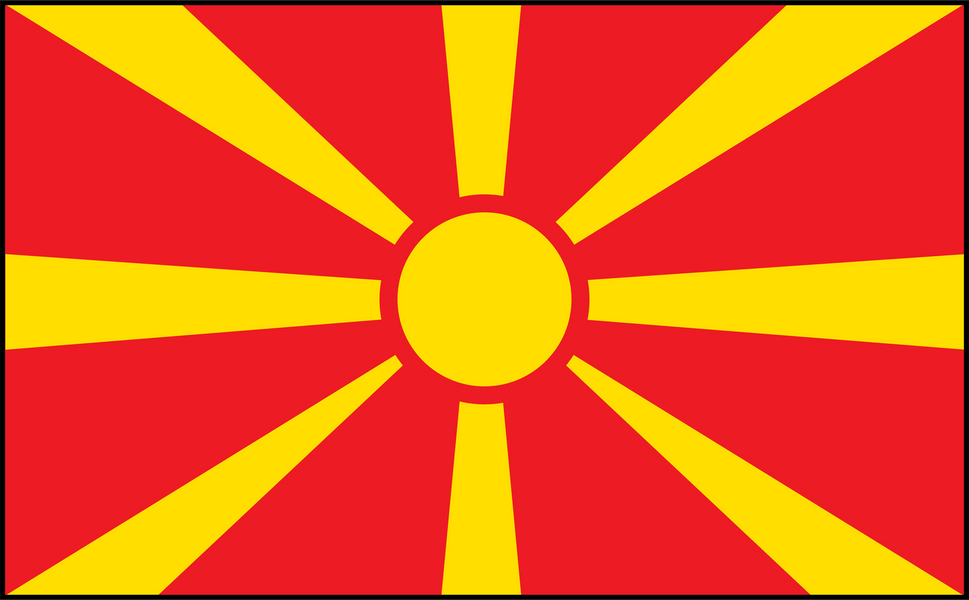
A red field with a stylised golden yellow sun at the centre, sending out eight rays that broaden as they reach the edges of the flag.
It replaced an earlier flag that used the Vergina Sun, an ancient symbol found in a royal Macedonian tomb in Greece. Greece objected strongly, and the current simpler sun was adopted in 1995 as part of easing that dispute.