
Latvia
Latvia is more than half forest, and its capital Riga has the largest collection of art nouveau buildings of any city in the world.
- CapitalRigaThe largest city in the Baltic states
- PopulationAbout 1.9 millionMiddle of the three Baltic states
- Area64,589 km2Over half of it forest
- Art nouveauAround 800 buildingsThe largest concentration anywhere
Latvia sits between Estonia and Lithuania on the Baltic coast. It is low and flat, with a 498 km coastline of white sand beaches, thousands of rivers and forest covering more than half the country.
Riga grew rich as a Hanseatic trading port, and around 1900 it built whole districts in the art nouveau style, with faces, animals and flowing plant shapes carved into the facades. Around a third of the buildings in central Riga are art nouveau.
National symbols
- National bird White wagtail
- National flower Oxeye daisy
- National anthem Dievs, sveti Latviju! (Translation: God Bless Latvia!)
- National day Proclamation Day, 18 November
Map of Latvia
Geography
Latvia covers 64,589 km2 and borders Estonia, Russia, Belarus and Lithuania, with a 498 km Baltic Sea coast including the Gulf of Riga.
The land is low and glacial, with the highest point, Gaizinkalns, only 312 m. More than half the country is forest and around 10 per cent is bog and wetland. The Daugava is the main river, flowing from Russia to the sea at Riga.
Climate
Latvia has a temperate climate with cold winters and mild summers, moderated near the coast by the Baltic Sea.
Winters average around minus 3C to minus 7C with snow cover for two to three months, and summers average around 18C to 22C. Rainfall is spread evenly, and autumn is the wettest season.
Culture
Latvian is the official language, one of only two surviving Baltic languages along with Lithuanian. Around a quarter of the population speaks Russian as a first language.
Singing is central to national identity: the drive to independence from the Soviet Union in the late 1980s is remembered as the Singing Revolution. Around 36 per cent of Latvians are Christian and a large share report no religion.
Economy
Timber and wood products are the biggest export, unsurprising for a country this forested. Food processing, machinery and pharmaceuticals follow.
Riga is a transport and logistics hub, with a large port and airport serving the Baltic region. Latvia joined the EU in 2004 and adopted the euro in 2014.
The flag
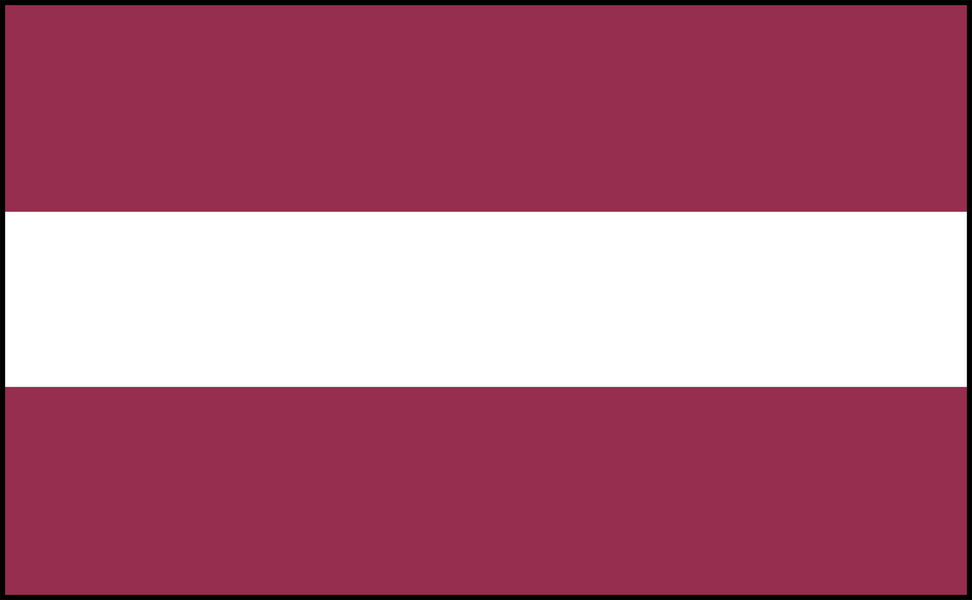
A dark red field, sometimes called Latvian red or carmine, crossed by a narrow white stripe in the middle. The proportions are unusual: the white stripe is only one fifth of the height.
A legend says the flag comes from a wounded Latvian chief wrapped in a white sheet: the edges stained with his blood, the middle left white where he lay. It is one of the oldest flag designs in the world, mentioned in a chronicle from the 1200s.