
Italy
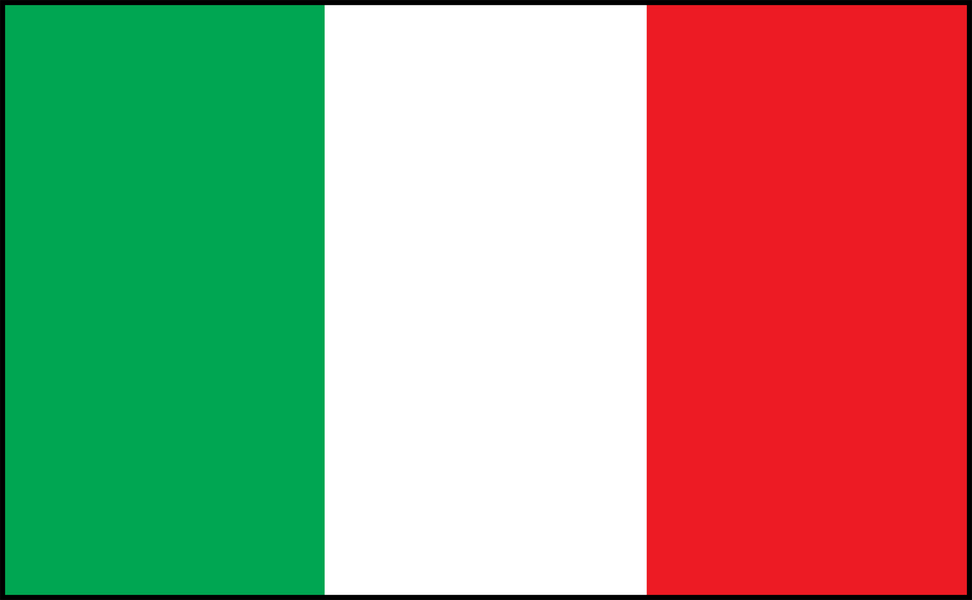
Italy is shaped like a boot kicking a football, and it has more UNESCO World Heritage Sites than any other country on Earth.
- CapitalRomeFounded, by legend, in 753 BC
- PopulationAbout 59 millionFalling, with one of the oldest populations in Europe
- Area301,340 km2Including Sicily and Sardinia
- World Heritage Sites59More than any other country
Italy is a long peninsula reaching into the Mediterranean, with the Alps across the top and the Apennine mountains running down the middle like a spine. Sicily sits at the toe of the boot and Sardinia out to the west.
Rome was the centre of an empire that ruled from Britain to Egypt, and much of it still stands: the Colosseum, the Pantheon and roads still in use. A thousand years later the Renaissance began in Florence, producing Leonardo da Vinci, Michelangelo and Galileo.
National symbols
- National animal Italian wolf
- National flower Strawberry tree, whose green leaves, white flowers and red berries match the flag
- National anthem Il Canto degli Italiani (Translation: The Song of the Italians)
- National day Republic Day, 2 June
Map of Italy
Geography
Italy covers 301,340 km2 and borders France, Switzerland, Austria and Slovenia, with the Mediterranean Sea around the rest of it.
The Alps form the northern border and include Monte Bianco at 4,806 m, shared with France. The Apennines run the length of the peninsula. Italy has three active volcanoes: Vesuvius near Naples, Etna on Sicily, which is the tallest active volcano in Europe, and Stromboli, which erupts almost constantly.
Climate
Most of Italy has a Mediterranean climate: hot dry summers and mild wet winters, which suits olives, grapes and lemons.
The north is different. The Po Valley has cold foggy winters and humid summers, and the Alps are genuinely alpine with heavy snow. Sicily and the far south can be very hot in summer, regularly passing 35C.
Culture
Italian is the official language, and it developed from the Tuscan dialect used by the poet Dante. Regional languages such as Sardinian, Friulian and Ladin are also protected.
Italian food is regional rather than national: pizza belongs to Naples, ragu to Bologna, risotto to the north. Opera was invented in Italy. Around 74 per cent of Italians are Catholic, and Vatican City in Rome is the centre of the Catholic Church.
Economy
Italy has the third largest economy in the eurozone. Machinery, cars, especially Ferrari, Lamborghini and Fiat, and industrial equipment lead its exports.
Fashion and design are Italian strengths: Milan is one of the world's fashion capitals. Food and wine exports are enormous, and tourism draws around 60 million visitors a year to Rome, Venice, Florence and the coasts.
The flag
Three vertical bands of green, white and red. It was inspired by the French tricolore, brought into Italy by Napoleon's armies in the 1790s, with green replacing blue.
The usual explanation is that green stands for the plains and hills, white for the snow of the Alps, and red for the blood shed in the wars of independence that united Italy in 1861. Before then, Italy was a patchwork of separate kingdoms and city states.