
Ireland
Ireland is called the Emerald Isle because it rains often enough to keep the whole island green all year round.
- CapitalDublinOn the east coast at the mouth of the Liffey
- PopulationAbout 5.3 millionStill below its pre-famine level
- Area70,273 km2Five sixths of the island of Ireland
- NicknameThe Emerald IsleFrom its year-round green fields
The Republic of Ireland covers about five sixths of the island of Ireland; the north-eastern corner is Northern Ireland, part of the United Kingdom. The land is a saucer shape: a low, boggy central plain ringed by hills and mountains around the coast.
Between 1845 and 1852 a potato blight caused the Great Famine. About a million people died and a million more emigrated, mostly to America. Ireland's population has still not returned to what it was before, and around 70 million people worldwide claim Irish descent.
National symbols
- National symbol Harp, the only country with a musical instrument as its emblem
- National plant Shamrock
- National anthem Amhran na bhFiann (Translation: The Soldiers' Song)
- National day Saint Patrick's Day, 17 March
Map of Ireland
Geography
Ireland covers 70,273 km2 and shares its only land border with Northern Ireland, part of the United Kingdom. The Atlantic Ocean lies to the west and the Irish Sea to the east.
A low central plain of bog and farmland is ringed by coastal mountains, the highest being Carrauntoohil at 1,038 m. The Shannon is the longest river in Ireland or Britain. The Cliffs of Moher rise 214 m straight out of the Atlantic.
Climate
Ireland has a very mild, wet maritime climate thanks to the Gulf Stream. Winters rarely drop below freezing and summers rarely rise above 22C, so the grass grows nearly all year.
The west coast is much wetter than the east, getting over 1,200 mm of rain a year, and it can rain on more than 200 days annually. Snow is uncommon at sea level.
Culture
Irish and English are both official. Irish is a Celtic language taught in every school, and there are Gaeltacht regions on the west coast where it is the everyday language.
Ireland has produced an extraordinary number of writers for its size, including four Nobel laureates in literature. Traditional music with fiddle, tin whistle and bodhran drum is played in pubs across the country. Hurling, an ancient stick and ball game, is one of the fastest field sports in the world.
Economy
Ireland has become a European base for many of the world's largest technology and pharmaceutical companies, attracted by low corporation tax, English language and EU membership.
Medical devices and pharmaceuticals are the biggest exports by value. Agriculture remains important, especially beef and dairy: Irish butter and cheese are exported worldwide.
The flag
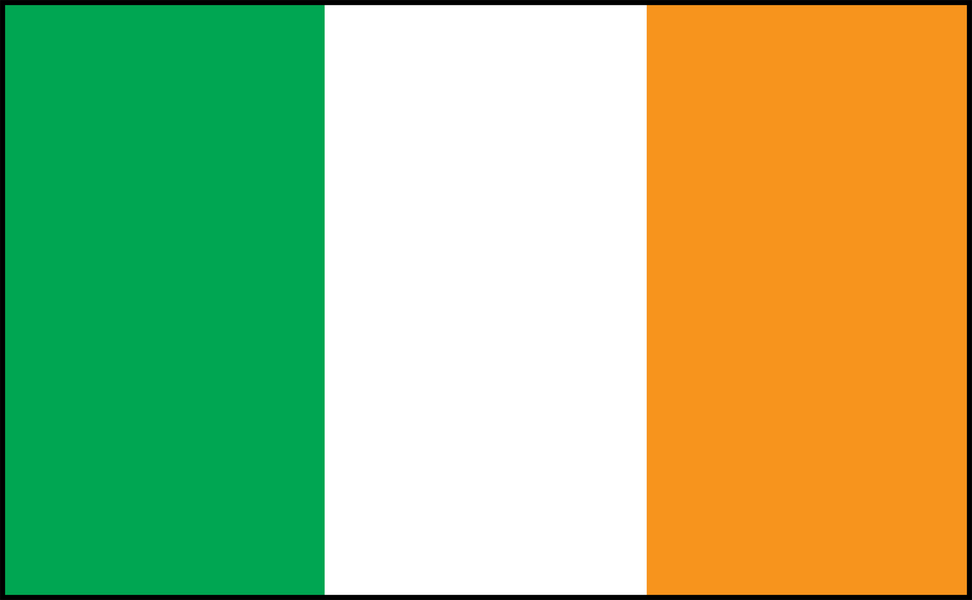
Three vertical bands of green, white and orange. Green stands for the Catholic and nationalist tradition, orange for the Protestant and unionist tradition, named after William of Orange.
The white band between them stands for a lasting peace between the two. It was first flown in 1848 and became the national flag when Ireland gained independence. Getting the orange the right way round matters: reversed, it becomes the flag of Ivory Coast.