
Iceland
Iceland sits directly on the join between two tectonic plates, so it is pulling apart by about 2 cm a year and building new land as it goes.
- CapitalReykjavikThe northernmost capital of a sovereign state
- PopulationAbout 390,000Most live around Reykjavik
- Area103,000 km2About 11 per cent covered by glaciers
- ElectricityAlmost 100 per cent renewableFrom geothermal and hydro power
Iceland straddles the Mid-Atlantic Ridge, where the North American and Eurasian plates pull apart. That is why it has around 130 volcanoes, geysers, hot springs and lava fields, and why the island keeps growing.
All that underground heat is put to work. Geothermal energy heats around 90 per cent of Icelandic homes, and combined with hydroelectric power it means the country runs on essentially 100 per cent renewable electricity. Pavements in Reykjavik are heated to melt the snow.
National symbols
- National animal Gyrfalcon, and the Icelandic sheepdog
- National flower Mountain avens
- National anthem Lofsongur (Translation: Hymn)
- National day Icelandic National Day, 17 June
Map of Iceland
Geography
Iceland covers 103,000 km2 and has no land borders, sitting in the north Atlantic just below the Arctic Circle, about 800 km from Norway.
The interior is a barren volcanic plateau of lava, ash and ice where almost nobody lives. Vatnajokull is the largest glacier in Europe by volume and covers about 8 per cent of the country. Hvannadalshnjukur is the highest point at 2,110 m.
Climate
Iceland is far milder than its name and latitude suggest, because the North Atlantic Current brings warm water past it. Reykjavik averages around 0C in winter and 13C in summer.
The weather changes constantly, and Icelanders say if you do not like it, wait five minutes. Wind is strong and frequent, and the highlands are genuinely Arctic with deep snow for much of the year.
Culture
Icelandic is the official language and has changed so little in a thousand years that Icelanders can read medieval sagas in the original without much difficulty.
Most Icelanders do not have family surnames. Instead, a child takes their father's or mother's first name plus "son" or "dottir", so the phone book is ordered by first name. Around 60 per cent belong to the Church of Iceland.
Economy
Fishing built modern Iceland and marine products are still a leading export. The country manages its fish stocks carefully with strict quotas.
Cheap renewable electricity attracted aluminium smelters, which need enormous amounts of power. Tourism grew explosively after 2010 and now brings in more visitors each year than there are Icelanders, by a factor of about five.
The flag
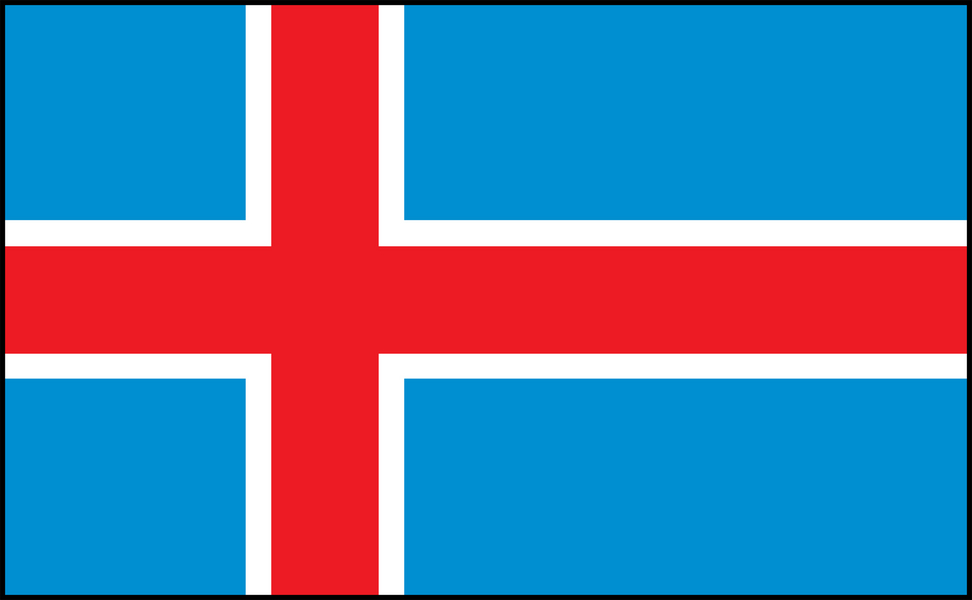
A blue field with a red cross outlined in white, laid out in the Nordic cross pattern.
The colours describe the island: blue for the sea and mountains, white for the ice and snow, and red for the fire of the volcanoes. It was adopted in 1915 while Iceland was still under Danish rule, and became the national flag at independence in 1944.