
Hungary
Hungarian is unrelated to any of the languages around it, and Hungary has more thermal springs than almost any country on Earth.
- CapitalBudapestTwo cities, Buda and Pest, joined in 1873
- PopulationAbout 9.6 millionLandlocked in central Europe
- Area93,030 km2Mostly flat plain
- Thermal springsOver 1,300About 120 of them in Budapest alone
Hungary sits on the Great Hungarian Plain, a wide, flat expanse of farmland and grassland known as the puszta. The Danube cuts the country in two on its way south, and Lake Balaton in the west is the largest lake in central Europe.
Hot water is everywhere. Hungary sits on a thin part of the Earth's crust, so geothermally heated water rises close to the surface. Budapest has around 120 thermal springs, and its grand public baths have been used since Roman and Ottoman times.
National symbols
- National bird Turul, a mythological falcon
- National flower Tulip
- National anthem Himnusz (Translation: Hymn)
- National day Saint Stephen's Day, 20 August
Map of Hungary
Geography
Hungary covers 93,030 km2 and borders Austria, Slovakia, Ukraine, Romania, Serbia, Croatia and Slovenia. It is landlocked.
Most of the country is flat plain, split by the Danube into the Great Plain in the east and Transdanubia in the west. The highest point, Kekes, is only 1,014 m. Lake Balaton covers 592 km2 and is the largest lake in central Europe.
Climate
Hungary has a continental climate with hot summers and cold winters. Budapest averages around 0C in January and 22C in July, and summer temperatures can pass 35C on the plain.
Rainfall is relatively low, around 600 mm a year, and the eastern plain can be dry. Spring and autumn are short, with the change between summer and winter happening quickly.
Culture
Hungarian, called Magyar by its speakers, is the official language. It is spoken by around 13 million people, including large communities in neighbouring Romania, Slovakia and Serbia.
Paprika, ground dried peppers, is central to Hungarian cooking and gives goulash its colour and flavour. Hungary has produced an unusual number of Nobel Prize winners for its size, especially in physics and chemistry. Around 39 per cent of Hungarians are Christian.
Economy
Car manufacturing is the largest industry, with Audi, Mercedes-Benz and Suzuki all building vehicles in Hungary, and the sector accounts for a large share of exports.
Electronics, pharmaceuticals and agriculture, especially maize, wheat, sunflowers and wine from Tokaj, are also significant. Budapest attracts millions of tourists a year.
The flag
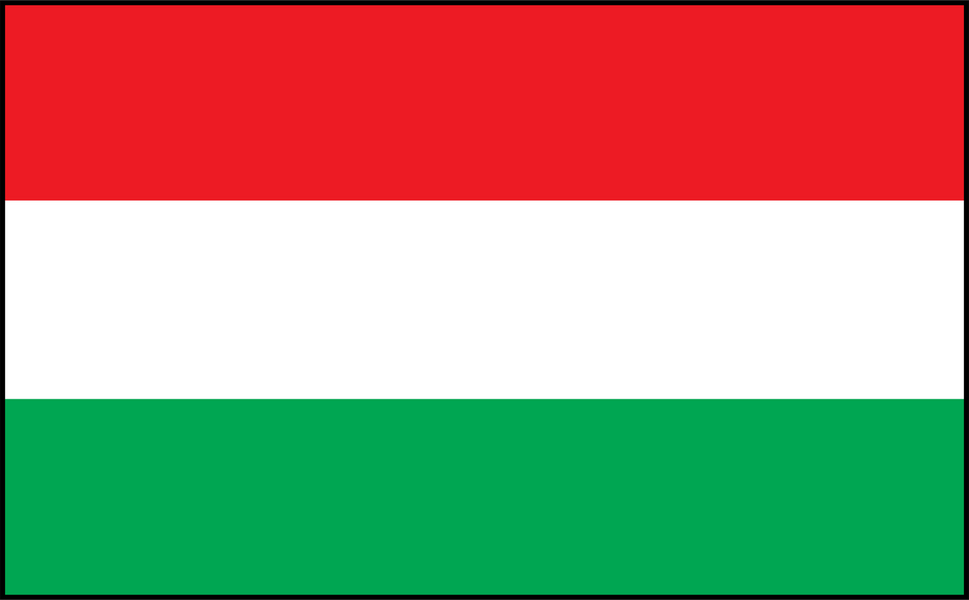
Three horizontal bands of red, white and green. The colours come from the Hungarian coat of arms and have been used since the Middle Ages.
They are traditionally explained as red for strength, white for faithfulness and green for hope. The horizontal tricolour design was adopted during the 1848 revolution against Austrian rule, inspired by the French flag turned on its side.