
Greece
Greece has around 6,000 islands, but only about 227 of them have anybody living on them.
- CapitalAthensInhabited for over 5,000 years
- PopulationAbout 10.4 millionAround a third live in Athens
- IslandsAbout 6,000Only around 227 are inhabited
- CoastlineAbout 13,676 kmThe longest in the Mediterranean
Greece is mostly mountains and sea. About 80 per cent of the mainland is mountainous, and the coastline is so broken up by peninsulas and islands that no part of the country is more than about 137 km from the water.
Ancient Greece gave the world democracy, the Olympic Games, theatre, and much of the foundation of European philosophy, mathematics and science. Words like democracy, physics, telephone and school all come from Greek.
National symbols
- National animal Dolphin
- National plant Olive tree, and the laurel
- National anthem Hymn to Liberty, which has 158 verses
- National day Independence Day, 25 March
Map of Greece
Geography
Greece covers 131,957 km2 and borders Albania, North Macedonia, Bulgaria and Turkey, with the Aegean, Ionian and Mediterranean Seas around it.
The Pindus mountains run down the mainland, and Mount Olympus, home of the gods in Greek myth, is the highest point at 2,917 m. The islands fall into groups: the Cyclades, Dodecanese and Ionian islands, plus Crete, the largest.
Climate
Greece has a Mediterranean climate: hot dry summers, often above 35C, and mild wet winters. That climate suits olives, grapes and citrus, which have been grown here for thousands of years.
The mountains are much cooler and get real snow, enough for ski resorts. A strong northerly summer wind called the meltemi blows across the Aegean and can disrupt ferries for days.
Culture
Greek is the official language and has been written continuously for around 3,400 years, longer than any other European language. The Greek alphabet is the ancestor of the Latin one used for English.
Around 90 per cent of Greeks belong to the Greek Orthodox Church, and Easter is a bigger celebration than Christmas. Greek food centres on olive oil, vegetables, fish and yoghurt, and is often cited as one of the healthiest diets in the world.
Economy
Shipping is the largest industry. Greek owners control one of the biggest merchant fleets in the world, carrying a substantial share of global seaborne trade.
Tourism is the other pillar, drawing around 30 million visitors a year to Athens, Santorini, Mykonos and Crete. Olive oil, feta cheese and fruit are the main agricultural exports.
The flag
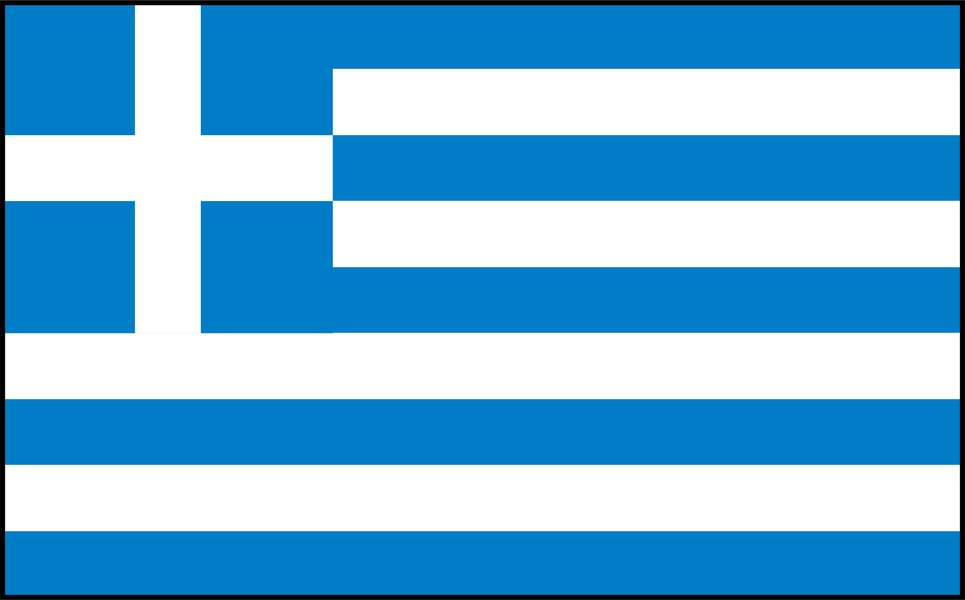
Nine horizontal stripes alternating blue and white, with a white cross on a blue square in the top left corner.
The cross stands for the Greek Orthodox Church. The nine stripes are usually said to represent the nine syllables of the Greek phrase meaning Freedom or Death, the rallying cry of the 1821 war of independence against Ottoman rule.